

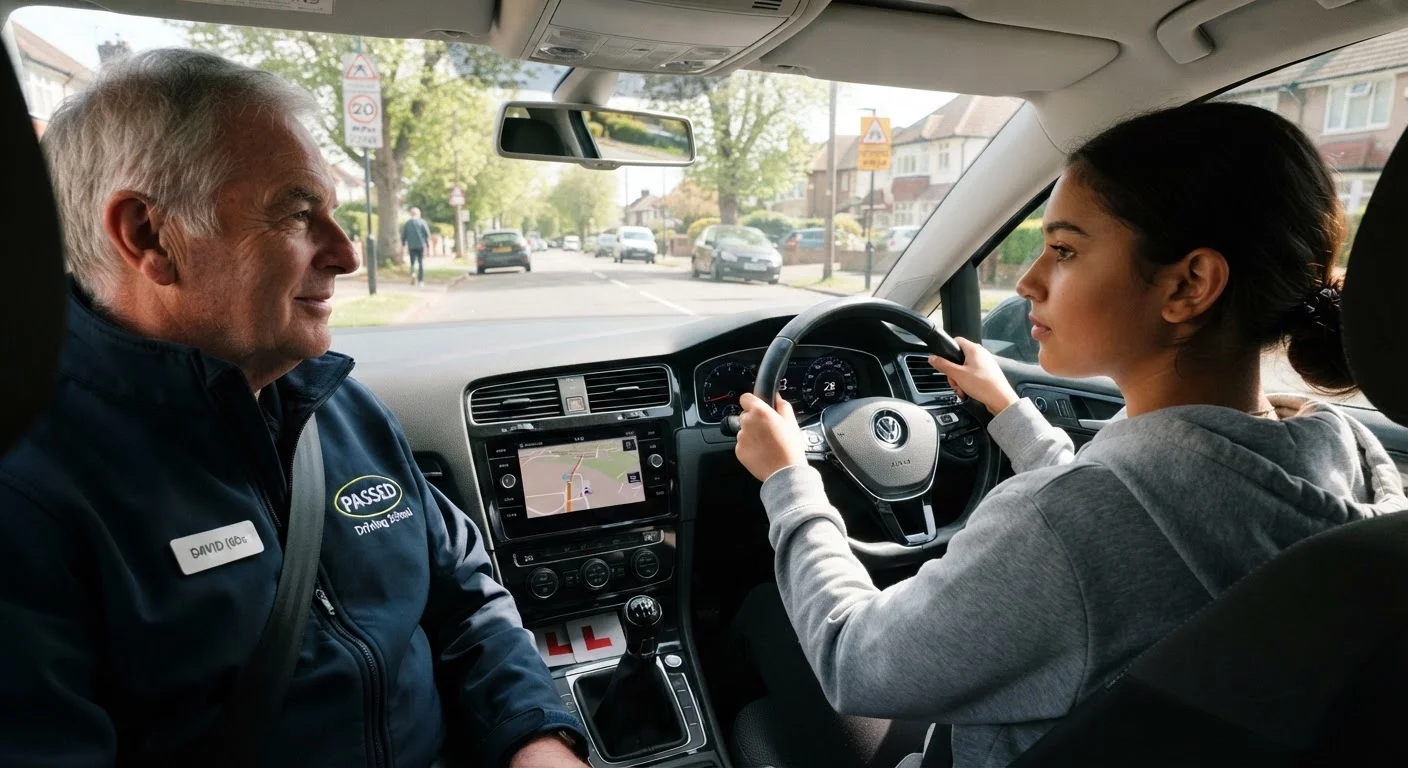
What Driver Education Actually Covers
Driver education in the United States typically combines classroom instruction with behind-the-wheel practice under a licensed instructor. Most state-approved programs follow guidelines developed by traffic safety agencies and cover a consistent set of core topics: traffic laws and signs, vehicle control, right-of-way rules, and crash avoidance strategies.
The classroom component introduces concepts like the Smith System-a five-habit framework for visual awareness-and the IPDE process (Identify, Predict, Decide, Execute), which teaches students to systematically scan for and respond to hazards before they escalate. See our traffic signs and road markings reference guide for a breakdown of the regulatory, warning, and guide signs new drivers are expected to know.
Behind-the-wheel instruction builds on those concepts by putting them into real-world practice-teaching lane positioning, intersection management, and how to handle highway merges and adverse conditions. The combination of theory and supervised practice is intentional: research consistently shows that knowledge alone does not translate into safe behavior without practical application.
Practice scanning intersections before entering, not as you enter. A quick left-center-right-left check at every intersection can catch conflicting movements that straight-ahead focus misses.
Intersection crashes are among the most common crash types for new drivers, and most involve a failure to detect a hazard that was visible-just not observed.
When supervising a new driver, narrate what you're observing-gaps in traffic, a pedestrian about to step off a curb-to model the verbal scanning habit instructors teach in the classroom.
Experienced drivers internalize hazard identification silently, but making it verbal during practice helps new drivers understand what to look for and builds that mental habit faster.
The Role of Perception and Hazard Recognition
One of the most significant gaps between new and experienced drivers isn't vehicle handling-it's hazard perception. Studies by traffic safety researchers have found that novice drivers tend to fixate on the road directly ahead rather than scanning broadly, missing pedestrians, cyclists, and developing conflicts in their peripheral view.
Driver education addresses this through scanning drills and structured observation techniques. Students are taught to check mirrors every five to eight seconds, look well ahead to identify stopped traffic or intersection conflicts early, and check blind spots before every lane change. These habits reduce reaction time by giving the driver more space and time to respond.
Defensive driving techniques build directly on hazard perception skills, framing safe driving as an active, anticipatory process rather than a reactive one.
Speed, Space, and Stopping Distance
New drivers are taught that speed has a nonlinear relationship with stopping distance and crash severity. Doubling speed more than doubles the energy that must be absorbed in a collision-a physics principle with direct safety consequences. Instructors use this to explain why posted speed limits reflect more than arbitrary regulation.
The three-second following rule is a foundational concept: drivers should maintain at least three seconds of space between their vehicle and the one ahead under normal conditions, and more in rain, fog, or heavy traffic. This space provides the reaction time needed to stop without rear-ending a slowing vehicle.
For a deeper look at the research behind posted limits, see our article on speed limits as a safety tool.
3 sec
Minimum recommended following distance
Traffic safety educators and the NHTSA recommend at least a three-second gap under normal driving conditions, more in poor weather.
~16%
Teen share of distraction-related fatal crashes
Drivers aged 15-19 are disproportionately involved in distraction-related crash fatalities relative to their share of licensed drivers, according to NHTSA data.
0.05% BAC
Impairment begins below the legal limit
Research cited by traffic safety agencies shows measurable degradation in reaction time and judgment before drivers reach the 0.08% legal threshold.
Impairment, Distraction, and Fatigue
Driver education devotes significant attention to three impairment categories that are distinct in mechanism but overlapping in consequence: alcohol and drug impairment, cognitive and manual distraction, and drowsy driving.
Alcohol instruction covers how blood alcohol concentration (BAC) affects reaction time, judgment, and coordination-and that impairment begins below the legal limit of 0.08% BAC. Drug impairment, including from prescription medications, is increasingly covered as state laws and public awareness have evolved.
Distraction is framed around three types: visual (eyes off road), manual (hands off wheel), and cognitive (mind off task). Texting while driving is highlighted because it involves all three simultaneously. According to the National Highway Traffic Safety Administration (NHTSA), distraction is a reported factor in a meaningful share of annual crash fatalities.
Fatigue education covers the warning signs of drowsiness-frequent blinking, lane drift, difficulty recalling the last few miles-and emphasizes that there is no safe substitute for stopping and resting. New drivers are also introduced to the elevated crash risk present during nighttime driving.
Occupant Protection and Vehicle Readiness
Seat belt use is addressed as a foundational safety measure, not an optional precaution. Driver education reinforces that seat belts are effective across all crash types, including low-speed collisions, and that airbags are designed to work with seat belts-not replace them. Common misconceptions about seat belt safety are addressed directly; our companion piece on seat belt myths covers several that persist among drivers of all experience levels.
Vehicle readiness-often called a pre-trip inspection-is also part of foundational training. Students learn to check tire pressure and tread depth, verify fluid levels, test lights and signals, and ensure mirrors are properly adjusted before driving. These habits are grounded in the principle that a vehicle in poor condition reduces the driver's ability to respond safely to unexpected events. See our car maintenance hub for guidance on routine upkeep that supports road safety.
Child passenger safety is a related topic new drivers with young family members should understand; car seat requirements change with a child's size and development, and the rules are often more specific than drivers realize. Our guide on car seat stages explains each transition point.
Why These Lessons Stick-or Don't
Research on novice driver behavior consistently shows that the transition from supervised to independent driving is one of the highest-risk periods. The first six to twelve months after licensure are associated with elevated crash rates, even among students who completed formal driver education.
This is partly why most states have adopted Graduated Driver Licensing (GDL) systems, which restrict nighttime driving and passenger limits for new drivers before granting full licensure. GDL programs give novice drivers additional supervised or semi-supervised practice before they face the full complexity of independent driving.
The habits most likely to persist are those practiced consistently during the learning period. Instructors and safety researchers emphasize that parents and supervising adults play a central role in reinforcing-or undermining-the skills taught in formal programs. Drivers who continue to observe scanning habits, maintain space cushions, and avoid distraction in the months after licensing tend to carry those practices forward.
Understanding road rage and emotional regulation behind the wheel is also part of becoming a complete driver-something that driver education increasingly acknowledges as a behavioral safety factor.
The content on this site is provided for informational purposes only and should not be considered a substitute for professional advice. While we strive to provide accurate and up-to-date information, we make no guarantees regarding its completeness or accuracy. Always consult a qualified professional for advice specific to your circumstances before making any decisions.