

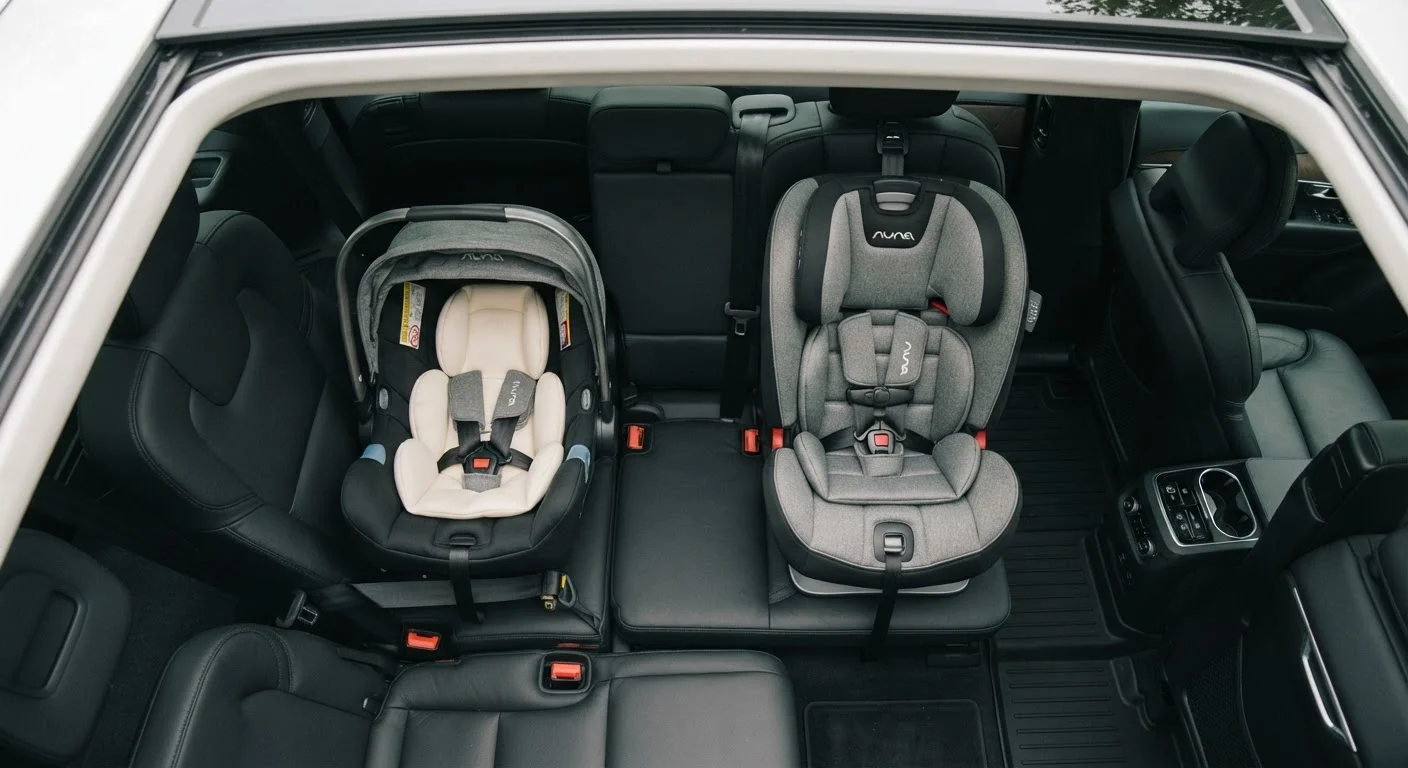
Why Each Stage Exists
Car seat stages aren't arbitrary milestones - they're engineering responses to how a child's body changes and how crash forces work. In a collision, a restraint system must spread the energy of impact over the strongest parts of the body and prevent the head, neck, and spine from moving violently. A system calibrated for a 6-month-old provides fundamentally different protection than one designed for a 6-year-old, because the biomechanics are different.
According to the National Highway Traffic Safety Administration (NHTSA), child restraint systems reduce the risk of fatal injury by 71 percent for infants and 54 percent for toddlers compared with seat belts alone. Those gains depend on using the right stage at the right time. Transitioning too early - moving to a booster before a child has outgrown a harnessed seat, for example - removes a layer of protection before the child's body is ready for it.
Understanding the stages also matters in the context of broader road safety principles. Just as seat belt misconceptions can lead adults to make riskier choices, misunderstandings about car seat transitions can have real consequences for children.
71%
Reduction in fatal injury risk for restrained infants
According to NHTSA data, properly used child restraints reduce fatal injury risk by 71% for infants compared with seat belts alone.
54%
Reduction in fatal injury risk for restrained toddlers
NHTSA reports that child restraints reduce the risk of fatal injury by 54% for toddlers versus seat belt use alone in the same crash scenarios.
~46%
Car seats misused in some critical way
Research cited by the CDC has found that a substantial proportion of car seats are not used or installed correctly, reducing their protective effectiveness.
Stage 1: Rear-Facing Seats
Rear-facing seats are the first and most protective stage. When a child faces the rear of the vehicle, crash energy is distributed across the back, shoulders, and buttocks - the largest, strongest surface area available. The seat also cradles and moves with the child, limiting the stress on the developing neck and spine.
There are two main types: infant-only seats, which are smaller and often include a carry handle, and convertible seats, which can be used rear-facing for longer and later converted to forward-facing. Convertible seats often allow rear-facing to higher weight limits - sometimes up to 50 pounds - making it possible for many children to remain in this stage well past their second birthday.
The key rule: keep a child rear-facing until they reach the maximum height or weight limit printed on their specific seat. A child does not need to transition simply because they turned two or because their legs touch the seat back - leg contact is not a safety concern in a rear-facing position.
Important: Never place a rear-facing seat in front of an active passenger airbag. The back seat is the appropriate location for all rear-facing restraints.
Stage 2: Forward-Facing Seats with a Harness
Once a child has genuinely outgrown the rear-facing limits of their seat, a forward-facing seat with an internal harness is the next step. The five-point harness - straps at both shoulders, both hips, and between the legs - restrains the child's body directly, distributing crash forces across the chest and hips and preventing forward movement of the torso and head.
Most forward-facing harnessed seats accommodate children from roughly 22 to 65 pounds, though higher-limit models exist. The goal is to keep a child in the harnessed seat for as long as they fit within the manufacturer's stated limits, rather than rushing to a booster seat.
Correct harness fit is critical. The harness straps should sit at or just above the child's shoulders, lie flat without twisting, and pass the "pinch test" - you should not be able to pinch excess webbing at the collarbone. The chest clip belongs at armpit level, not on the stomach.
“The best car seat is the one that fits your child, fits your vehicle, and is used correctly every single time.”
— American Academy of Pediatrics, Leading U.S. pediatric health authority and child passenger safety advocate
Stage 3: Booster Seats
Booster seats do not restrain a child directly. Instead, they raise the child so the vehicle's own seat belt - specifically the lap and shoulder belt - can fit correctly across the body. A seat belt designed for an adult will ride across the stomach and neck of a small child, which is dangerous in a crash; a booster corrects that geometry.
There are two types: high-back boosters, which provide head and neck support and are better suited for vehicles without headrests, and backless boosters, which work well in vehicles with adequate head support already built into the seat.
Children generally need a booster until the vehicle's seat belt fits correctly without one. Proper fit means the lap belt lies across the upper thighs (not the abdomen) and the shoulder belt crosses the center of the chest and shoulder (not the neck or face). This fit typically occurs when a child reaches approximately 4 feet 9 inches in height.
Stage 4: Seat Belt Alone
The final transition - to a standard vehicle seat belt with no additional restraint - should happen only when the belt fits correctly on its own. There is no specific age at which this occurs; height, posture, and how a child sits all matter. A child who slouches, tucks the shoulder belt behind their back, or lets the lap belt ride up over the stomach has not yet made a safe transition.
All children under 13 should ride in the back seat when possible. Front-seat airbags are calibrated for adult bodies and can cause injury to smaller passengers in certain crash scenarios.
Staying informed about seat belt safety principles broadly supports better decisions at every stage. The same evidence-based thinking that applies to adult restraints - addressed in detail when common seat belt myths are debunked - is equally relevant when evaluating whether a child is truly ready for a belt alone.
This article provides general educational information about child passenger safety. For guidance specific to your child's needs or a particular car seat, consult a certified Child Passenger Safety Technician (CPST) or your child's pediatrician.
Frequently Asked Questions
Children should remain rear-facing until they reach the maximum height or weight limit set by their specific car seat manufacturer - not a set birthday. Many convertible seats accommodate rear-facing children up to 40-50 pounds. The American Academy of Pediatrics advises keeping children rear-facing as long as the seat allows.
Age alone is not the right measure. A child is ready for a seat belt when the belt fits correctly: the lap belt lies flat across the upper thighs (not the stomach), and the shoulder belt crosses the chest and shoulder (not the neck). This typically happens around 4 feet 9 inches tall, often between ages 8 and 12.
The National Highway Traffic Safety Administration (NHTSA) recommends replacing a car seat after any moderate or severe crash, even if no damage is visible. Minor crashes - defined by NHTSA using five specific criteria - may not require replacement, but when in doubt, replace the seat.
Yes. Most car seats carry an expiration date stamped on the shell, typically six to ten years from manufacture. Materials degrade over time and safety standards evolve, so an expired seat should not be used regardless of its apparent condition.
Rear-facing seats should never be placed in a front seat with an active passenger-side airbag. In a crash, the airbag deploys with enough force to cause serious injury to a rear-facing child. The back seat remains the safest position for all children under 13.
A correctly installed seat should not move more than one inch in any direction when gripped at the belt path. Many local fire stations, hospitals, and certified Child Passenger Safety Technician (CPST) inspection stations offer free installation checks - NHTSA maintains a locator at nhtsa.gov.
The content on this site is provided for informational purposes only and should not be considered a substitute for professional advice. While we strive to provide accurate and up-to-date information, we make no guarantees regarding its completeness or accuracy. Always consult a qualified professional for advice specific to your circumstances before making any decisions.