

Start here
What Defensive Driving Actually Means
Core concepts
The Core Principles in Practice
Build awareness
Situational Awareness: Seeing the Whole Picture
Apply it
Space Management and Following Distance
High-risk zones
Managing Risk at Intersections and Merges
Master the mindset
Mindset: The Factor Most Drivers Overlook
What Defensive Driving Actually Means
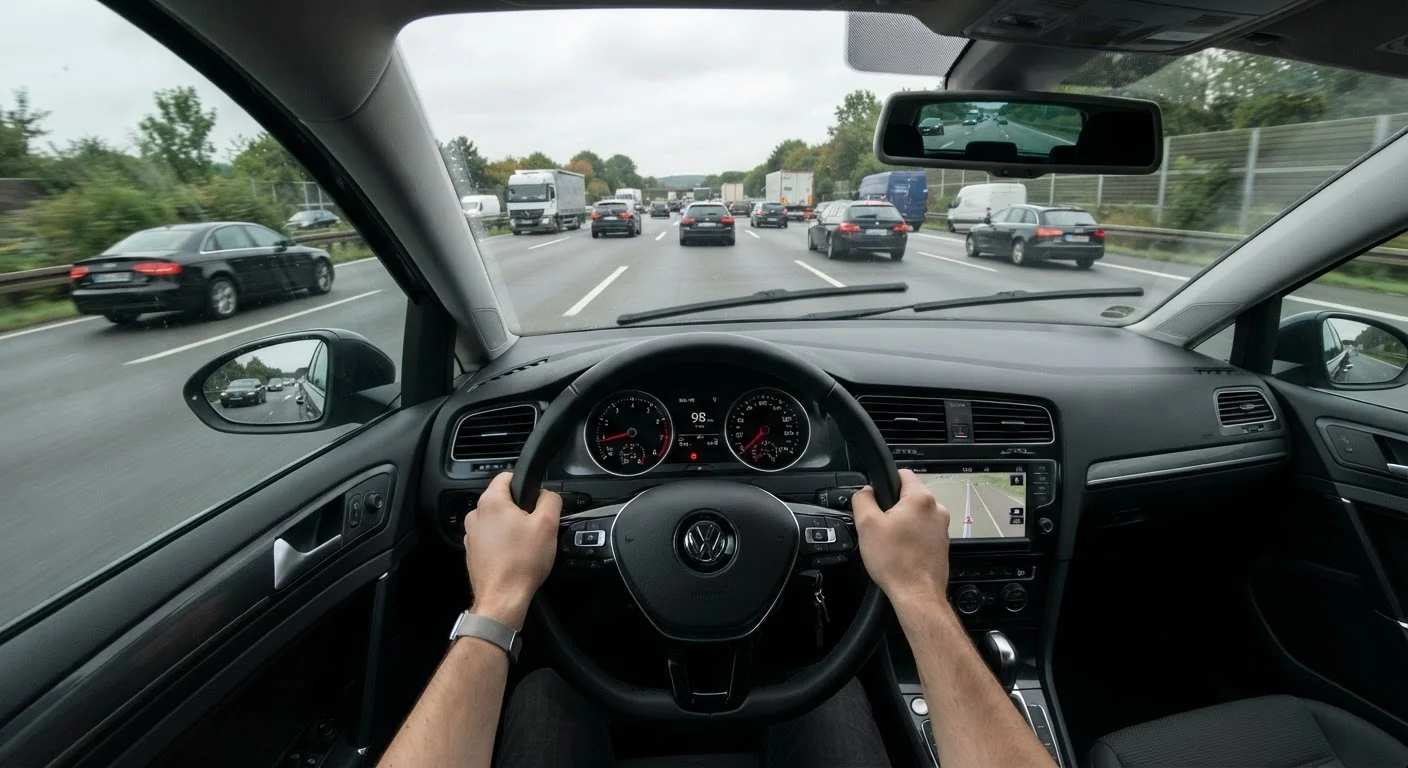
Most drivers have heard the term defensive driving, but it is often misunderstood as simply driving slowly or being overly cautious. In practice, it means something more specific: actively anticipating hazards and making decisions that reduce your exposure to risk - before a situation becomes an emergency.
The National Safety Council defines defensive driving as driving to save lives, time, and money, in spite of the conditions around you and the actions of others. That last phrase is key. Defensive driving acknowledges a fundamental truth: you cannot control what other road users do, but you can control how prepared you are to respond.
Defensive driving
A set of driving behaviors focused on anticipating hazards and reducing risk, rather than simply reacting to situations as they arise.
Situational awareness
The continuous process of perceiving, understanding, and predicting what is happening around your vehicle so you can make informed decisions.
Following distance
The gap maintained between your vehicle and the one ahead, expressed in time or distance, which determines how much room you have to brake safely.
Blind spot
An area around your vehicle that mirrors do not show and that requires a physical head check to monitor before lane changes.
Space cushion
The buffer of clear space maintained on all sides of your vehicle to allow room to maneuver or stop if a hazard appears.
Hazard perception
The ability to identify developing risks in the traffic environment early enough to respond safely before they become emergencies.
The Core Principles in Practice
Defensive driving rests on a handful of interconnected principles that work together rather than independently:
- Anticipation: Reading the road ahead and predicting where risks might develop - a merging truck, a cyclist in a door zone, a pedestrian about to cross.
- Space management: Maintaining adequate buffers on all sides of your vehicle so you have room to react.
- Reduced speed in uncertain conditions: Adjusting speed to match visibility, surface grip, and traffic density - not just the posted limit.
- Minimal distraction: Keeping attention on the driving task rather than dividing it between the road and a phone, conversation, or other competing input.
- Emotional regulation: Keeping your decision-making calm and deliberate, even when other drivers behave badly.
None of these principles requires exceptional driving skill. They require consistent, deliberate habit.
Situational Awareness: Seeing the Whole Picture
Situational awareness is the engine of defensive driving. It means knowing - at any given moment - what vehicles surround you, what pedestrians or cyclists are in your path, and what road conditions are developing ahead. Most drivers underestimate how quickly this picture becomes stale.
Practice the 5-8 Second Mirror Scan
Make a habit of glancing at each mirror every 5-8 seconds, not just when you plan to change lanes. This keeps your mental picture of surrounding traffic current, so you are never caught off-guard by a vehicle that 'appeared from nowhere.' Pair mirror checks with periodic head checks for blind spots whenever traffic patterns shift.
Beyond mirror checks, scanning the horizon 10-15 seconds ahead allows you to read traffic flow early. If brake lights are rippling back from an overpass, you have seconds to ease off the accelerator before you are within emergency-braking range. That kind of anticipation is what separates reactive driving from defensive driving. For a deeper look at what physics says about stopping, see our guide to stopping distance.
Space Management and Following Distance
Of all the habits associated with defensive driving, following distance has among the clearest relationship to crash risk. Rear-end collisions are consistently among the most common crash types in the U.S., and insufficient following distance is a primary contributing factor.
The three-second rule - ensuring at least three seconds of travel time separate your vehicle from the one ahead - is a widely taught baseline. At highway speeds, or in wet, icy, or low-visibility conditions, that margin should increase. Tailgating carries more risk than most drivers recognize, partly because braking distance grows nonlinearly with speed.
Space management also applies laterally. When driving alongside large trucks, giving extra side clearance reduces your exposure to tire blowout debris and sudden lane shifts. When parked cars line the road, positioning slightly toward the center of your lane reduces exposure to doors opening unexpectedly.
Managing Risk at Intersections and Merges
Intersections are among the highest-risk environments on any road. A significant share of serious injury crashes occur at or near intersections, where multiple vehicles, pedestrians, and cyclists converge with crossing and conflicting paths. Understanding intersection hazards in detail is worthwhile for any driver who wants to apply defensive principles in practice.
Defensive habits at intersections include:
- Covering the brake when approaching - foot hovering near the pedal, not resting on it.
- Looking left-right-left before proceeding, even on a green light.
- Waiting a beat before moving on a signal change to clear any vehicles running the late yellow or red.
- Treating a flashing yellow as a prompt to slow and confirm it is clear, not merely an advisory.
Complacency Is a Real Crash Risk
Studies on driver behavior consistently find that experienced drivers are more prone to habitual inattention - the sense that a familiar route 'drives itself.' Familiarity does not reduce road hazards; it only reduces the driver's alertness to them. Treat every trip as requiring the same active attention, regardless of how routine it feels.
Mindset: The Factor Most Drivers Overlook
Technical habits matter, but mindset is what makes or breaks defensive driving in real conditions. A calm, unhurried driver scans more effectively, maintains safer distances instinctively, and makes better decisions when something unexpected happens. An angry or stressed driver does the opposite.
Road rage and aggressive driving represent the direct opposite of the defensive mindset - they narrow attention, increase speed, and reduce the margin for error that defensive driving is designed to preserve. Recognizing when your emotional state is affecting your judgment is itself a safety skill.
Defensive driving is not a fixed technique mastered once. It is an ongoing practice - revisited, reinforced, and applied every time you get behind the wheel. Drivers looking to build from the ground up may also find value in reviewing foundational road safety concepts taught in driver education.
Defensive Driving Courses Are Available Nationwide
Many states recognize approved defensive driving courses for insurance or license point purposes. These programs vary by provider and state, so check with your state's motor vehicle authority for details on approved options. Completing a course can reinforce habits that are easy to let slip over time.
Frequently Asked Questions
Defensive driving is about anticipating and managing risk to protect yourself and others. Aggressive driving involves behaviors - tailgating, speeding, cutting off others - that increase risk for everyone on the road. The two are fundamentally opposite in intent and outcome.
Research and road safety organizations widely recognize that defensive driving habits - such as maintaining space, scanning ahead, and avoiding distractions - meaningfully reduce crash exposure. No technique eliminates risk entirely, but consistent application lowers it significantly.
A commonly recommended guideline is the three-second rule: pick a fixed point and ensure at least three seconds pass between when the vehicle ahead passes it and when you do. In poor weather or at highway speeds, extending that to four or more seconds is prudent.
No. Experienced drivers can develop habitual blind spots and overconfidence. Defensive driving is a set of active, ongoing practices relevant throughout a driver's life - not a beginner-only concept.
Hazards include anything that could require you to change speed or direction unexpectedly - a pedestrian stepping off a curb, a driver running a red light, wet pavement, a merging truck, or an obscured sightline at an intersection. Defensive driving means scanning for these proactively.
Yes. Emotional arousal from anger or frustration narrows attention and impairs judgment, eroding the calm, deliberate thinking that defensive driving depends on. Recognizing and managing your emotional state is a legitimate part of safe driving practice.
The content on this site is provided for informational purposes only and should not be considered a substitute for professional advice. While we strive to provide accurate and up-to-date information, we make no guarantees regarding its completeness or accuracy. Always consult a qualified professional for advice specific to your circumstances before making any decisions.