

Two Phases You Need to Understand
Most drivers think of stopping as a single act - hitting the brakes. In reality, stopping a vehicle involves two distinct and measurable phases that together determine your total stopping distance.
The first is reaction distance: the ground your car covers between the moment you perceive a hazard and the moment your foot actually depresses the brake pedal. Research consistently places the average driver's reaction time at roughly 1.5 seconds under normal conditions. At 60 mph, that's approximately 132 feet traveled before braking even begins.
The second is braking distance: how far the vehicle continues moving while the brakes slow it to a stop. This phase is governed by physics, specifically the kinetic energy your vehicle carries. Because kinetic energy scales with the square of speed, even modest increases in velocity require disproportionately longer distances to shed that energy. A car traveling at 40 mph needs roughly four times the braking distance of one traveling at 20 mph.
Understanding both phases is foundational to defensive driving - because you can only manage a risk you understand.
How Speed, Surface, and Vehicle Condition Interact
Three variables have the most significant effect on your total stopping distance in real-world driving.
Speed
The relationship between speed and braking distance is not linear - it is exponential. Going from 30 mph to 60 mph doesn't double your stopping distance; it quadruples it. This is why speed limits near schools, pedestrian crossings, and intersections exist at the levels they do: small reductions in speed produce outsized safety benefits.
Road Surface
Tire friction - the grip between rubber and road - is what converts braking force into deceleration. Dry asphalt provides the highest friction coefficients; wet pavement reduces grip substantially; ice can reduce it by as much as 80% compared to dry conditions. Loose gravel and packed snow fall somewhere in between. The practical implication is clear: conditions that look only mildly slippery can dramatically extend the distance your car needs to stop.
Vehicle Condition
Worn tire tread reduces the contact patch that generates friction, extending braking distance even on dry roads. Similarly, degraded brake pads, contaminated brake fluid, or a poorly maintained braking system all reduce stopping efficiency. Regular vehicle maintenance is not optional when it comes to stopping performance.
132 ft
Reaction distance at 60 mph
Based on an average human reaction time of 1.5 seconds, a car at 60 mph travels roughly 132 feet before braking begins.
4×
Braking distance increase when speed doubles
Kinetic energy - and therefore braking distance - increases with the square of speed; doubling speed quadruples the distance needed to stop.
50%+
Braking distance increase on wet roads
Wet pavement can extend braking distance by more than 50% compared to dry conditions due to reduced tire-road friction.
Following Distance: Translating Physics Into Practice
The physics of stopping distance have a direct, practical application: how much space you should leave between your car and the vehicle ahead. Tailgating eliminates the buffer that reaction time and braking distance require. If the car in front stops suddenly and you are 1 second behind it at highway speeds, you will not stop in time - the math simply does not allow it.
The widely taught 3-second rule offers a practical minimum. Pick a stationary roadside object - a sign, overpass, or mile marker - and count from when the car ahead passes it. If you reach the same point in under 3 seconds, you are following too closely. In rain, fog, heavy traffic, or at speeds above 60 mph, extend that gap to 4-6 seconds to account for reduced friction and longer braking distances.
For a deeper look at why close following is far more dangerous than most drivers intuitively feel, see our article on why tailgating is more dangerous than most drivers realize.
Adjust Your Gap for Conditions
The 3-second rule is a baseline for dry roads at moderate speeds. In rain, increase to 4 seconds; on snow or ice, consider 6 seconds or more. At highway speeds above 65 mph, add an additional second as a buffer even in dry conditions. When hauling a heavy load or towing a trailer, braking distance increases further - adjust accordingly.
New drivers learning these concepts for the first time can find a broader breakdown of foundational safety topics in road safety from start to license.
What Drivers Often Overlook
Even experienced drivers tend to underestimate how much their personal state affects reaction distance. Fatigue is one of the most significant and underappreciated factors: studies have compared driving while severely sleep-deprived to driving while legally impaired. When reaction time extends from 1.5 to even 2.5 seconds, the additional distance traveled before braking starts can be the difference between a near-miss and a collision.
Distraction - glancing at a phone, adjusting a radio, or turning to speak to a passenger - produces the same effect. A vehicle traveling at highway speed covers the length of a football field in roughly 3.5 seconds. Even a momentary lapse eliminates the reaction-distance buffer entirely.
The takeaway is straightforward: stopping distance is not a fixed property of your car. It is a dynamic result of physics, road conditions, and driver state - all of which vary every time you get behind the wheel.
A driver on a dry highway at 65 mph sees brake lights ahead and reacts in 1.5 seconds - covering about 143 feet - before the brakes engage, then requires additional hundreds of feet to stop.
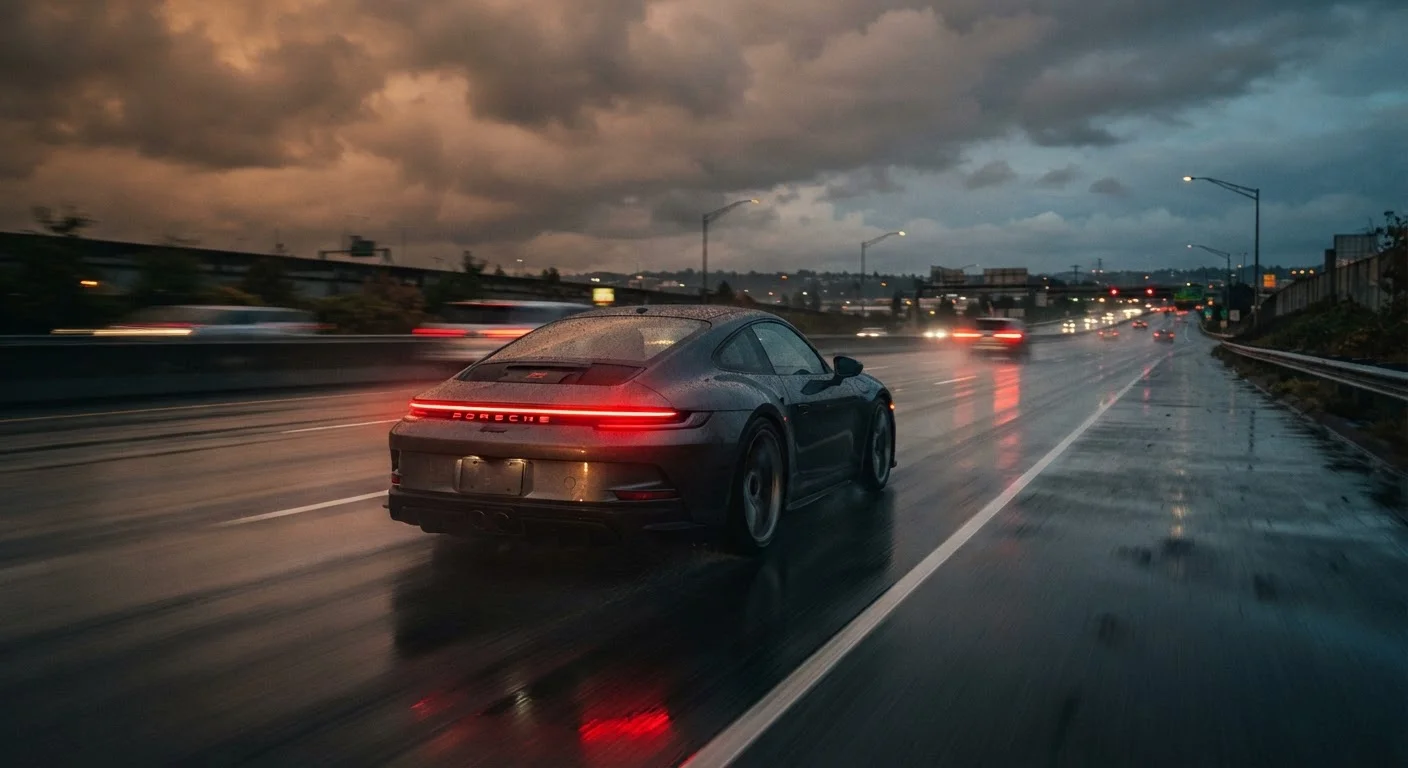
A commuter driving on a rainy evening finds that their usual 2-second following gap, which felt adequate in dry weather, is no longer sufficient to stop before rear-ending a car that brakes suddenly.
A driver with worn tires attempts an emergency stop on dry pavement and stops noticeably longer than a vehicle with full-tread tires performing the same maneuver.
Frequently Asked Questions
At 60 mph on dry pavement, total stopping distance is generally estimated at around 240-300 feet when accounting for both reaction time and braking. This figure varies depending on driver alertness, vehicle condition, and road surface. Always treat published estimates as minimums, not targets.
Wet roads significantly reduce tire friction, which can extend braking distance by 50% or more compared to dry conditions. Standing water can also cause hydroplaning, temporarily eliminating traction entirely. Drivers should increase following distance substantially in rain.
Anti-lock braking systems (ABS) prevent wheel lockup, helping drivers maintain steering control during hard braking. On dry pavement, ABS may not dramatically shorten stopping distance, but on slippery surfaces it can improve both stopping performance and directional control.
The 3-second rule recommends keeping at least 3 seconds of gap between your vehicle and the one ahead. Choose a fixed roadside marker and count from when the car ahead passes it until you reach it. In adverse conditions or at high speeds, increase this to 4-6 seconds.
At 60 mph, a driver covering 1.5 seconds of reaction time travels approximately 132 feet before the brakes even activate. Fatigue, distraction, or impairment can extend reaction time well beyond this average, adding substantially more distance before any deceleration begins.
The content on this site is provided for informational purposes only and should not be considered a substitute for professional advice. While we strive to provide accurate and up-to-date information, we make no guarantees regarding its completeness or accuracy. Always consult a qualified professional for advice specific to your circumstances before making any decisions.