

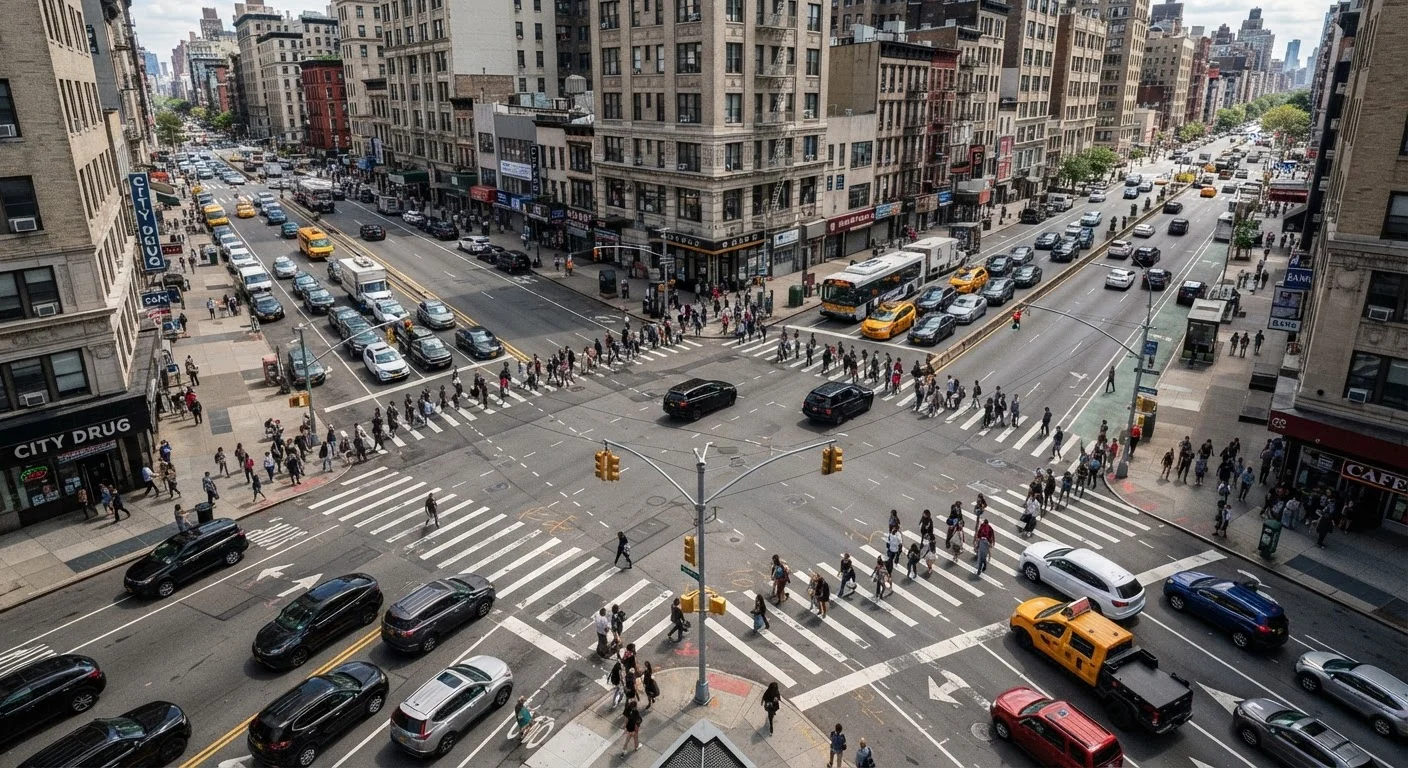
Why Intersections Are Among the Most Dangerous Places on the Road
Federal crash data from the National Highway Traffic Safety Administration (NHTSA) consistently identifies intersections as locations where a disproportionate share of serious injuries and fatalities occur. The reason is structural: intersections are points where multiple streams of traffic, pedestrians, and cyclists converge, creating a dense web of potential conflicts compressed into a small physical space.
Even a controlled intersection - one with signals and marked crosswalks - involves drivers making split-second decisions under time pressure, often with incomplete information about what other road users intend to do. Uncontrolled intersections and those in lower-visibility conditions compound the risk further. Understanding why these zones are inherently complex is the first step toward navigating them more safely.
~40%
Of all U.S. traffic crashes occur at intersections
According to NHTSA estimates, roughly 40 percent of all reported crashes in the United States involve intersections.
96%
Of intersection crashes attributed to driver error
An NHTSA study found driver error - including inattention, misjudgment, and illegal maneuvers - was a factor in the vast majority of intersection crashes examined.
The Driver Behaviors Behind Most Intersection Crashes
Research from the NHTSA has found that driver error - rather than vehicle failure or road conditions - accounts for the vast majority of intersection crashes. The most frequently cited behaviors include failing to yield the right-of-way, running red lights or stop signs, misjudging the speed or distance of approaching vehicles, and driving while distracted.
Distraction deserves particular attention. Glancing at a phone for even two seconds at 30 mph means traveling roughly 88 feet without eyes on the road - enough to miss a pedestrian stepping off a curb or a driver running a stale yellow light. For a deeper look at how distraction and risk perception interact on the road, see our guide to following-distance risks.
Left turns across oncoming traffic are a particularly high-risk maneuver. Studies have shown that left-turn crashes account for a large portion of intersection fatalities, largely because drivers must simultaneously judge oncoming speed, gaps in traffic, and signal timing.
Proven Habits That Make a Measurable Difference
Safety professionals and driver educators consistently point to a core set of behaviors that reduce intersection crash risk. These are not instinctive - they require deliberate practice until they become automatic.
Scan cross-traffic in both directions before entering any intersection, even on a green light.
A green signal gives you the legal right of way, but it does not guarantee cross-traffic has stopped. Scanning before you commit to the intersection gives you a fraction of a second to react if a driver runs a red light - and that fraction of a second can be the difference between a near-miss and a serious crash.
Cover the brake when approaching a yellow light or any intersection with limited sightlines.
Covering the brake - moving your foot from the accelerator to hover over the brake pedal - reduces your reaction time if a hazard appears suddenly. It is particularly valuable when buildings, parked vehicles, or vegetation block your view of cross-traffic until you are already in the intersection.
Eliminate in-vehicle distractions before reaching an intersection.
Cognitive distraction - not just physical distraction - degrades hazard perception. Even a hands-free call can reduce your ability to notice unexpected movement in your peripheral vision. Intersections demand your full attentional capacity.
Position your vehicle to maximize visibility when making a left turn.
Left turns are statistically among the most hazardous intersection maneuvers. Creeping forward gradually into the intersection while waiting for a gap - rather than sitting far back behind the stop line - improves your sightline to oncoming traffic and reduces the risk of misjudging closing speeds.
Allow extra time when yielding to pedestrians and cyclists at crosswalks.
Pedestrians and cyclists are among the most vulnerable road users at intersections. Drivers frequently underestimate how quickly a pedestrian can step into a crosswalk or how far a cyclist travels between glances. Yielding fully - not just slowing - ensures they clear your path safely.
Adapting your approach when conditions change is equally important. Wet pavement, reduced visibility, and glare from low sun all affect stopping distance and your ability to read cross-traffic. Our article on driving in rain, ice, and fog covers how to adjust for each condition.
Quick Actions You Can Take Starting Today
Most effective intersection habits don't require special equipment or training - just conscious attention applied consistently. Start with the highest-impact behaviors and build from there.
“Most intersection crashes are not caused by recklessness - they are caused by routine inattention and the false confidence that comes from driving familiar routes.”
— NHTSA Traffic Safety Research Division, U.S. National Highway Traffic Safety Administration
New drivers benefit especially from reinforcing these habits early. Our broader overview, Road Safety From Start to License, explains the foundational principles taught in driver education and why they remain relevant for experienced drivers too.
The content on this site is provided for informational purposes only and should not be considered a substitute for professional advice. While we strive to provide accurate and up-to-date information, we make no guarantees regarding its completeness or accuracy. Always consult a qualified professional for advice specific to your circumstances before making any decisions.