

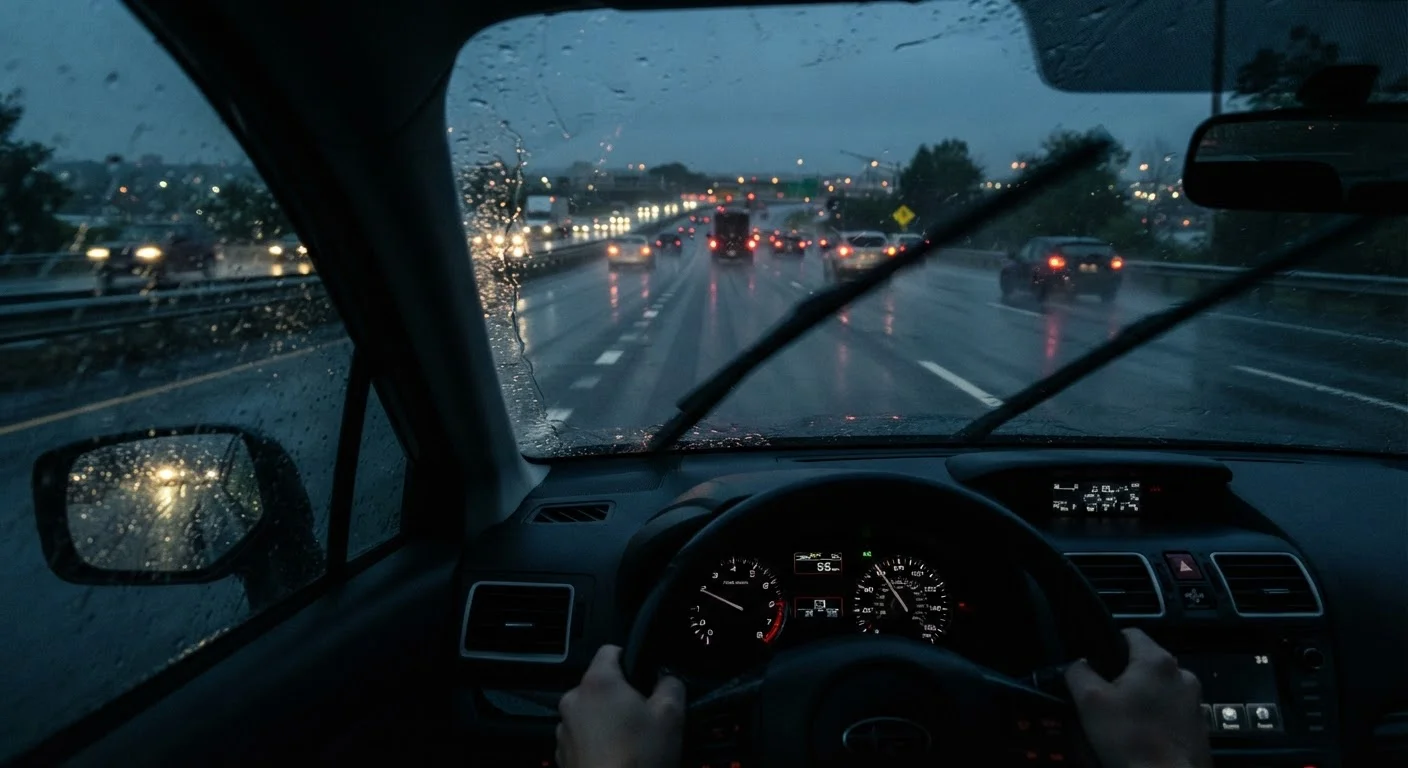
Why Weather Changes Everything About Driving
Clear, dry pavement gives tires their maximum grip. The moment precipitation or reduced visibility enters the picture, the safety margins that drivers rely on - stopping distance, steering response, and sight lines - shrink significantly. According to the Federal Highway Administration, weather-related crashes account for roughly 21% of all vehicle accidents annually in the United States, a figure that underscores how much environmental conditions shape risk.
Understanding how each condition changes the road environment helps drivers make smarter decisions before and during those conditions, rather than reacting after the fact. For a broader grounding in safe driving fundamentals, see our foundational road safety guide covering what new drivers are taught and why it matters at every stage.
What you will need
What You Need Before You Head Out
Before adjusting technique, your vehicle must be in condition to respond reliably. Worn tires, cracked wipers, or dim headlights are liabilities that no amount of careful driving fully compensates for. Reviewing your car maintenance essentials regularly is one of the most direct ways to improve bad-weather safety.
Tire tread depth gauge
Measures remaining tread to confirm tires can channel water effectively and maintain grip on wet or icy roads.
Winter or all-season tires
Designed with tread patterns and rubber compounds that perform better in cold, snowy, or icy conditions than standard summer tires.
Ice scraper and snow brush
Clears ice and snow from all windows, mirrors, and lights before driving - a legal requirement in many states.
Portable traction aids (sand, kitty litter, or traction mats)
Helps free a vehicle stuck on ice or compacted snow by providing temporary grip under the drive wheels.
Step-by-Step: Adapting Your Driving to Each Condition
The steps below address rain, ice, and fog in sequence. Some principles - like slowing down and increasing space - apply across all three, but each condition also has specific techniques that matter. Work through this guidance before conditions deteriorate, not during them.
Reduce speed below the posted limit in rain
Speed limits are set for ideal conditions. In rain, reduce your speed by at least 5-10 mph on surface streets and more significantly on highways, particularly if water is pooling. Hydroplaning - where tires ride on a film of water and lose contact with the pavement - can occur at speeds as low as 35 mph on worn tires. Ease off the accelerator smoothly; sudden braking on wet roads can cause skidding.
Triple your following distance in wet conditions
The standard 3-second following distance recommended for dry roads is insufficient in rain. Wet pavement can increase stopping distances by 50% or more. Aim for at least a 6-second gap from the vehicle ahead, and extend it further if visibility is also reduced. Choose your reference point - a fixed roadside marker - and count seconds from when the vehicle ahead passes it to when you do.
Identify and respond to black ice
Black ice is a thin, transparent glaze of ice that blends with the pavement surface, making it nearly impossible to see. It forms most readily on bridges, overpasses, shaded road sections, and intersections where water accumulates and refreezes. Suspect black ice whenever the air temperature is at or below 32°F and the road surface looks unusually shiny or wet despite no active precipitation.
If you hit black ice: keep the wheel pointed straight ahead, ease off the accelerator, and avoid braking abruptly. On a vehicle with ABS (anti-lock braking system), apply steady, firm brake pressure. Without ABS, pump the brakes gently to avoid locking up the wheels.
Use correct lights in fog
In fog, switch on your low-beam headlights - not high beams. High beams scatter off water droplets and reflect glare back at you, reducing forward visibility. If your vehicle has dedicated front fog lights, use them. Rear fog lights, where equipped, help following drivers see you. Keep headlights on even in light daytime fog so other drivers can detect your position.
Drive to visible distance in fog
A key fog rule: you should be able to stop within the distance you can see ahead. If visibility is 200 feet, your speed must allow a complete stop within 200 feet. On interstate highways in dense fog, this may mean speeds well below 30 mph. If conditions become too dangerous to proceed safely, pull completely off the road onto a shoulder, turn off your driving lights (to avoid attracting other drivers toward you), and keep hazard lights on until conditions improve.
Communicate your presence clearly to other drivers
In any adverse condition, other drivers have less time and visibility to react to you. Signal earlier than you normally would, brake progressively rather than suddenly, and avoid abrupt lane changes. Check your mirrors more frequently, since vehicles behind you may also be struggling to stop. Good signaling habits - covered in depth in our merging and lane changes guide - become more critical, not less, in poor weather.
When to Pull Over and Stop
Some weather conditions deteriorate beyond what any driver adjustment can safely manage. If visibility drops to near zero, roads are sheets of ice, or you feel you have lost control of your speed or direction, the safest decision is to pull off the road entirely at a safe, well-lit location - a rest stop, parking lot, or wide paved shoulder. Attempting to push through severe conditions risks your life and those of other road users.
Staying Safer at Intersections and on Highways
Adverse weather raises the stakes at locations that are already high-risk. Intersections deserve particular attention - wet or icy pavement extends stopping distances well beyond what posted speed limits assume. Our guide on intersection hazards and how to reduce them covers the driver behaviors that make the biggest difference in these zones.
On highways, lane changes and merges that feel routine in dry conditions require extra lead time and caution in rain or fog. Reduced visibility means other drivers may not see your signals as quickly, and wet roads mean less margin for error during lateral movement. The principles in our merging and lane changes guide apply with added urgency when conditions are poor.
Check Conditions Before You Leave
State transportation departments and the National Weather Service publish real-time road condition reports and weather advisories. Checking these before a trip - especially in winter or during storm systems - lets you choose alternate routes, delay departure, or prepare appropriately. A few minutes of pre-trip planning often prevents hours of dangerous exposure.
The content on this site is provided for informational purposes only and should not be considered a substitute for professional advice. While we strive to provide accurate and up-to-date information, we make no guarantees regarding its completeness or accuracy. Always consult a qualified professional for advice specific to your circumstances before making any decisions.