

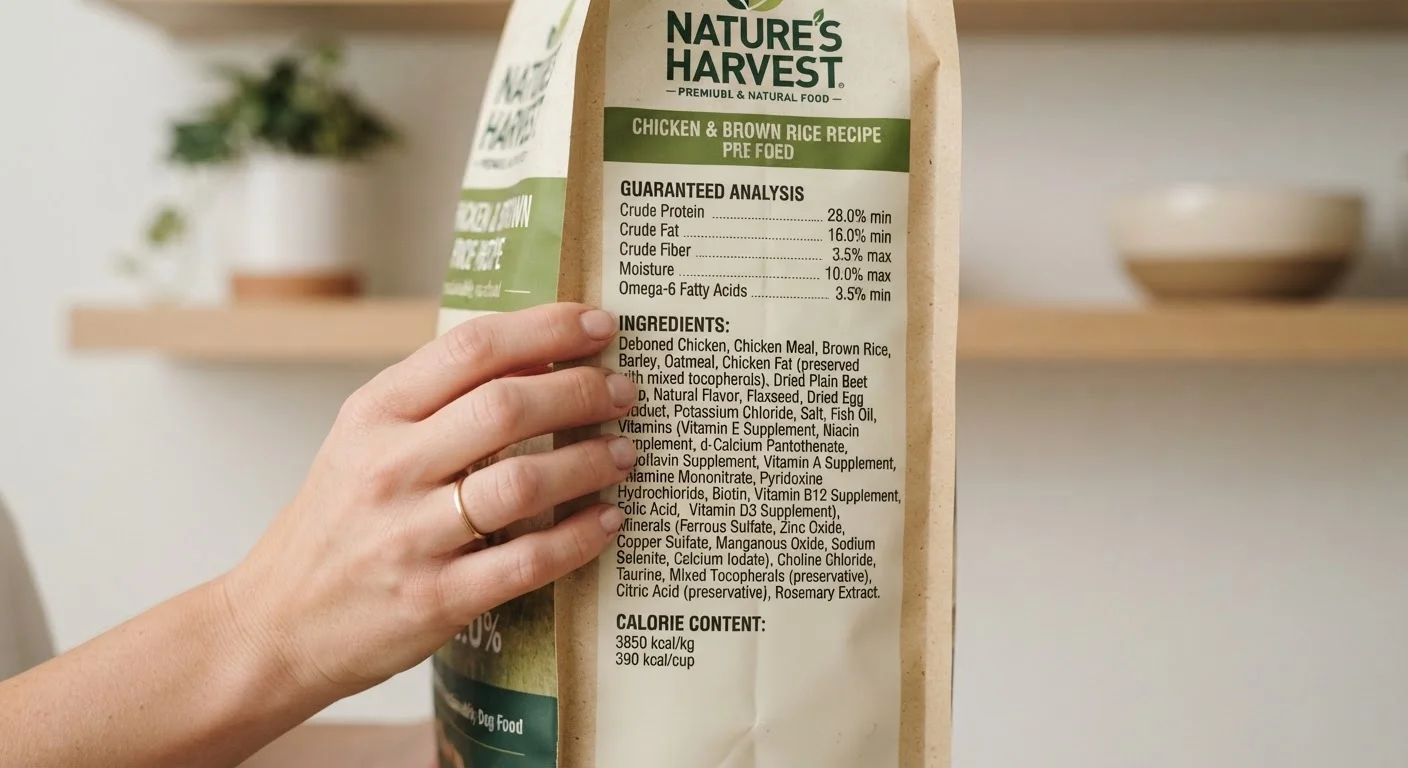
The Five Sections Every Label Must Include
U.S. pet food regulations require every label to contain five core elements: the product name, net weight, manufacturer information, an ingredient list, and a guaranteed analysis panel. A nutritional adequacy statement - sometimes called an AAFCO statement - is also required for any food marketed as a complete diet. Understanding what each section means is the foundation of confident label reading.
The product name is more regulated than most owners realize. AAFCO naming rules, adopted by most states, specify how prominently a single ingredient can be featured. If the name says "Salmon Cat Food," salmon must make up at least 70% of the total product. If it says "with Salmon," only 3% is required. These naming thresholds are a quick way to gauge ingredient emphasis before you even read the list.
For a deeper look at how these regulations shape what ends up on packaging, see what pet food labels are actually telling you.
Decoding the Ingredient List
Ingredients are listed in descending order by weight before processing. This matters because many whole meats - chicken, beef, salmon - contain significant water content. Once cooked and dried during manufacturing, their actual mass shrinks considerably. A dry ingredient like "chicken meal" listed fourth may contribute more protein by weight than whole chicken listed first.
This doesn't mean whole meats are bad ingredients - it means the ingredient list alone can't tell you precisely how much of each nutrient a food delivers. That's what the guaranteed analysis panel is for.
Watch for Ingredient Splitting
When a single ingredient source appears under multiple names - such as 'corn,' 'corn gluten meal,' and 'corn bran' - each entry is listed separately, pushing each one lower on the list than if they were combined. Scan the full ingredient list for repeated ingredient families to get a truer sense of their combined presence in the food.
Ingredient splitting is another tactic worth knowing. If a manufacturer lists "ground corn," "corn gluten meal," and "corn bran" separately, each appears lower on the list than if they were combined. The total corn content in the food could be substantial even though no single corn ingredient appears near the top. This is legal and common, so scanning for ingredient families - not just individual items - is useful.
What the Guaranteed Analysis Actually Tells You
The guaranteed analysis panel lists crude protein (minimum), crude fat (minimum), crude fiber (maximum), and moisture (maximum). These are regulatory thresholds - the floor or ceiling a manufacturer must stay within - not precise measurements of what's in the bag.
One important caveat: comparing wet and dry foods using raw guaranteed analysis figures is misleading because moisture content differs dramatically. A wet food at 10% protein and 78% moisture contains far more protein on a dry-matter basis than those numbers suggest. To compare foods fairly, you need to convert both to a dry-matter basis - a step veterinary nutritionists recommend when evaluating diets for pets with specific health needs.
Comparing Wet and Dry Foods Fairly
Raw guaranteed analysis numbers are not directly comparable between wet and dry foods because moisture content differs so much. To make a fair comparison, convert both to a dry-matter basis by dividing the nutrient percentage by the percentage of dry matter (100 minus moisture percentage). A veterinary nutritionist can help interpret these figures for pets with specific dietary requirements.
Understanding how protein and fat function in your pet's diet pairs well with general nutrition literacy. Our guide to macronutrients in plain English covers the fundamentals that apply across species.
The AAFCO Nutritional Adequacy Statement
This single sentence may be the most important line on the label. It tells you whether the food is intended as a complete and balanced diet or only as a treat, snack, or supplemental feeding. Look for language like: " is formulated to meet the nutritional levels established by the AAFCO Dog Food Nutrient Profiles for all life stages."
There are two ways a manufacturer can substantiate that claim. The first is formulation - the recipe meets AAFCO nutrient profiles on paper. The second is feeding trials - the food was actually fed to animals under controlled conditions, with health outcomes monitored. Feeding trial substantiation is generally considered a more rigorous standard, though formulation-based foods can still be nutritionally appropriate.
If a label says the food is for "intermittent or supplemental feeding only," it should not be used as a primary diet. This phrasing is common on raw toppers, broths, and many grain-free mixes marketed as complete meals. For more context on evaluating alternative feeding approaches, see our article on raw food diets for pets.
Marketing Language vs. Regulated Claims
Terms like premium, holistic, gourmet, and human-grade carry no standardized regulatory definition in the U.S. pet food market. Manufacturers can use them freely without meeting any specific nutritional threshold. AAFCO has defined "natural" in a limited sense - generally excluding chemically synthesized ingredients - but enforcement is not uniform.
The practical takeaway: these terms describe marketing positioning, not verified nutritional quality. A food labeled holistic is not held to a higher standard than one without that word. Focus your evaluation on the ingredient list, guaranteed analysis, and AAFCO adequacy statement - the sections where regulations actually apply.
Pair what you learn from labels with your vet's input on your pet's body condition. Our guide to body condition scoring explains how to assess whether your pet is at a healthy weight - a useful complement to monitoring what they eat.
This article is for general informational purposes only and is not a substitute for personalized veterinary advice. Always consult a licensed veterinarian for guidance specific to your pet's health and dietary needs.
Frequently Asked Questions
It means the food has been formulated or tested to meet the minimum nutritional requirements established by AAFCO for a specific life stage. A food labeled 'complete and balanced' for adult maintenance, for example, is intended to serve as a pet's sole diet without needing supplements. If no AAFCO statement appears, the product is likely a treat or supplement, not a primary diet.
Ingredients are listed by weight before moisture is removed. A named meat like 'chicken' contains a lot of water, so after processing its actual contribution may be smaller than a dry ingredient listed lower on the list. Looking at the overall ingredient profile - not just the first item - gives a more accurate picture.
The guaranteed analysis is a panel that lists minimum percentages of crude protein and crude fat, and maximum percentages of crude fiber and moisture. These figures reflect regulatory thresholds rather than precise amounts, so two foods with similar numbers can differ meaningfully in actual nutrient quality and digestibility.
AAFCO has defined 'natural' in a limited way - generally meaning the ingredient has not been chemically synthesized - but enforcement is inconsistent. 'Holistic' has no official regulatory definition on pet food labels and is purely a marketing term. Neither label guarantees superior nutrition.
Feeding guidelines are general estimates based on average body weight and activity level. Individual pets vary in metabolism, health status, and life stage. Use the label as a starting point, then adjust based on your pet's body condition and consult your veterinarian for tailored guidance.
Whole chicken is listed before moisture is removed, so it weighs more on the list but contributes less protein after processing. Chicken meal is already rendered and dehydrated, meaning it is a more concentrated protein source per pound. Both can be legitimate protein ingredients; neither is automatically superior.
The content on this site is provided for informational purposes only and should not be considered a substitute for professional advice. While we strive to provide accurate and up-to-date information, we make no guarantees regarding its completeness or accuracy. Always consult a qualified professional for advice specific to your circumstances before making any decisions.