

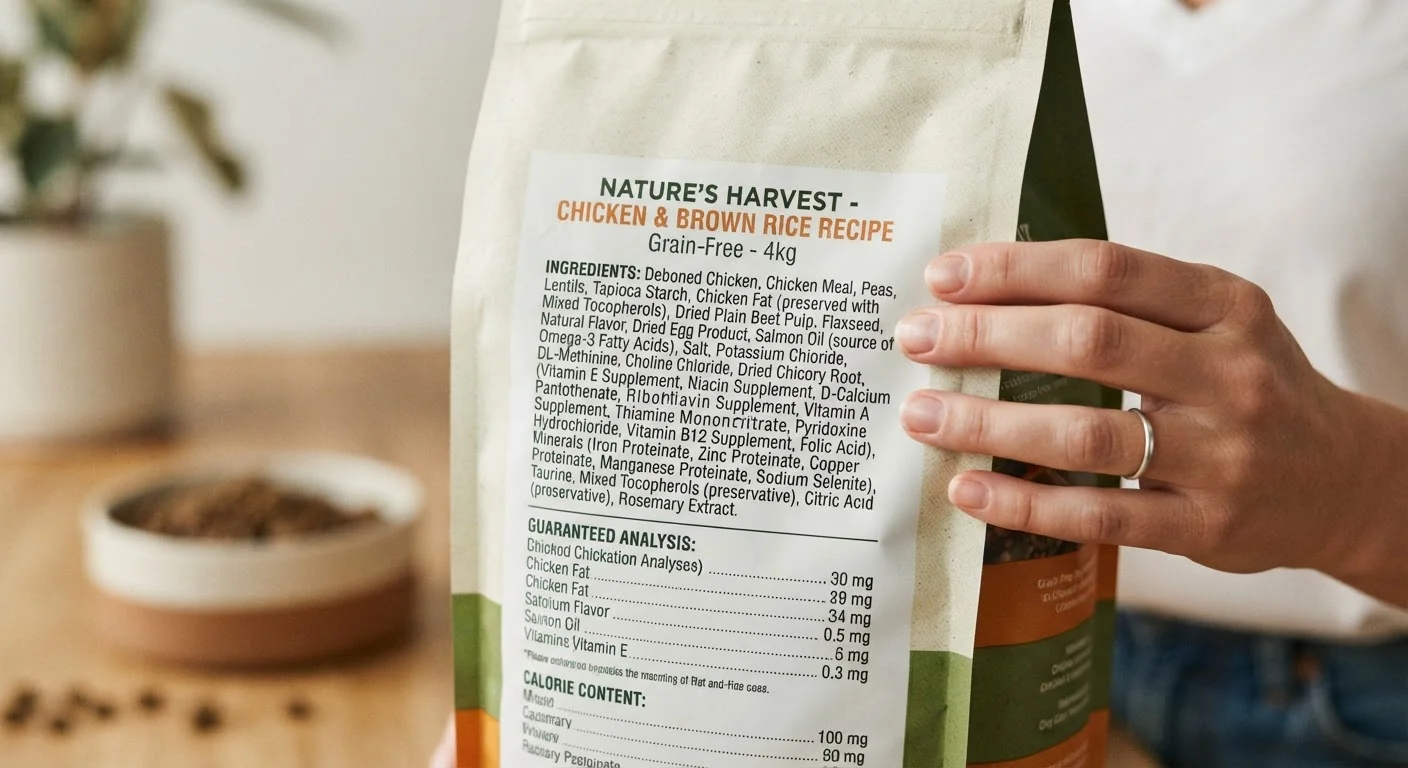
The Ingredient List: More Nuanced Than It Looks
The ingredient list on a pet food label is organized by weight - heaviest ingredients first - measured before cooking. This sounds straightforward, but moisture content complicates the picture significantly.
Whole chicken, for example, is roughly 70% water. A "chicken meal" listed further down the same label has already had most of its moisture removed, so it may actually contribute more protein to the finished product than the whole chicken listed above it. Neither placement is deceptive - it's simply how the regulatory system works.
Ingredient splitting is another pattern worth recognizing. When a single ingredient like corn appears in multiple forms - corn flour, corn gluten meal, ground corn - each variation is listed separately. This can push them lower on the list individually, even if their combined weight is substantial.
Ingredient Lists Follow Specific Rules
AAFCO and state feed laws govern how ingredients must be named, defined, and ordered. An ingredient cannot appear on the label under a trade name or vague descriptor - it must use a defined common or usual name. This means terms like 'meat by-products' and 'poultry meal' have specific regulatory definitions, not open-ended meanings.
For a broader look at how ingredient lists function across consumer products, see how to read a pet food label without getting confused in our Pet Care Basics section.
The Guaranteed Analysis: What the Numbers Actually Mean
The guaranteed analysis panel shows minimum or maximum percentages for four core nutrients: crude protein (minimum), crude fat (minimum), crude fiber (maximum), and moisture (maximum). Some labels voluntarily include additional nutrients like ash or omega fatty acids.
These figures are regulatory benchmarks, not precise measurements of what's in the bag. A food guaranteeing a minimum of 26% crude protein could contain 28% or more - the label only commits to a floor.
~70%
Moisture content in whole fresh meat ingredients
This high water content is why whole meats often rank first on ingredient lists by weight but may contribute less protein than processed meat meals after cooking.
2
AAFCO methods to substantiate nutritional adequacy
AAFCO recognizes formulation to meet nutrient profiles and animal feeding trials as the two accepted methods for making a nutritional adequacy claim on a pet food label.
4
Nutrients always required in guaranteed analysis
U.S. regulations require pet food labels to disclose minimums for crude protein and crude fat, and maximums for crude fiber and moisture in the guaranteed analysis panel.
Comparing a wet food and a dry food using guaranteed analysis numbers directly is misleading because moisture levels differ so dramatically - sometimes 10% in kibble versus 78% in canned food. To make an accurate comparison, both values must be converted to a dry matter basis by removing moisture from the equation mathematically. Your veterinarian or a board-certified veterinary nutritionist can walk you through this process.
The AAFCO Statement: The Label's Most Important Line
Tucked near the bottom of most pet food labels is the nutritional adequacy statement, and it carries more weight than almost anything else on the package. AAFCO - the Association of American Feed Control Officials - establishes the nutrient profiles that define whether a pet food is considered nutritionally complete for a given life stage.
A valid AAFCO statement does one of two things: it confirms the food was formulated to meet AAFCO nutrient profiles, or it states the food has been substantiated through AAFCO feeding trials. Both are acceptable, though feeding trials involve real animals consuming the food over a defined period and are considered a more rigorous standard by many veterinary nutrition experts.
The life stage indicated matters too. A food suitable for "adult maintenance" is not necessarily appropriate for a growing puppy or a pregnant cat. Foods labeled "for all life stages" meet the higher nutrient requirements of growth and reproduction, making them suitable across the board - though not always the most efficient choice for senior pets with different needs.
A dog owner sees "salmon" listed as the first ingredient on a kibble bag and assumes salmon is the primary protein source.
A cat owner compares the protein percentage on a canned food (10%) and a dry food (32%) and concludes the dry food has far more protein.
A pet owner buys a food labeled "for supplemental feeding only" thinking it can replace their dog's main diet.
A kitten owner selects a food labeled "adult maintenance" because the package features an image of a cat.
Marketing Terms: Regulated vs. Aspirational
Pet food packaging is covered in compelling language - "premium," "holistic," "human-grade," "ancestral diet." Some of these terms have regulatory definitions; many do not.
"Natural" has a specific meaning under AAFCO guidelines: it refers to ingredients derived solely from plant, animal, or mined sources without chemically synthetic processes, with limited exceptions for added vitamins and minerals. However, "natural" says nothing about the nutrient density or overall quality of the diet.
Terms like "premium," "ultra," and "holistic" carry no regulatory definition in pet food labeling. They are marketing descriptors and cannot be used to assess nutritional quality. Similarly, "grain-free" indicates an ingredient decision but does not indicate that the food is low-carbohydrate or nutritionally superior. Some grain-free diets substitute legumes or potatoes, which also contribute carbohydrates.
The most reliable signals on a pet food label remain the AAFCO nutritional adequacy statement, the ingredient list, and the guaranteed analysis - not the front-of-bag claims. For more on foundational pet care practices, including feeding basics, explore our Pet Care Basics hub.
This article is for general informational purposes only and does not constitute veterinary or dietary advice. Always consult a licensed veterinarian before making changes to your pet's diet, especially for animals with health conditions, specific life stages, or nutritional concerns.
Frequently Asked Questions
It means the food is formulated to meet AAFCO nutrient profiles or has passed AAFCO feeding trials for a stated life stage. It is a regulated claim, not just marketing language. A food labeled this way should be suitable as a primary diet - not just a supplement or treat.
Generally yes, but with an important caveat. Ingredients are listed by pre-cooking weight, which includes water. A whole meat listed first may outweigh a meat meal that appears later, but once moisture is removed during processing, the meal may actually contribute more protein by dry weight.
An AAFCO nutritional adequacy statement tells you whether a food meets established nutrient standards and for which life stage - such as growth (puppies or kittens), adult maintenance, or all life stages. Without this statement, you cannot confirm the food is nutritionally complete.
Not necessarily. 'Natural' has a specific but limited definition in pet food regulations - it refers to ingredients not produced synthetically, but it says nothing about nutritional quality. 'Grain-free' simply means grains were excluded; the overall nutrient profile still matters most. Discuss dietary choices with your vet.
It's a section of the label showing minimum or maximum percentages of key nutrients - typically crude protein, crude fat, crude fiber, and moisture. These are regulatory floors or ceilings, not precise measurements, so they describe a range rather than an exact nutritional composition.
Direct comparison of wet and dry foods requires converting both to a dry matter basis first, because moisture content heavily affects the percentages shown. A nutritionist or veterinarian can help interpret these numbers in context of your pet's specific needs.
The content on this site is provided for informational purposes only and should not be considered a substitute for professional advice. While we strive to provide accurate and up-to-date information, we make no guarantees regarding its completeness or accuracy. Always consult a qualified professional for advice specific to your circumstances before making any decisions.