

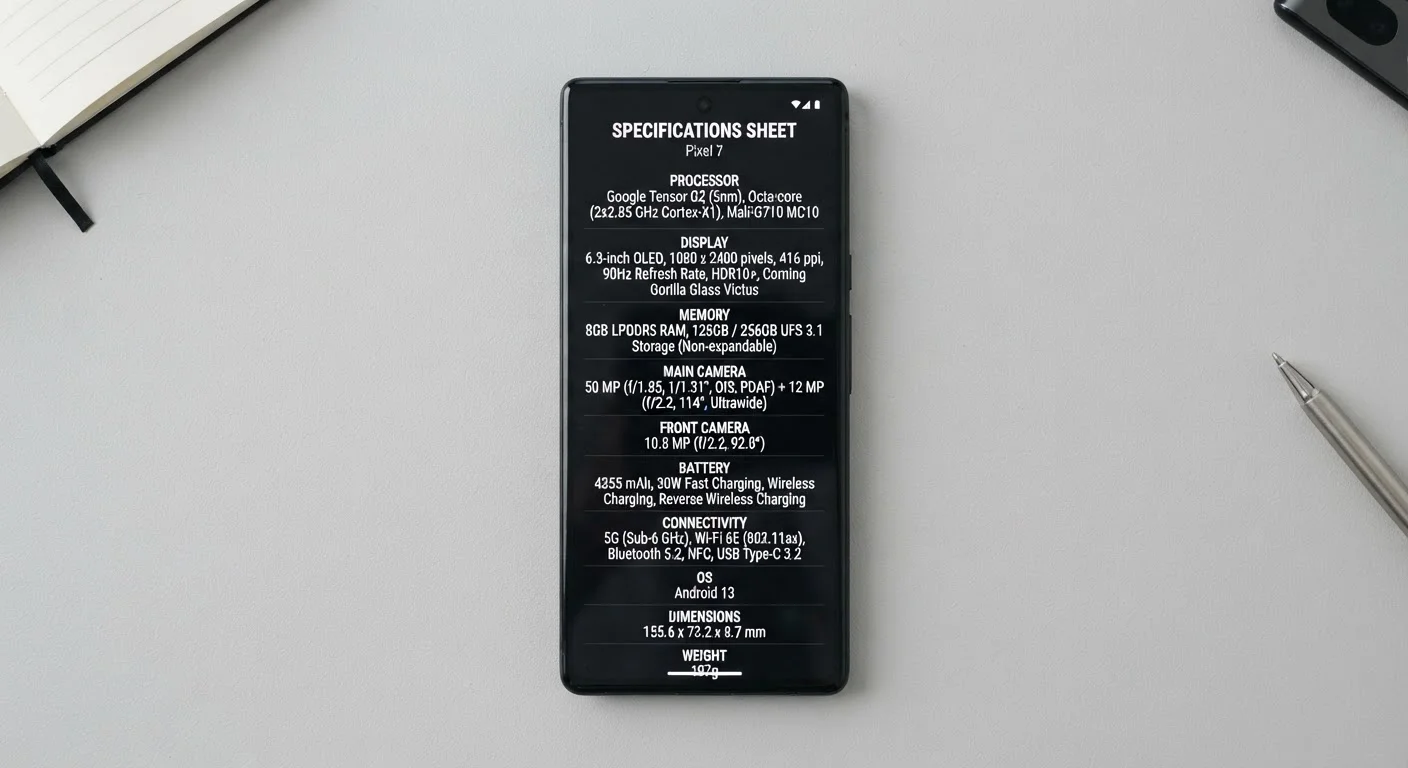
Processor and Memory: The Performance Section
The processor listing is usually the most intimidating part of a phone spec sheet. You'll see a chip name, a clock speed in GHz, and a core count. What matters most in daily use isn't the raw GHz number - it's the overall chip design and how efficiently it manages tasks. For a plain-language breakdown, see our guide to what processor speed actually means.
The chip is technically called an SoC (System on a Chip) - it bundles the processor, graphics, modem, and AI processing into one component. Brand names like Snapdragon, Dimensity, and Apple's A-series all refer to SoCs.
RAM is listed separately and affects multitasking. If you notice apps reloading when you return to them, low RAM is often the cause. Most phones in the mid-range and above carry enough RAM for typical use - the number itself is less important than it was a few years ago.
Internal storage is listed in GB or TB. The type matters too: UFS 4.0 storage transfers files significantly faster than older UFS 2.x versions, which affects how quickly apps open and photos save. For more on storage capacity decisions, see our guide to mobile storage.
Specs Don't Tell the Whole Story
A higher number doesn't always mean a meaningfully better experience. A phone with 16 GB of RAM won't feel twice as fast as one with 8 GB in everyday tasks. Real-world performance depends on how well the operating system, software, and hardware are tuned together - not any single spec in isolation.
Display, Connectivity, and Durability Terms
The display section of a spec sheet packs in several terms. AMOLED and OLED refer to screen technologies that produce vivid colors and true blacks. LCD panels are generally less vibrant but can look perfectly fine - especially in bright environments. Resolution (measured in pixels, e.g., 1080p or 2K) affects sharpness, and refresh rate affects smoothness. Our screen specs explainer covers when each actually matters.
| IP68 max water depth (typical) | 1.5-6 meters for 30 minutes (IEC 60529 standard; exact depth varies by manufacturer) |
| Common phone RAM range | 6 GB - 16 GB (Mid-range to flagship phones, general market observation) |
| Typical flagship refresh rate | 120Hz (adaptive) (Standard across most flagship-tier phones as of recent years) |
| 5G Sub-6 coverage in U.S. | Broadly available from major carriers (Carrier coverage maps; mmWave remains limited to select urban zones) |
| Standard fast-charging descriptor | 18W-120W (varies by phone) (Wattage figures vary widely across brands and price tiers) |
On the connectivity side, you'll see 5G Sub-6 and sometimes mmWave. Sub-6 is the 5G you'll actually use across the country. mmWave is extremely fast but only works in dense urban spots within close range of specific antennas. If you're outside a major metro, mmWave support is largely irrelevant in practice. Our 5G explainer goes deeper on what the difference means for real-world use.
NFC is worth checking if you use mobile payments or transit apps. Wi-Fi 6 or Wi-Fi 6E indicates support for newer router standards - relevant if your home network supports them. For what terms like VoLTE and Wi-Fi Calling mean on your carrier's end, see our connectivity guide.
The IP rating (e.g., IP67, IP68) tells you about dust and water resistance. The first digit is dust protection (6 = fully sealed); the second is water protection (7 = 1m submersion for 30 min; 8 = deeper, per manufacturer spec). Note that IP ratings are lab-tested conditions - real-world outcomes can differ, and water damage is typically not covered by standard warranties even on IP68 devices.
SoC (System on a Chip)
A single chip that combines the processor, graphics unit, modem, and other components. It's the closest thing to a phone's brain and engine combined.
RAM (Random Access Memory)
Short-term memory that holds the apps and processes currently running. More RAM generally means you can switch between apps without them reloading.
AMOLED / OLED
Display technologies where each pixel produces its own light, enabling deep blacks and vivid contrast. AMOLED is Samsung's branded variant of OLED.
IP Rating
A standardized measure of resistance to dust (first digit) and water (second digit). IP68 means the phone is fully dust-tight and can survive submersion at a specified depth.
5G Sub-6 / mmWave
Two different 5G frequency bands. Sub-6 GHz offers broader coverage at moderate speeds; mmWave delivers very high speeds but only over short distances in dense areas.
Refresh Rate (Hz)
How many times per second the display redraws the image. A 120Hz screen feels noticeably smoother than a 60Hz one when scrolling or gaming.
NFC
Near Field Communication - a short-range wireless standard used for tap-to-pay, contactless transit cards, and pairing accessories.
UFS Storage
Universal Flash Storage - the internal storage standard used in most modern phones. Higher UFS versions (e.g., UFS 3.1, UFS 4.0) read and write data faster.
The content on this site is provided for informational purposes only and should not be considered a substitute for professional advice. While we strive to provide accurate and up-to-date information, we make no guarantees regarding its completeness or accuracy. Always consult a qualified professional for advice specific to your circumstances before making any decisions.