

What Happens When Audio Gets Compressed
When a song is recorded in a studio, the raw audio file is enormous - far too large to stream smoothly over most home internet connections. To solve this, streaming services compress the audio using algorithms that shrink the file size. The most common approach is lossy compression, used in formats like MP3 and AAC.
Lossy compression works by identifying sounds the human ear is statistically less likely to notice - quiet sounds that occur simultaneously with louder ones, or frequencies at the extreme edges of hearing - and permanently discarding them. The result is a smaller file that sounds similar to the original to most listeners but is missing real data.
The tradeoff is measured in bitrate, expressed in kilobits per second (kbps). A higher bitrate means more data is retained per second of audio. A stream at 128 kbps will sound noticeably thinner than one at 320 kbps, even through modest headphones. For a plain-English breakdown of terms like bitrate and codec, see our streaming terms glossary.
320 kbps
Maximum bitrate for standard MP3 compression
This is the highest quality available in the MP3 format, widely used as a benchmark for compressed audio quality on streaming platforms.
1,411 kbps
Bitrate for standard CD-quality lossless audio
CD audio (16-bit, 44.1 kHz) represents the baseline lossless quality that many streaming services reference when advertising lossless tiers.
~5-30 MB
Data used per minute of lossless audio
Compared to roughly 1-5 MB per minute for standard compressed streams, lossless audio places a significantly higher demand on data plans and network bandwidth.
What Lossless Audio Actually Means
Lossless audio takes a different approach: it compresses the file size without throwing away any sound data. Formats like FLAC (Free Lossless Audio Codec) and ALAC (Apple Lossless) can reduce file size by roughly 50% compared to raw audio while keeping every bit of the original recording intact. When you decompress a lossless file, you get back exactly what went in.
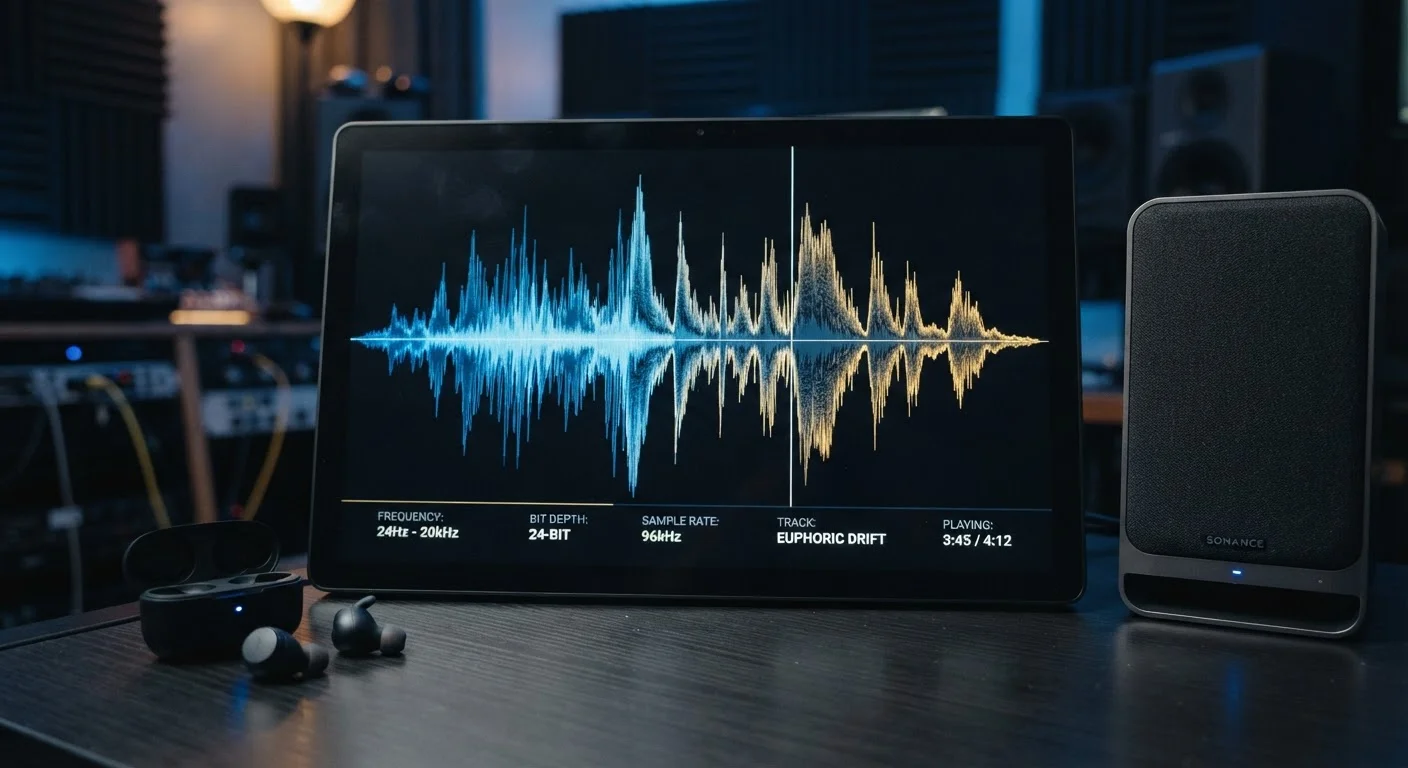
CD-quality audio - 16-bit depth at 44.1 kHz sample rate - is the baseline for lossless. Hi-Res Audio goes further, using higher sample rates (96 kHz or 192 kHz) and 24-bit depth to capture even more sonic detail than a standard CD. Whether that extra detail is audible depends heavily on your listening equipment and environment.
Some streaming platforms offer lossless tiers, though the quality varies between CD-quality and true Hi-Res depending on the track and your subscription level. Network stability also matters - lossless streams demand more consistent bandwidth. If your home connection fluctuates, understanding your home network basics can help you get the most from a lossless subscription.
Does Better Audio Quality Actually Matter for You?
The honest answer is: it depends on your setup and your ears. Research consistently shows that casual listeners in blind tests often struggle to identify lossless audio versus high-bitrate compressed audio. The gap becomes more audible when listening on quality over-ear headphones or a dedicated home stereo system in a quiet room.
Your playback chain matters end to end. Lossless audio routed through a low-quality Bluetooth speaker will not sound better than compressed audio through the same speaker - the speaker becomes the limiting factor. Similarly, most standard Bluetooth headphones re-compress audio during transmission, which means the lossless signal you're streaming may not reach your ears intact. A wired connection to a capable DAC (digital-to-analog converter) or quality headphones makes the most difference.
Test Before You Commit to a Paid Tier
Many streaming platforms offer free trials of their higher-quality audio tiers. Use that window to do your own listening test on your actual equipment at home - not through earbuds at a store. Listen to music you know well, in a quiet room, on your best available headphones. That's the most reliable way to judge whether the upgrade is worth it for your setup.
If you use a smart speaker as your primary listening device, audio format improvements may have less impact than you'd expect. Smart speakers have real audio quality limits that are worth understanding before upgrading a streaming subscription for sound quality alone.
Practical Considerations Before You Upgrade
Before paying for a higher-quality audio tier, it's worth auditing your current setup. Ask: what are you listening through, and does it support the format? If your network connection is inconsistent, a lossless stream may actually buffer or downgrade mid-song. A wired Ethernet connection often outperforms Wi-Fi for stable high-bitrate audio, particularly in larger homes.
A household streams music through a mid-range Bluetooth soundbar at 128 kbps compressed audio and then upgrades to a lossless tier.
An audiophile listener connects quality wired over-ear headphones to a standalone DAC fed by a lossless stream.
A commuter streams music on a smartphone over a cellular connection using Bluetooth earbuds.
Data usage is another real-world factor. Lossless audio can use several times more data than standard quality. If you stream on a mobile plan with data caps, that cost adds up. Many services let you set audio quality separately for cellular versus Wi-Fi connections - a smart setting to use if data is a concern.
The bottom line: compressed audio at high bitrates sounds genuinely good on most consumer equipment. Lossless offers a real advantage for listeners with capable hardware and a stable connection - but it's not a universal upgrade for every household.
Frequently Asked Questions
Many casual listeners cannot reliably tell the difference, especially on standard earbuds or laptop speakers. Audible differences are more noticeable on high-quality headphones or home audio systems with a quiet listening environment. Instruments with complex overtones - like piano or acoustic guitar - tend to reveal differences most clearly.
Yes, significantly more. A standard compressed stream might use 1-5 MB per minute, while lossless can use 5-30 MB per minute depending on the resolution. If you have a capped data plan, streaming lossless audio consistently can add up quickly. Downloading tracks for offline listening can reduce repeated data use.
For general listening, 256 kbps AAC or 320 kbps MP3 is considered high-quality compressed audio and sounds good on most consumer equipment. Lossless typically starts at CD quality, which is 1,411 kbps. If a service advertises "high quality" without specifying bitrate, it's worth checking the fine print.
Most standard Bluetooth headphones do not transmit lossless audio because common Bluetooth codecs (like SBC and AAC) compress the signal again during transmission. Some headphones support higher-quality codecs like aptX HD or LDAC, which get closer to lossless quality, but true bit-perfect lossless typically requires a wired connection.
Not exactly. Hi-Res Audio refers to audio with a higher sample rate and bit depth than standard CD quality - it captures more detail than a standard lossless file. Lossless simply means no data was discarded during compression. Hi-Res files are lossless by definition, but not all lossless audio is Hi-Res.
The content on this site is provided for informational purposes only and should not be considered a substitute for professional advice. While we strive to provide accurate and up-to-date information, we make no guarantees regarding its completeness or accuracy. Always consult a qualified professional for advice specific to your circumstances before making any decisions.