

The Science Behind the Method
Positive reinforcement draws on well-established principles of behavioral science. When an animal performs a behavior and something pleasant immediately follows, the brain registers a connection between the action and the outcome. That connection strengthens each time it is repeated, making the behavior more reliable over time.
This process is not unique to dogs. Researchers have documented it in cats, birds, horses, marine mammals, and many other species. The underlying biology - primarily the role of dopamine in reinforcing rewarding experiences - is consistent across vertebrates. This is why reward-based training is endorsed by veterinary behaviorists and professional trainers alike as a humane and effective foundation for teaching pets.
The alternative - using punishment or aversive correction - can suppress behavior in the short term, but it comes with significant trade-offs. Studies in animal behavior suggest that aversive methods are associated with increased stress, fear, and in some cases aggression. For pet owners focused on pet health and wellness, building a training relationship on trust rather than avoidance is widely considered the better long-term approach.
“Reward-based methods are not just kinder - they are more effective for the long-term reliability of behavior, because the animal is choosing to repeat an action rather than avoiding a consequence.”
— Dr. Karen Overall, Veterinary behaviorist and author of foundational texts in clinical animal behavior
Getting the Timing and Reward Right
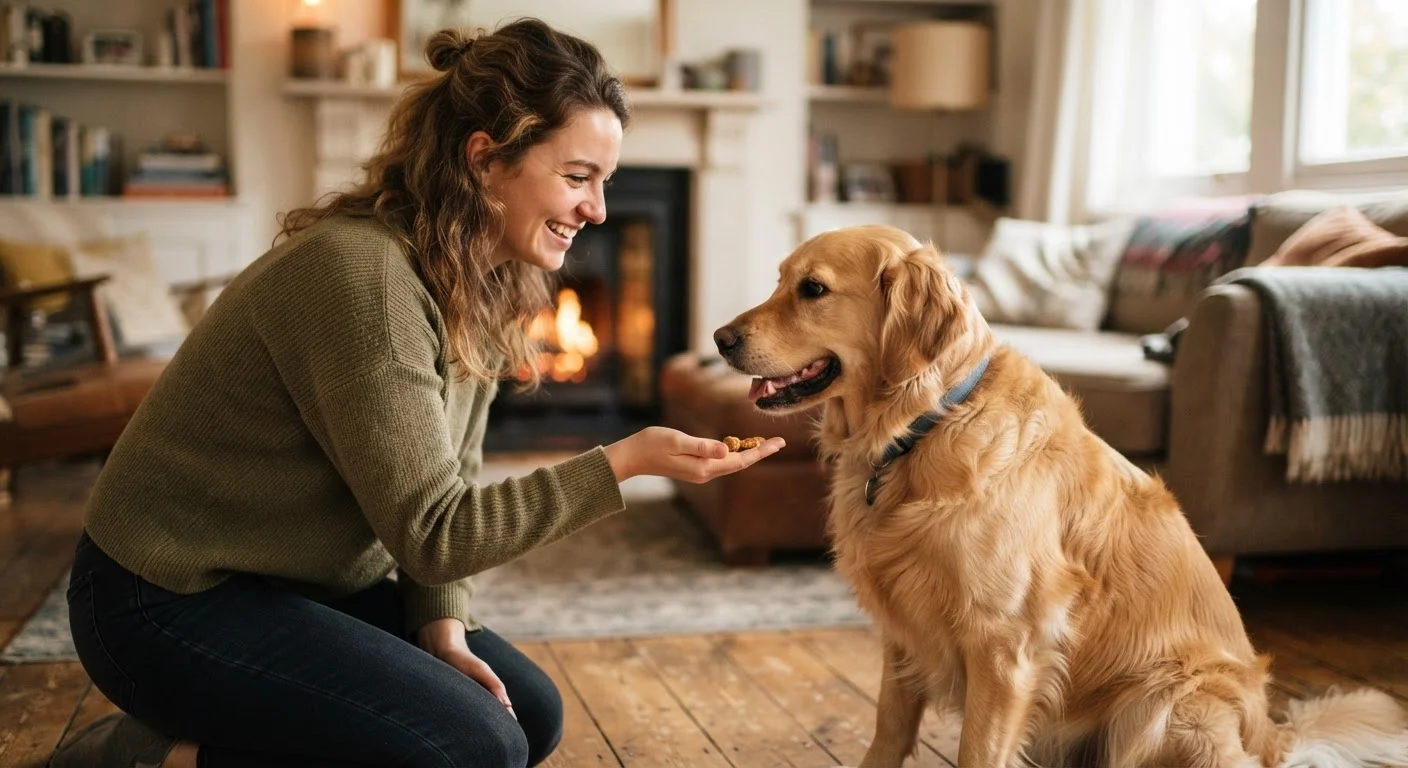
The single most important mechanical detail in positive reinforcement is timing. The reward must arrive within one to two seconds of the desired behavior. A longer delay creates ambiguity - the animal cannot reliably connect the reward to the specific action you intended to reinforce.
Many trainers use a marker signal - a short, distinct sound like a clicker or a verbal cue such as "yes" - to bridge that gap. The marker tells the animal precisely when it did the right thing, even if the treat takes a moment to appear. This is especially useful for complex behaviors or for working with animals that move quickly.
Use a Marker Signal for Precision
A clicker or a short verbal marker like "yes" tells your pet the exact moment it did the right thing. Introduce the marker by pairing it with a treat several times before using it in training. Once the association is established, it becomes a precise communication tool that closes the timing gap between behavior and reward.
Choosing the right reward matters too. Food treats are popular because they are easy to deliver quickly and most animals find them highly motivating. However, the reward should match what the pet values in that moment. A dog that is more excited about a tennis ball than a biscuit will likely respond better to a brief game of fetch as the reinforcer.
Keep treat sizes small - roughly pea-sized for most dogs - so the animal stays engaged across multiple repetitions without becoming full or distracted. For cats, very short sessions of two to three minutes are generally more productive than extended ones.
Applying It Day to Day
Positive reinforcement is not limited to formal training sessions. Every interaction with a pet is an opportunity to reinforce or inadvertently ignore good behavior. Acknowledging calm behavior, sitting politely, or checking in with you are all worth a quiet word of praise or a brief scratch - this builds a broader vocabulary of trust between you and your animal.
Consistency across the household is critical. If one person rewards a dog for jumping up while another discourages it, the animal receives conflicting information and the behavior tends to persist. Everyone living with the pet should agree on which behaviors earn rewards and which are simply ignored. This principle is central to the kind of responsible pet ownership habits that make a real difference over time.
73%
Dog owners using reward-based methods reporting fewer behavior problems
A survey published in the journal Frontiers in Veterinary Science found that reward-based training was associated with significantly fewer problematic behaviors compared to aversive methods.
1-2 sec
Ideal reward delivery window after a desired behavior
Behavioral science literature consistently identifies this narrow timing window as critical for the animal to correctly associate the reward with the intended behavior.
Pairing training with a consistent daily routine also accelerates results. Pets that know when to expect meals, walks, and play tend to be calmer and more receptive to learning. See how a structured daily routine supports behavior and overall wellbeing for more on this connection.
If a pet seems persistently unresponsive, distracted, or shows signs of anxiety during training, it may be worth consulting a veterinarian or a certified applied animal behaviorist. Stress can interfere significantly with learning - understanding signs your pet may be stressed is a useful companion skill for any owner.
A new puppy jumps on guests at the front door. The owner turns away and withholds attention every time the puppy jumps, then immediately rewards four paws on the floor with a treat and calm praise.
A cat owner wants to teach their cat to come when called. Each time the cat's name is said and the cat moves toward the owner, it receives a small piece of chicken immediately upon arrival.
A household with young children uses positive reinforcement to teach the family dog to go to a designated mat when guests arrive, keeping greetings calm and controlled.
Frequently Asked Questions
Yes. Cats are fully capable of learning through positive reinforcement, though they tend to be more selective about what counts as a reward. Many cats respond well to small food treats, while others prefer play or brief petting. Short sessions of two to three minutes tend to work best.
Simple behaviors like sit or come can often be shaped within a few short sessions. More complex behaviors or replacing unwanted habits may take weeks of consistent practice. Progress depends on the individual animal, the clarity of your cues, and how consistently the reward is delivered.
Yes. The approach involves redirecting the animal toward an acceptable alternative behavior and rewarding that instead. It takes patience, but most unwanted behaviors can be reduced over time by consistently reinforcing what you do want, rather than reacting to what you don't.
Food is a common and convenient reinforcer, but it isn't the only option. Praise, a favorite toy, access to play, or even the chance to sniff something interesting can all serve as rewards. The key is identifying what your specific pet genuinely values in that moment.
No. Animals can learn new behaviors at any age, though older pets may take longer to unlearn established habits. Starting at any point is worthwhile, and even senior pets benefit from the mental stimulation and strengthened bond that training provides.
The content on this site is provided for informational purposes only and should not be considered a substitute for professional advice. While we strive to provide accurate and up-to-date information, we make no guarantees regarding its completeness or accuracy. Always consult a qualified professional for advice specific to your circumstances before making any decisions.