

Start here
Why Consistency Matters More Than Intensity
Next
Choosing the Right Starting Point
Then
Structuring Your First Weekly Plan
After that
Building Habits That Actually Stick
When you're ready
Overcoming Common Obstacles
Why Consistency Matters More Than Intensity
One of the most persistent myths about exercise is that it has to be hard to work. In reality, the research base consistently shows that regular, moderate movement produces meaningful health benefits - benefits that sporadic intense workouts cannot match. Building a weekly habit is about frequency and sustainability, not peak effort.
The U.S. Department of Health and Human Services' Physical Activity Guidelines for Americans recommend that adults accumulate at least 150 minutes of moderate-intensity aerobic activity per week, along with muscle-strengthening activities on two or more days. That works out to roughly 30 minutes of brisk walking five days a week - an achievable target for most people starting from zero. See our guide to structuring a realistic weekly workout plan for a more detailed breakdown of how to allocate those minutes.
The Two-Minute Rule for Getting Started
When resistance to starting a workout is high, commit only to two minutes. Put on your shoes, step outside, and tell yourself you only need to do two minutes. Most of the time, you'll continue once you've begun. This technique lowers the psychological barrier to starting, which is often the hardest part.
Choosing the Right Starting Point
Beginners often make the mistake of copying advanced workout routines. Instead, your starting point should reflect your current fitness level - not the level you want to reach.
Begin by asking three questions:
- What activities do I genuinely not dread? Enjoyment is a strong predictor of long-term adherence.
- What is realistically available to me? Consider time, location, cost, and physical space.
- Can I do this without risk of injury? Low-impact options like walking, swimming, or bodyweight movements are ideal for most beginners.
Walking is frequently underestimated as a starting point - but the evidence supporting it is substantial. Research consistently links regular walking to cardiovascular health, improved mood, and longevity. Our companion guide on starting a walking routine covers how to structure and progress one effectively.
Moderate-intensity activity
Exercise that noticeably raises your heart rate and makes you breathe faster, but still allows you to carry on a conversation - like brisk walking or casual cycling.
Muscle-strengthening activity
Any movement that works your muscles against resistance, such as bodyweight exercises, resistance bands, or lifting weights.
DOMS
Delayed-onset muscle soreness - the muscle ache that typically appears 24-48 hours after unfamiliar or intense physical activity. It is a normal response to exercise stress.
Habit stacking
A behavioral strategy that involves attaching a new habit to an existing one, using the old behavior as a reliable trigger for the new one.
Active recovery
Low-intensity movement done on rest days - like gentle stretching or a slow walk - that promotes blood flow and reduces soreness without taxing the body further.
Structuring Your First Weekly Plan
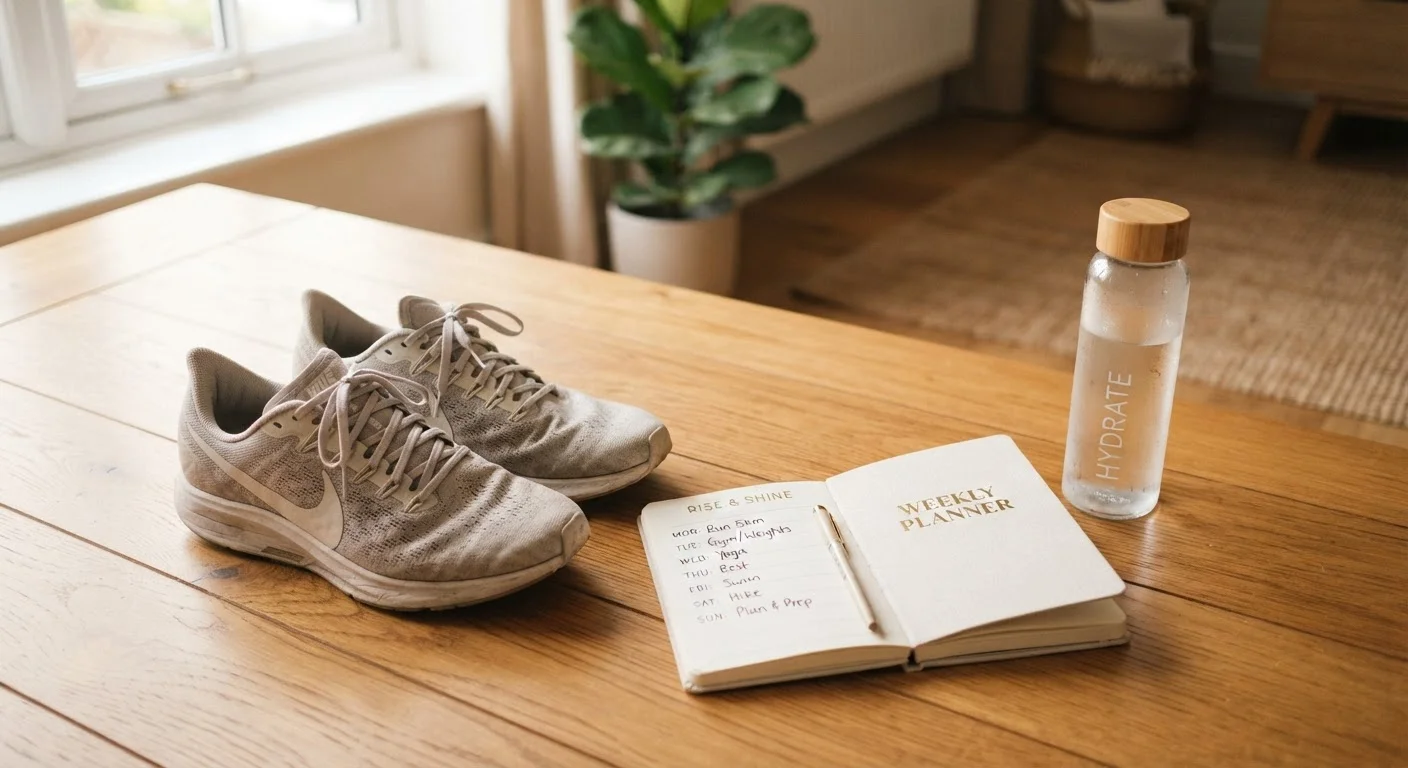
A beginner-friendly weekly plan balances activity days with recovery. A simple and effective framework looks like this:
| Day | Activity | Duration |
|---|---|---|
| Monday | Brisk walk or light cardio | 20-30 min |
| Tuesday | Rest or gentle stretching | 10-15 min |
| Wednesday | Bodyweight movements (squats, push-ups) | 20 min |
| Thursday | Rest | - |
| Friday | Walk or low-impact cardio | 25-30 min |
| Saturday | Active activity of choice | 30 min |
| Sunday | Rest | - |
This structure gives you three active days and four rest or light-activity days - enough stimulus to build fitness without overwhelming a body that isn't conditioned yet. Adjust based on how your body responds in the first two weeks.
If you work at a desk, integrating movement into your workday can also make a measurable difference. The practical strategies for staying active with a desk job article offers evidence-informed approaches that complement a weekly exercise plan.
Building Habits That Actually Stick
Behavioral research suggests that habits form more reliably when new behaviors are anchored to existing routines. Rather than treating exercise as a standalone task to carve time for, attach it to something you already do. Walk before your morning coffee. Do bodyweight exercises after you brush your teeth at night. The trigger reduces the decision-making burden.
Other evidence-supported strategies include:
- Scheduling it like an appointment. Blocking specific times on your calendar increases follow-through.
- Preparing in advance. Setting out workout clothes the night before lowers friction at the moment of decision.
- Tracking progress simply. Even a paper calendar with checkmarks provides a visual record of consistency - a motivational cue researchers call the "chain" method.
- Starting smaller than feels necessary. A 10-minute walk you actually do beats a 45-minute session you skip repeatedly.
Overcoming Common Obstacles
Most people who abandon new exercise routines do so within the first few weeks - usually due to unrealistic expectations, scheduling conflicts, or early soreness. Understanding these barriers in advance makes them easier to manage.
Time pressure: Even three 10-minute walks spread across a day meet the activity accumulation standard in current guidelines. Movement does not need to be continuous to be beneficial.
Muscle soreness: Delayed-onset muscle soreness (DOMS) is normal when starting out and typically peaks 24-48 hours after activity. Light movement - not complete rest - tends to ease it faster. Soreness that is sharp, localized to a joint, or persistent beyond a few days warrants medical attention.
Motivation dips: Motivation fluctuates for everyone. Relying on discipline and environmental design - rather than motivation alone - produces more durable habits. If you haven't exercised in a long time, our article on rebuilding movement habits safely after a long gap addresses this specific scenario with a low-pressure approach.
This article is for general informational and educational purposes only. It is not a substitute for professional medical advice, diagnosis, or treatment. Always consult a qualified healthcare provider before beginning a new exercise program, particularly if you have any underlying health conditions.
Frequently Asked Questions
Most health guidelines suggest starting with 3 days per week and building from there. This gives your body adequate recovery time while establishing a reliable pattern. Consistency across fewer days is far more beneficial than sporadic sessions every day.
Brisk walking, cycling, swimming, bodyweight movements, and even active housework all count as physical activity. The key is elevating your heart rate moderately and moving your body intentionally. You do not need a gym to get meaningful exercise.
Even 10-20 minutes of movement per session is a legitimate starting point. Research supports the idea that shorter bouts of activity accumulate health benefits over time. You can gradually extend duration as your fitness and confidence grow.
Missing a session is normal - the goal is your pattern over weeks, not perfection on any single day. Simply resume your schedule at the next planned session without trying to make up for lost time. Guilt or overcompensation often leads to burnout.
Adults who are generally healthy can begin a light to moderate exercise routine without a prior medical evaluation. However, if you have a chronic condition, have been sedentary for an extended period, or experience any concerning symptoms, consult your healthcare provider first.
Many people notice improvements in mood, energy, and sleep within 2-4 weeks of consistent activity. Physical changes like strength or endurance take longer and vary by individual. Focusing on how you feel day-to-day helps maintain motivation before measurable changes appear.
The content on this site is provided for informational purposes only and should not be considered a substitute for professional advice. While we strive to provide accurate and up-to-date information, we make no guarantees regarding its completeness or accuracy. Always consult a qualified professional for advice specific to your circumstances before making any decisions.