

Why Most Exercise Schedules Fall Apart
The most common reason people abandon workout plans isn't lack of motivation - it's that the plan was never realistic to begin with. Schedules built around idealized time and energy don't survive contact with real life: unpredictable workdays, family demands, and ordinary fatigue. Exercise science consistently shows that adherence - showing up regularly over months - produces far greater health benefits than occasional intense effort.
A sustainable schedule works with your life rather than against it. That means acknowledging your actual constraints, not the version of your week you wish you had. If you're completely new to structured movement, starting with a simple weekly habit before adding structure is often the smarter path.
Talk to Your Doctor Before Starting
This article provides general fitness education, not personalized medical advice. If you have a chronic condition, recent injury, or have been inactive for an extended period, consult a qualified healthcare professional before beginning a new exercise program. They can help you identify any movement limitations and set appropriate starting points.
What a Balanced Weekly Plan Actually Looks Like
General physical activity guidelines for adults - as outlined by public health bodies - recommend at least 150 minutes of moderate-intensity aerobic activity per week, along with muscle-strengthening activities on two or more days. That averages to roughly 30 minutes of movement on five days, which is far more manageable than it sounds when broken into focused sessions.
A practical three-to-five day structure might look like this: two days of strength or resistance training, two days of cardio or aerobic activity, and one day of active recovery such as walking or yoga. Rest fills the remaining days. Variety matters both physiologically - it prevents overuse injuries - and psychologically, reducing the boredom that quietly erodes consistency.
Treat Workouts Like Meetings
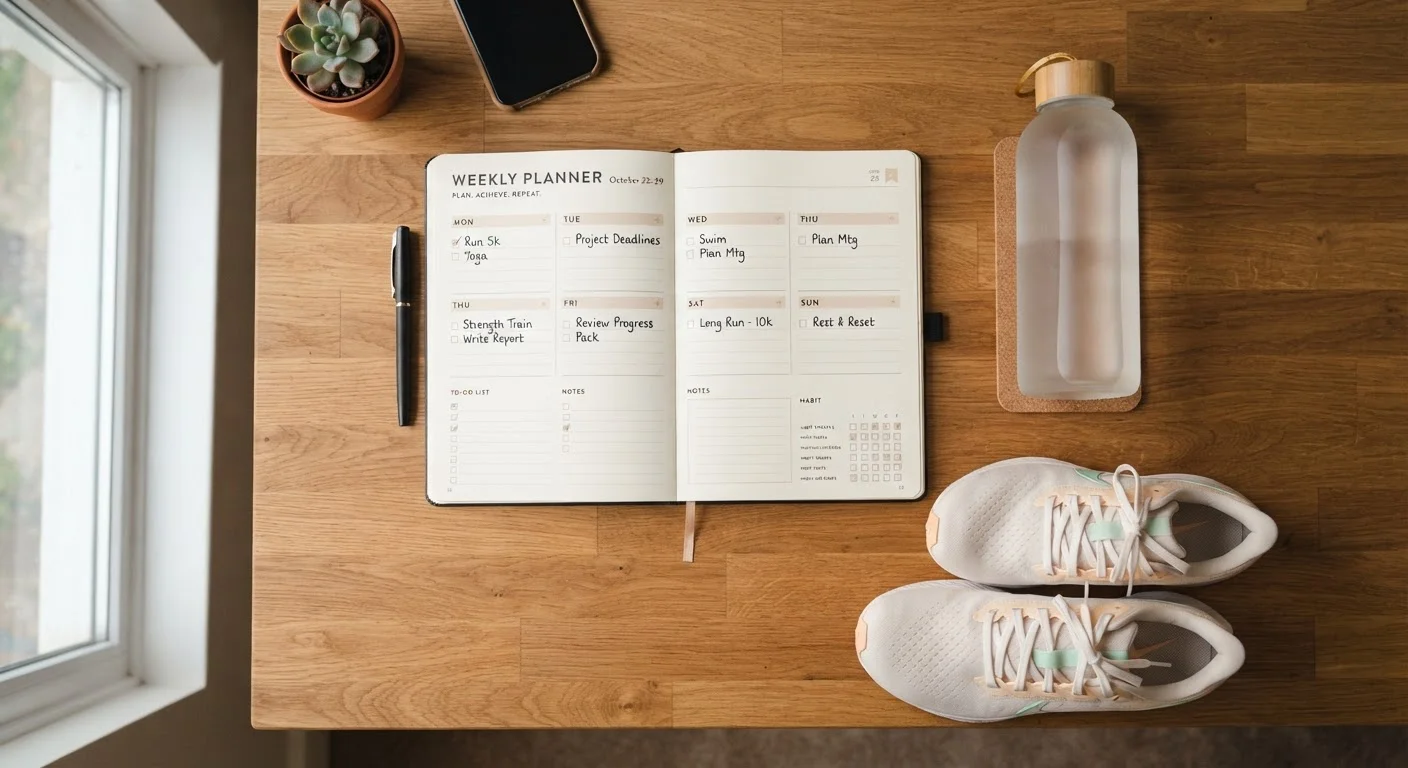
Block exercise time directly in your calendar - phone, paper planner, or wherever you manage your day. Treating a workout as a non-negotiable appointment, rather than something you'll fit in if time allows, is one of the most evidence-supported behavioral strategies for exercise adherence. Even a 20-minute slot counts.
If plateaus become a concern later, understanding why exercise routines stop producing results can help you make smart adjustments without overhauling everything.
How to Build and Refine Your Schedule
Follow the steps below to design a weekly plan that reflects your real schedule, energy patterns, and goals. The process takes under 30 minutes and produces a concrete, written structure you can test and adjust over four-week cycles.
What you will need
Weekly planner or calendar app
Used to block workout times visually and treat them as committed appointments.
Fitness tracking app or journal
Logs completed sessions and helps you spot patterns over time.
Timer or interval app
Keeps workouts time-efficient, especially for shorter sessions during busy weeks.
Audit your actual available time
Before choosing any workout format, look honestly at your week. Identify three to five time windows - even short ones - where exercise is genuinely realistic. Consider commute times, family commitments, and energy patterns throughout the day. A 25-minute window you'll actually use beats a 60-minute slot that never materializes.
Set a clear, specific goal for the next four weeks
Vague goals like 'get fit' produce vague effort. Instead, define a concrete short-term target: completing three workouts per week, walking a certain number of days, or building a consistent strength routine. A four-week timeframe is short enough to stay motivated and long enough to see early results. Revisit and adjust after that window.
Choose your workout types based on your goal
A balanced weekly schedule typically includes a mix of cardiovascular activity, strength or resistance training, and flexibility or mobility work. If you're starting from minimal activity, building a consistent movement habit is the right priority before worrying about workout variety. Pick two or three formats you genuinely don't dread - enjoyment is an underrated driver of consistency.
Map workouts to your energy levels across the week
Not all days carry equal energy. Most people have predictable high-energy and low-energy patterns - schedule more demanding sessions (strength training, interval work) on your higher-energy days, and lighter activity (walking, stretching, mobility) on draining days. This matching approach reduces the psychological friction that leads to skipped sessions.
Build in at least two rest or recovery days
Rest is not passive - it's when your muscles repair and grow stronger. Recovery days are a biological requirement, not a reward for hard work. Schedule them deliberately rather than letting them happen randomly. Active recovery options - gentle walks, light stretching, or yoga - keep you moving without adding training stress.
Write the schedule down and review it weekly
A mental commitment is far less durable than a written one. Map out your full week on Sunday or at the start of your week, noting which days have workouts and which are rest days. At the end of each week, take five minutes to assess what worked, what didn't, and what to adjust. Small, data-driven tweaks over time build a plan that genuinely fits your life - not an idealized version of it. For a complementary approach to structuring the rest of your day, see building a wind-down routine that supports recovery.
Doing Too Much Too Soon Backfires
Ramping up training volume or intensity faster than your body can adapt is one of the most common reasons people quit or get injured early on. Resist the urge to schedule seven days of hard workouts in week one. A modest, sustainable plan almost always outperforms an ambitious one that collapses by week two.
For readers whose challenge is finding any starting point at all, a structured walking routine is one of the most evidence-supported and accessible entry points available - no equipment required.
The content on this site is provided for informational purposes only and should not be considered a substitute for professional advice. While we strive to provide accurate and up-to-date information, we make no guarantees regarding its completeness or accuracy. Always consult a qualified professional for advice specific to your circumstances before making any decisions.