

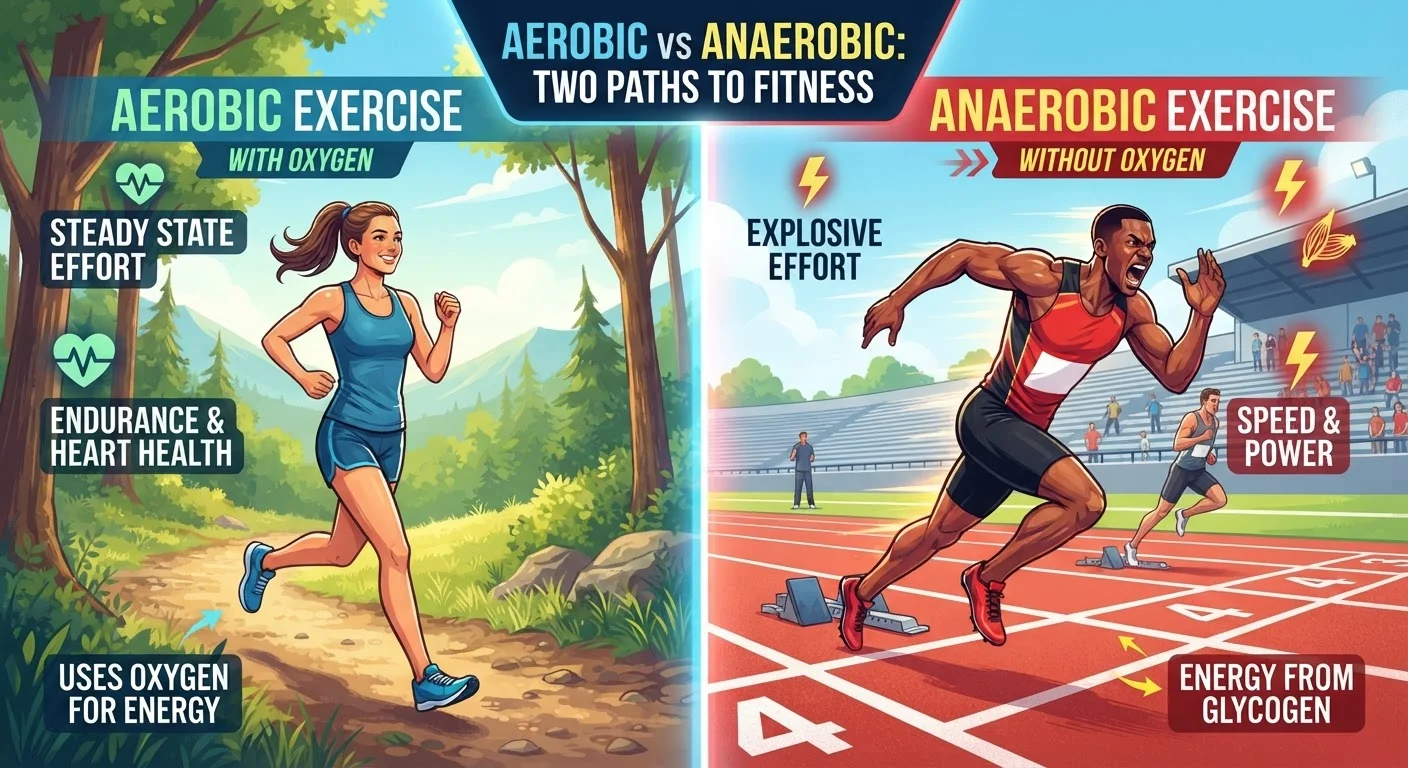
How Your Body Produces Energy During Exercise
Every time you move, your muscles need energy. That energy comes in the form of ATP, a molecule your body continuously regenerates through different metabolic pathways. The path your body chooses depends primarily on how hard you're working and how quickly energy is needed.
At lower intensities - a brisk walk or an easy bike ride - your cardiovascular system can deliver enough oxygen to your muscles to sustain a steady, efficient energy-production process. This is the aerobic (meaning "with oxygen") pathway. Push harder - say, into a sprint or a set of heavy squats - and the demand for ATP outpaces what oxygen delivery alone can support. Your body then shifts to anaerobic ("without oxygen") pathways that generate energy faster but can't be sustained as long.
It's important to understand that these systems don't switch on and off like a light switch. They overlap continuously. Intensity, not the type of activity, is the primary driver of which pathway dominates at any given moment.
150-300 min
Recommended weekly moderate aerobic activity
According to the U.S. Department of Health and Human Services Physical Activity Guidelines for Americans, adults should aim for 150 to 300 minutes of moderate-intensity aerobic activity per week.
75-150 min
Recommended weekly vigorous aerobic activity
The same guidelines note that 75 to 150 minutes of vigorous-intensity aerobic activity per week is an acceptable equivalent, reflecting the higher cardiovascular demand of anaerobic-adjacent intensities.
2x per week
Recommended muscle-strengthening activity
The Physical Activity Guidelines for Americans recommend muscle-strengthening activities - which heavily recruit anaerobic pathways - on two or more days per week for adults.
The Aerobic System: Built for the Long Haul
The aerobic energy system is your body's workhorse for sustained effort. It breaks down carbohydrates and fats using oxygen inside mitochondria - the energy-producing structures inside muscle cells - through a process called oxidative phosphorylation. This pathway is highly efficient, producing significantly more ATP per unit of fuel than anaerobic pathways.
Activities that primarily tap the aerobic system include distance running, cycling, swimming, and brisk walking - generally anything you can maintain for several minutes or more at a conversational intensity. Over time, consistent aerobic training causes measurable adaptations: the heart pumps blood more efficiently, the lungs extract oxygen more effectively, and muscles develop a denser network of capillaries and more mitochondria.
For a deeper look at what those long-term adaptations mean for your health, see what aerobic fitness actually means for your body. And because hydration directly affects aerobic performance, it's worth understanding how fluid intake affects physical performance as well.
The Anaerobic System: Power on Demand
When intensity spikes - a heavy deadlift, a 100-meter dash, a plyometric jump - your muscles need ATP faster than the aerobic system can supply it. Two anaerobic pathways step in.
- Phosphocreatine system: Provides an almost instant burst of energy by regenerating ATP from creatine phosphate stored in muscle. This system fuels maximal effort for only about 10 seconds before its reserves deplete.
- Anaerobic glycolysis: Breaks down glucose (from blood sugar or stored glycogen) without oxygen, producing ATP quickly but generating lactate as a byproduct. This supports high-intensity efforts lasting roughly 10 seconds to 2 minutes.
The burning sensation you feel during an all-out sprint or a tough set of push-ups is associated with the metabolic byproducts of this rapid energy production. Training these systems improves your muscles' capacity to buffer those byproducts and clear them faster, which is why trained athletes can sustain high effort longer.
“The body does not distinguish between 'cardio' and 'strength' the way we label them in gyms. It responds to the metabolic demand placed on it - and understanding that demand is the foundation of intelligent training.”
— American College of Sports Medicine, Leading professional organization in exercise science and sports medicine
Practical Implications: What This Means for Your Fitness
Understanding these systems has direct value for how you structure physical activity. If your goal is building cardiovascular endurance, prioritizing moderate-intensity sustained effort - activities that keep you in the aerobic zone - will drive the most relevant adaptations. If you're aiming to build strength and power, resistance training and short high-intensity efforts stress the anaerobic system productively.
Most exercise scientists and major health organizations, including the American College of Sports Medicine, recommend that a balanced fitness program includes both types of training. For a side-by-side breakdown of how strength training and cardiovascular exercise complement each other, see strength training vs. cardio - what each does for your health.
Nutrition also plays a role in which fuel your body favors. Carbohydrates are the primary fuel for anaerobic glycolysis, while fats contribute more substantially during aerobic activity at lower intensities. For practical guidance on fueling workouts effectively, fueling exercise before, during, and after physical activity offers evidence-informed recommendations.
This article is for general informational and educational purposes only and is not a substitute for professional medical advice. Consult a qualified healthcare provider before starting or significantly changing any exercise program, especially if you have a medical condition.
Frequently Asked Questions
The core difference is how your body produces energy. Aerobic exercise uses oxygen to break down fuel - mainly carbohydrates and fats - for sustained activity. Anaerobic exercise bypasses oxygen to generate energy rapidly, relying on stored glucose and phosphocreatine for short, intense efforts.
Aerobic exercise typically burns more total calories during the session due to its longer duration. However, high-intensity anaerobic exercise can elevate calorie burn after the workout through a process called excess post-exercise oxygen consumption (EPOC). Both contribute meaningfully to overall energy expenditure.
Yes - most workouts engage both systems simultaneously; the balance simply shifts with intensity. Interval training, for example, alternates between aerobic recovery periods and anaerobic high-effort bursts within a single session.
During intense anaerobic glycolysis, the body produces lactate as a byproduct. Contrary to popular belief, lactate is not simply a waste product - it can be shuttled to other tissues and used as fuel. The burning sensation during intense effort results from related metabolic byproducts and hydrogen ion accumulation, not lactate itself.
Aerobic exercise has the most robust evidence linking it to cardiovascular benefit, including improvements in blood pressure, cholesterol, and heart efficiency. Anaerobic training also supports heart health, particularly through its effects on body composition and metabolic health. Major health organizations generally recommend both types in a balanced program.
Research suggests measurable improvements in aerobic fitness can emerge within a few weeks of consistent training. Strength and power gains from anaerobic exercise also begin relatively quickly, though significant muscle growth typically takes longer. Individual results vary based on fitness level, genetics, and consistency.
The content on this site is provided for informational purposes only and should not be considered a substitute for professional advice. While we strive to provide accurate and up-to-date information, we make no guarantees regarding its completeness or accuracy. Always consult a qualified professional for advice specific to your circumstances before making any decisions.