

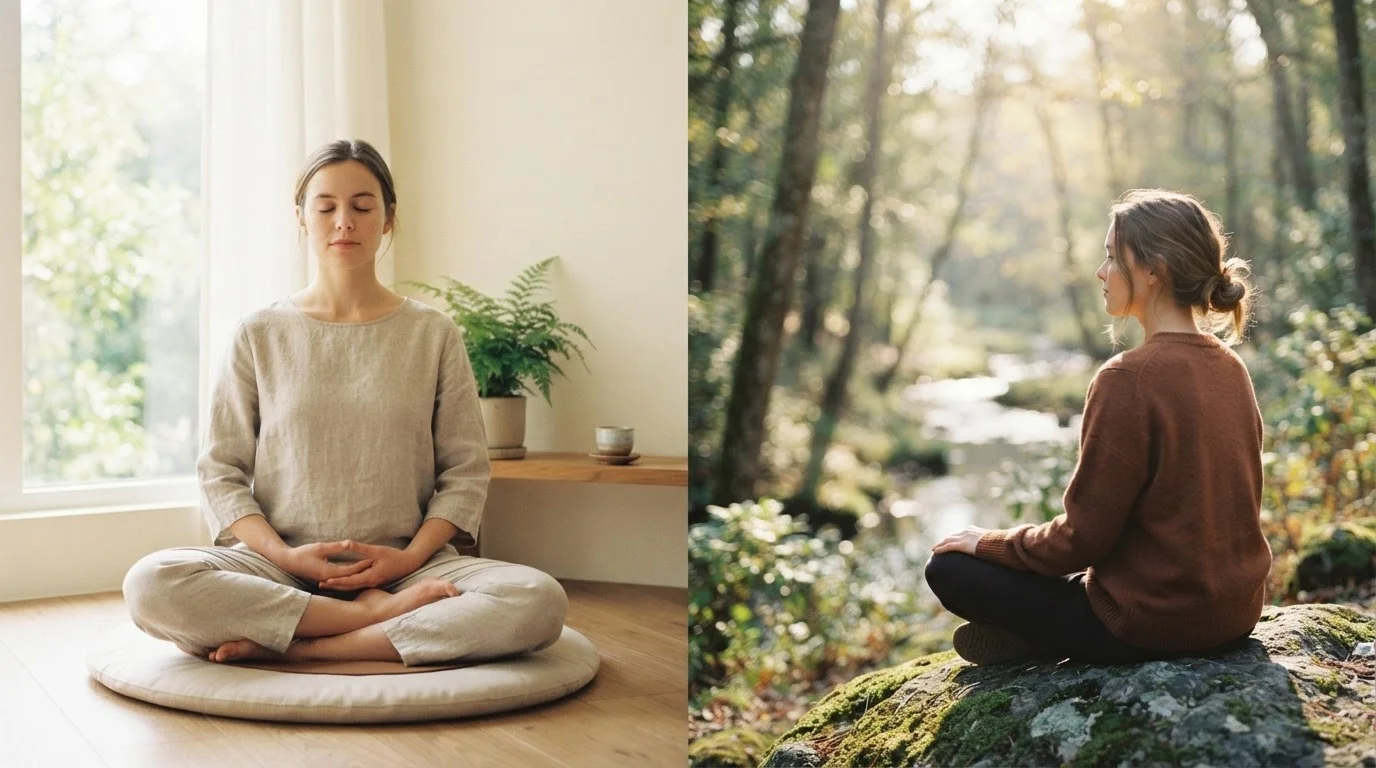
Option A
Mindfulness
A quality of awareness you can bring to any moment.
Best for: People who want to reduce stress and improve focus throughout daily life without setting aside dedicated practice time.
Option B
Meditation
A structured practice for training attention and awareness.
Best for: People ready to commit to a regular, intentional practice session to build mental skills over time.
Two Terms, One Common Mix-Up
Walk into almost any wellness conversation and you'll hear mindfulness and meditation used as if they mean the same thing. They don't - though they are closely related, which is exactly why the confusion persists.
Understanding the distinction isn't just semantic. Knowing what each term actually describes helps you choose an approach that fits your life, your schedule, and what you're hoping to get out of it. For a broader look at commonly misused wellness language, see our plain-language guide to mental health terms.
Mindfulness is a quality of attention - a way of being present, aware, and non-judgmental about your current experience. It's not something you do at a specific time; it's something you can bring to any moment: a conversation, a meal, a commute.
Meditation, by contrast, is a deliberate practice. It's a structured activity you set time aside for, with the specific goal of training your mind - often (but not always) using mindfulness as the mechanism.
How They Differ in Practice
The easiest way to grasp the difference is this: mindfulness is an ingredient; meditation is a recipe that often calls for it.
| Criterion | Mindfulness | Meditation |
|---|---|---|
| What it is | A mental state or quality of attention | A structured, intentional practice |
| When it happens | Anytime, woven into daily activities | During a dedicated session |
| Time required | No extra time needed | Typically 10-45 minutes per session |
| Setting | Anywhere - office, kitchen, outdoors | Usually quiet, designated space |
| Techniques involved | Observation, non-judgment, presence | Breath focus, body scan, mantra, visualization |
| Learning curve | Accessible immediately with guidance | Improves meaningfully with consistent practice |
Consider mindful eating - paying full attention to taste, texture, and hunger cues without distraction. That's mindfulness, and it requires no formal session. Now consider a 20-minute seated body scan, where you systematically bring awareness to different parts of your body. That's meditation - and it also uses mindfulness as its core tool.
Not all meditation is mindfulness-based, either. Transcendental meditation uses repeated mantras. Loving-kindness meditation focuses on cultivating compassion. Visualization practices direct the mind toward specific mental imagery. Each is a legitimate meditative form that operates quite differently from mindfulness-based approaches.
What the Research Generally Shows
Both practices have accumulated a meaningful body of research, though the quality of studies varies and results differ by individual, condition, and technique.
8 weeks
Duration of standard MBSR programs
Mindfulness-Based Stress Reduction courses, developed at UMass Medical School, typically run eight weeks and combine formal meditation with daily mindfulness practice.
~38%
U.S. adults who have tried meditation
National Center for Health Statistics data indicates meditation use among American adults has grown substantially over the past decade.
Modest
Effect size for anxiety reduction
A widely cited meta-analysis in JAMA Internal Medicine found mindfulness meditation programs produced modest improvements in anxiety, depression, and pain measures.
Mindfulness-Based Stress Reduction (MBSR), an eight-week structured program developed at the University of Massachusetts Medical School, has been among the most studied mindfulness interventions. It incorporates formal meditation sessions alongside mindfulness skills applied to daily life - a useful illustration of how the two work together rather than in competition.
Research published in journals including JAMA Internal Medicine and Psychological Science suggests that regular mindfulness meditation may modestly improve symptoms of anxiety, depression, and pain. However, experts caution that effect sizes vary, and mindfulness is not a replacement for evidence-based clinical treatment when a mental health condition is present. If you're navigating stress or anxiety, our article on the difference between anxiety and stress may also be useful context.
This article is for general informational purposes only and does not constitute medical or mental health advice. Always consult a qualified healthcare provider for concerns about your mental or physical health.
Choosing What Works for You
There's no single right answer - and you don't have to choose one exclusively. Many people find that starting with small mindfulness habits (pausing before meals, taking three deliberate breaths before a meeting) lowers the barrier to eventually trying formal meditation.
If you're drawn to meditation but unsure where to begin, comparing meditation and deep breathing can help you find a starting point that matches your comfort level and lifestyle.
For those dealing with diagnosed mental health conditions, neither mindfulness nor meditation substitutes for professional care. Speaking with a therapist, counselor, or psychiatrist is an important first step. Our overview of therapy, counseling, and psychiatry explains what each type of professional does and how to find the right fit.
The most effective practice is simply the one you'll actually do - consistently, without pressure, and with realistic expectations about what it can offer.
The content on this site is provided for informational purposes only and should not be considered a substitute for professional advice. While we strive to provide accurate and up-to-date information, we make no guarantees regarding its completeness or accuracy. Always consult a qualified professional for advice specific to your circumstances before making any decisions.