

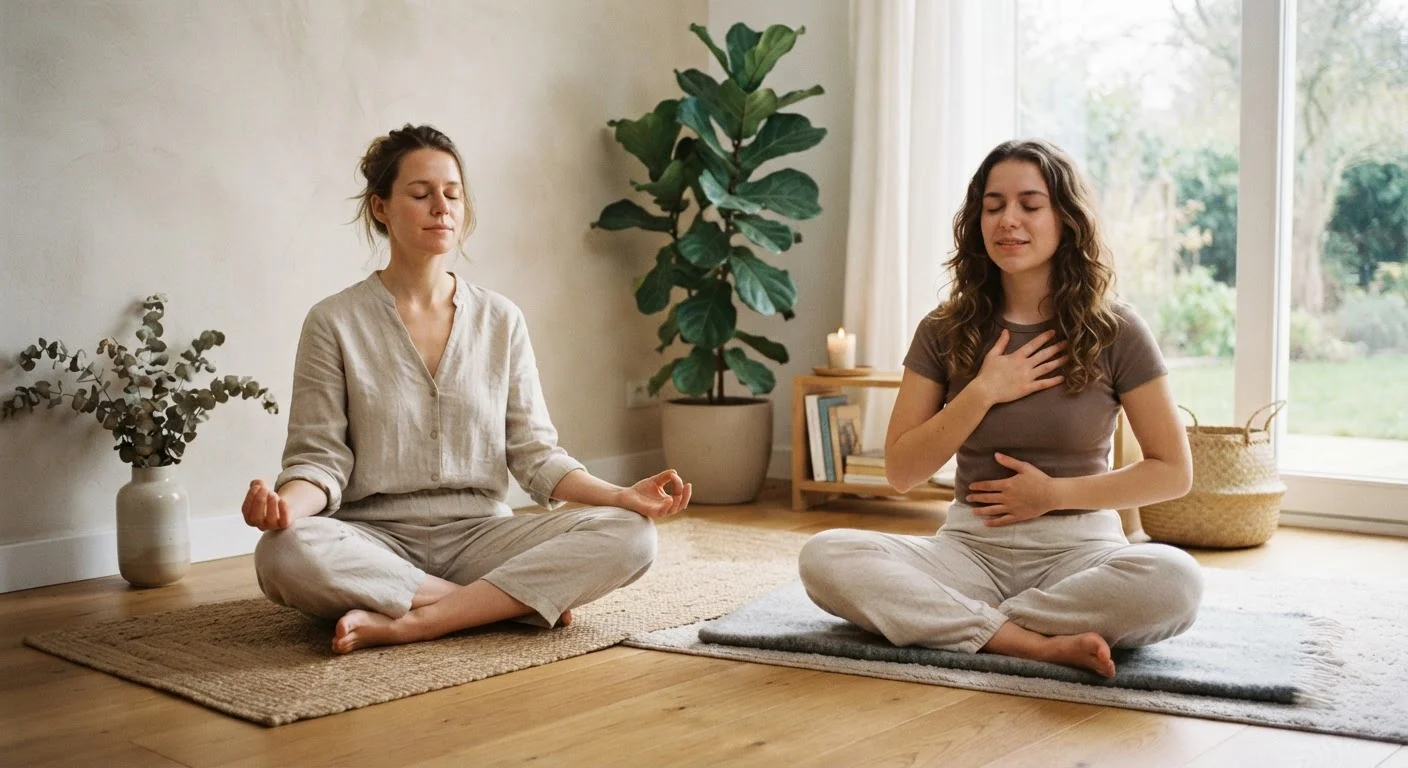
Option A
Meditation
The mind-training practice for long-term resilience.
Best for: People who want to build sustained mental clarity, emotional regulation, and a deeper relationship with their thoughts over time.
Option B
Deep Breathing
The fast-acting physiological reset.
Best for: People who need immediate, in-the-moment stress or anxiety relief with a simple, accessible technique they can use anywhere.
How Each Practice Works
Meditation and deep breathing both reduce stress, but they operate through distinct mechanisms. Understanding those differences helps you choose the right tool - or combine both effectively.
Deep breathing works primarily through the autonomic nervous system. When you breathe slowly and deliberately - typically extending the exhale longer than the inhale - you stimulate the vagus nerve and activate the parasympathetic ("rest and digest") response. This counteracts the body's fight-or-flight state, lowering heart rate and reducing the physical symptoms of acute stress. Techniques like diaphragmatic breathing, box breathing, and the 4-7-8 method all draw on this physiology. The effect is relatively immediate and measurable.
Meditation is a broader mental training practice. Rather than targeting a specific physiological response, it trains sustained attention, non-reactive awareness, and emotional regulation over time. Common forms include focused attention (such as breath-anchored mindfulness), open monitoring, and body scan practices. The stress-reducing benefits of meditation tend to accumulate with regular, consistent practice rather than arriving in a single session. To understand how chronic stress affects the mind and body in the first place, see what chronic stress actually does to your body and mind.
| Criterion | Meditation | Deep Breathing |
|---|---|---|
| Primary mechanism | Mental attention training | Autonomic nervous system regulation |
| Speed of effect | Builds over weeks of practice | Can work within minutes |
| Ease for beginners | Moderate learning curve | Very accessible, minimal learning required |
| Best use case | Long-term stress resilience | Acute, in-the-moment stress relief |
| Time commitment | 10-20+ min daily recommended | 1-5 minutes is often effective |
| Research support | Strong, with some study limitations | Well-established physiological evidence |
| Can be done anywhere | Easier in quiet, dedicated spaces | Yes, discreetly in most settings |
What the Research Suggests
Both practices have meaningful scientific support, though the quality and scope of evidence vary.
Deep breathing research is well-established in clinical and laboratory settings. Studies have consistently demonstrated that slow-paced breathing reduces markers of physiological stress - including blood pressure, cortisol levels, and heart rate variability - in both healthy individuals and those with stress-related conditions. This makes it one of the most evidence-supported self-regulation techniques available.
Meditation research has grown substantially over the past two decades. Mindfulness-based stress reduction (MBSR), an eight-week structured program developed at the University of Massachusetts Medical School, has been studied extensively. Research published in peer-reviewed journals suggests MBSR can reduce perceived stress, improve emotional regulation, and may produce measurable changes in brain regions associated with attention and self-awareness. However, researchers note that study quality varies and more rigorous large-scale trials are still needed.
8 weeks
Typical MBSR program duration studied in stress research
The Mindfulness-Based Stress Reduction program developed at UMass Medical School has been the basis for numerous published stress and well-being studies.
~6 breaths/min
Slow breathing pace linked to parasympathetic activation
Research in autonomic neuroscience suggests paced breathing around six cycles per minute is particularly effective at increasing heart rate variability and reducing stress markers.
~77%
U.S. adults reporting physical symptoms of stress
According to the American Psychological Association's Stress in America surveys, a large majority of U.S. adults report experiencing physical or emotional symptoms related to stress.
It is worth noting that meditation and mindfulness are related but not identical concepts. For a clear breakdown of how they differ, see how mindfulness and meditation compare.
Practical Considerations: Time, Skill, and Situation
Choosing between these practices often comes down to your schedule, goals, and current stress level.
Deep breathing has a low barrier to entry. No apps, no quiet rooms, no prior training are required - though all of these can enhance the experience. A person can begin using box breathing (inhale for four counts, hold for four, exhale for four, hold for four) within minutes of learning it. This makes it particularly useful in real-time stressful situations: before a difficult conversation, during a commute, or in a moment of overwhelm at work.
Meditation generally requires more upfront investment. Most guidance recommends starting with five to ten minutes daily and building from there, with meaningful benefits typically emerging after weeks of consistent practice. The learning curve can feel frustrating for beginners, especially those whose minds wander frequently - which is normal and not a sign of failure. Many people find guided audio sessions or structured programs helpful during the early stages.
If you tend to suppress or avoid stressful feelings rather than address them, research suggests that approach often backfires - making either of these practices a healthier alternative worth exploring.
When Stress May Signal Something More
Persistent stress that interferes with daily functioning, sleep, or relationships may overlap with anxiety or other mental health conditions. Stress and anxiety share symptoms but have distinct causes and implications. Understanding the difference matters for getting appropriate support - learn how stress and anxiety differ. Always speak with a licensed mental health professional if you are unsure.
This article is for general informational purposes only and does not constitute medical or mental health advice. If you are experiencing significant or persistent stress, anxiety, or related symptoms, please consult a qualified healthcare professional.
The content on this site is provided for informational purposes only and should not be considered a substitute for professional advice. While we strive to provide accurate and up-to-date information, we make no guarantees regarding its completeness or accuracy. Always consult a qualified professional for advice specific to your circumstances before making any decisions.