

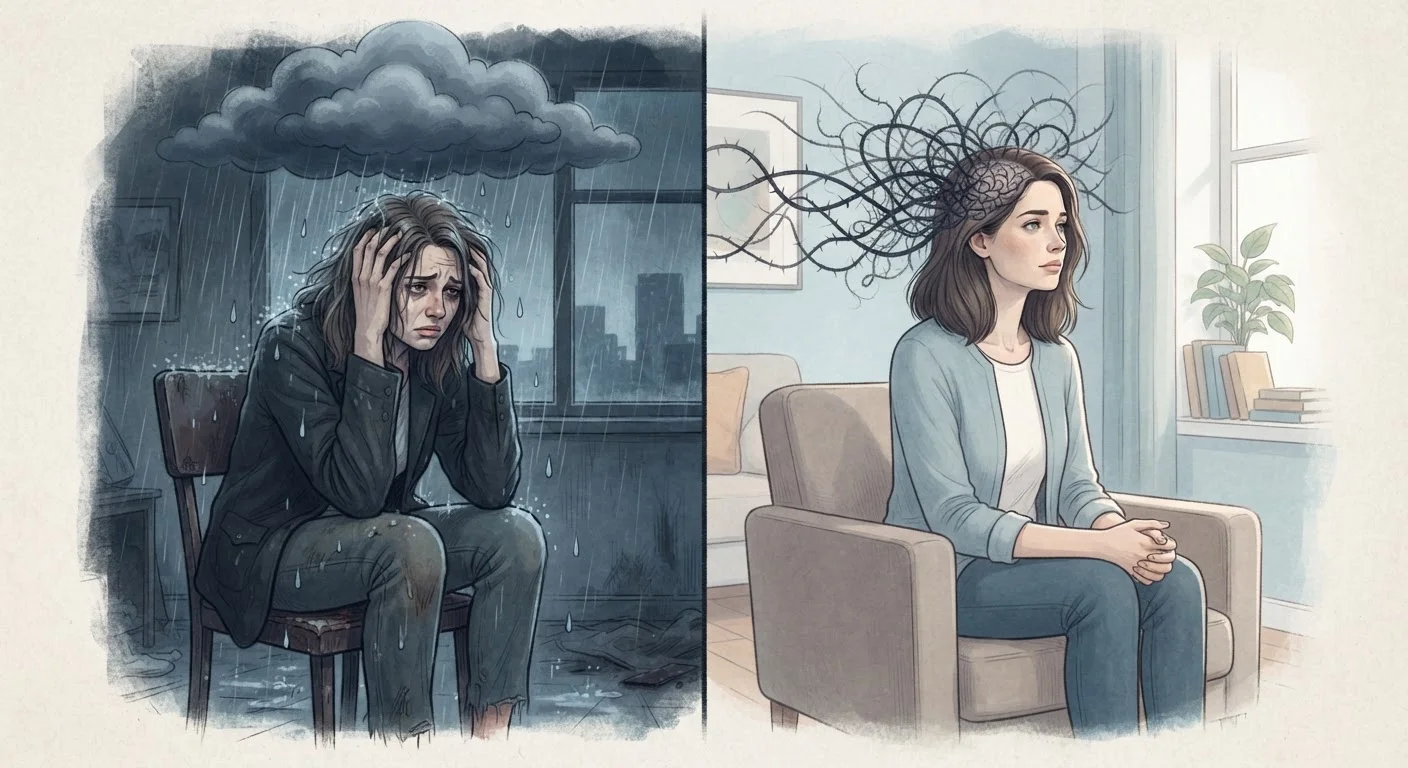
Option A
Stress
The external-trigger response.
Best for: Understanding a time-limited reaction to identifiable pressures - work deadlines, financial strain, or major life changes.
Option B
Anxiety
The internal, often persistent worry state.
Best for: Recognizing when worry or fear persists beyond an identifiable cause and may signal a condition worth evaluating with a professional.
The Core Difference: Source vs. State
Stress and anxiety can feel nearly identical in the moment - racing heart, tight chest, trouble sleeping. But the distinction between them matters, both for understanding your own experience and for finding the right kind of support.
Stress is generally a response to an external pressure. A looming deadline, a difficult conversation, or a sudden financial setback can all trigger the body's stress response. When the stressor goes away, the physical and emotional tension typically eases with it. Stress, in this sense, is a normal and even adaptive part of human biology - it signals that something in your environment requires attention.
Anxiety is a more internal state. It often involves fear or worry that is disproportionate to, or entirely disconnected from, any specific external cause. Where stress asks "What do I need to do about this?", anxiety tends to ask "What if something goes wrong?" - and keeps asking, even when no real threat is present. When anxiety is persistent, difficult to control, and begins to interfere with daily life, it may meet the criteria for an anxiety disorder as defined by the DSM-5.
According to the National Institute of Mental Health, anxiety disorders are among the most common mental health conditions in the United States, affecting approximately 19% of adults in any given year. That prevalence makes it all the more important that people can distinguish between temporary stress and something more durable.
Overlapping Symptoms and Why They Confuse Us
Part of what makes stress and anxiety so easy to conflate is that they activate many of the same biological systems. Both trigger the body's fight-or-flight response, releasing hormones such as adrenaline and cortisol. The result is a recognizable cluster of symptoms that can appear in both states:
- Muscle tension and headaches
- Disrupted sleep or insomnia
- Difficulty concentrating
- Irritability or emotional reactivity
- Racing thoughts or mental restlessness
The key distinguishing factor is usually duration and context. Stress symptoms tend to map onto specific circumstances and recede when those circumstances change. Anxiety symptoms often persist or reappear without a clear trigger - and the worry itself can become its own source of distress.
It is also worth noting that chronic, unmanaged stress can transition into anxiety over time. What chronic stress does to your body and mind goes beyond mood - it can reshape brain chemistry and hormone regulation in ways that create fertile ground for anxiety to develop.
| Criterion | Stress | Anxiety |
|---|---|---|
| Primary trigger | Identifiable external pressure | Internal; often no clear cause |
| Duration | Resolves when stressor is removed | Persists beyond the trigger |
| Core feeling | Overwhelmed, pressured | Fearful, worried, apprehensive |
| Physical symptoms | Tension, fatigue, disrupted sleep | Similar, plus frequent panic or dread |
| Clinical classification | Not a diagnosable disorder itself | Can meet DSM-5 disorder criteria |
| Common management approaches | Lifestyle changes, coping strategies | Therapy, medication, lifestyle support |
When to Seek Professional Support
Self-awareness is a useful starting point, but it has limits - especially with mental health. Neither stress nor anxiety should be assessed in isolation from a professional, particularly when symptoms are severe, prolonged, or affecting how you function day to day.
Some signals worth taking seriously include:
- Worry that feels uncontrollable or all-consuming
- Panic attacks or sudden, intense fear episodes
- Avoidance of ordinary situations due to fear
- Physical symptoms with no identified medical cause
- Sleep disruption lasting more than a few weeks
Signs that stress has crossed into something that needs attention offers a more detailed look at when professional evaluation becomes the appropriate next step.
For context around common misconceptions that may delay people from seeking help, common myths about anxiety clarifies what the evidence actually shows versus widely repeated assumptions.
19%
U.S. adults with an anxiety disorder annually
According to the National Institute of Mental Health, nearly one in five American adults experiences an anxiety disorder in any given year.
~33%
Adults affected by an anxiety disorder at some point in their lifetime
Research published in estimates suggest lifetime prevalence of any anxiety disorder among U.S. adults may be as high as one in three, based on epidemiological survey data.
This article is for general informational purposes only and does not constitute medical or mental health advice. If you are experiencing symptoms that concern you, please consult a qualified healthcare professional.
The content on this site is provided for informational purposes only and should not be considered a substitute for professional advice. While we strive to provide accurate and up-to-date information, we make no guarantees regarding its completeness or accuracy. Always consult a qualified professional for advice specific to your circumstances before making any decisions.