

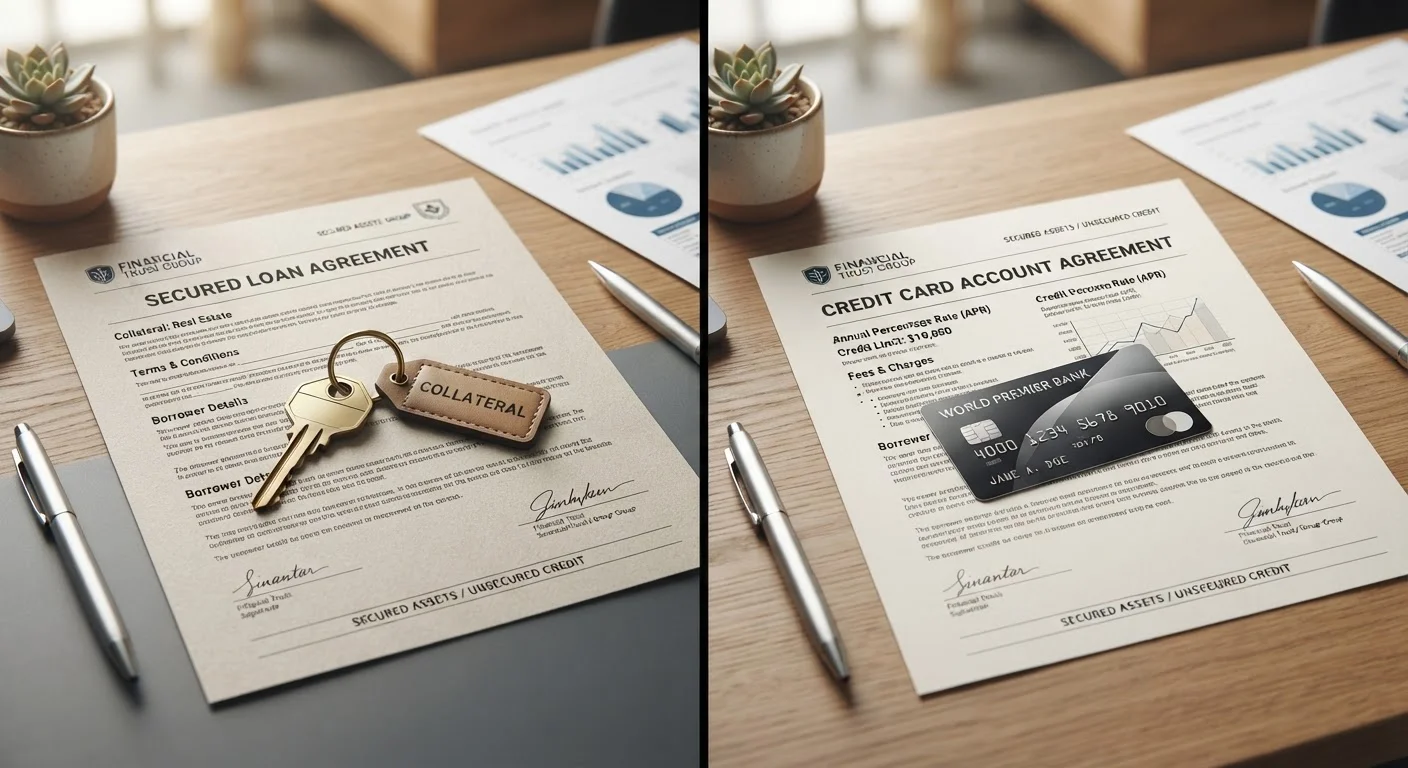
Option A
Secured Debt
Collateral-backed borrowing with lower rates and higher stakes.
Best for: Borrowers financing major assets like a home or vehicle who can tolerate the risk of losing that asset if they default.
Option B
Unsecured Debt
Credit extended on creditworthiness alone - no collateral required.
Best for: Borrowers who need flexible financing without pledging property, and who can manage typically higher interest rates.
The Core Distinction: What Makes Debt Secured or Unsecured
At its most basic, the difference between secured and unsecured debt comes down to one question: is there an asset backing the loan?
With secured debt, the borrower pledges a specific asset - called collateral - as a guarantee to the lender. If the borrower stops making payments, the lender has a legal right to seize that asset to recover what it's owed. Mortgages and auto loans are the clearest examples: the home or vehicle itself serves as collateral. This arrangement reduces the lender's risk, which is why secured loans typically carry lower interest rates.
With unsecured debt, no collateral is pledged. The lender extends credit based solely on the borrower's creditworthiness - factors like credit score, income, and debt-to-income ratio. Credit cards, personal loans, medical bills, and student loans are common examples. Because the lender has no specific asset to claim if you default, it takes on more risk and typically charges higher interest rates in return.
This single distinction - collateral versus no collateral - has significant consequences for how lenders price debt, what happens when borrowers default, and how repayment strategies should be prioritized. If you're just starting to navigate credit, this foundational guide covers the essentials without assuming prior financial knowledge.
| Criterion | Secured Debt | Unsecured Debt |
|---|---|---|
| Collateral required | Yes - asset pledged to lender | No - based on creditworthiness |
| Typical interest rates | Generally lower | Generally higher |
| Common examples | Mortgages, auto loans, HELOCs | Credit cards, personal loans, medical bills |
| Lender remedy on default | Repossession or foreclosure | Collections, lawsuits, wage garnishment |
| Speed of consequence on default | Relatively fast (legal process) | Slower - escalates over time |
| Risk to borrower's assets | Immediate - specific asset at risk | Indirect - potential judgment liens later |
| Eligibility requirements | Must own or purchase eligible asset | Credit score and income-based |
What Happens When You Default: Different Consequences, Different Urgency
Both types of debt can seriously damage your credit score if you miss payments. But the immediate consequences differ considerably.
When you default on secured debt, the lender's primary remedy is reclaiming the collateral. Miss enough mortgage payments and the lender can initiate foreclosure. Stop paying your auto loan and the vehicle can be repossessed - sometimes with very little notice. These outcomes can be financially devastating and are difficult to reverse once the legal process begins.
When you default on unsecured debt, lenders cannot immediately seize property. Instead, they typically pursue collection efforts: phone calls, collection agencies, and eventually civil lawsuits. If a court issues a judgment against you, a lender may then be able to garnish wages or place a lien on property. This process is slower, but the credit damage and legal exposure are still serious.
~$17.5T
Total U.S. household debt
According to Federal Reserve Bank of New York data, total U.S. household debt has exceeded $17 trillion, with mortgage debt comprising the largest secured component.
~20%+
Average credit card APR
The Federal Reserve has reported average credit card interest rates exceeding 20% annually in recent years, illustrating the cost premium on unsecured revolving debt.
1 in 13
Mortgages entering foreclosure historically
During the 2008-2010 financial crisis, roughly 1 in 13 U.S. mortgages was delinquent or in foreclosure, underscoring the real consequences of secured debt default.
This asymmetry matters when you're prioritizing which bills to pay during a financial hardship. Many financial professionals recommend keeping secured debt payments current first - losing a home or car creates immediate, compounding hardship that's harder to recover from than a damaged credit score alone. For guidance on restructuring what you owe, see our explainer on debt consolidation mechanics and realistic expectations.
Practical Implications for Borrowers: Interest Rates, Eligibility, and Strategy
Understanding your debt mix isn't just academic - it shapes the strategies available to you.
Interest rates: Secured debts generally carry lower rates because the lender's risk is lower. A 30-year mortgage might carry an interest rate several percentage points below what a personal loan or credit card charges. That gap has a significant effect on total cost over time.
Eligibility and access: Secured loans require owning (or purchasing) an eligible asset, so they're not always available in every situation. Unsecured credit is more flexible but harder to obtain - or more expensive - for borrowers with limited credit history. Secured vs. unsecured credit cards represent a useful entry point for borrowers building or rebuilding credit.
Repayment strategy: When working toward becoming debt-free, many people use either the avalanche method (paying highest-interest debt first) or the snowball method (smallest balances first). Either approach should account for the collateral risk attached to secured debts - falling behind on a mortgage while aggressively eliminating credit card debt could create a far worse crisis. If you're weighing how to deploy extra funds between a credit card balance and a personal loan, compare both paths in our personal loan vs. balance transfer breakdown.
This article provides general financial education and is not personalized financial or legal advice. Consult a qualified financial professional for guidance specific to your situation.
The content on this site is provided for informational purposes only and should not be considered a substitute for professional advice. While we strive to provide accurate and up-to-date information, we make no guarantees regarding its completeness or accuracy. Always consult a qualified professional for advice specific to your circumstances before making any decisions.