

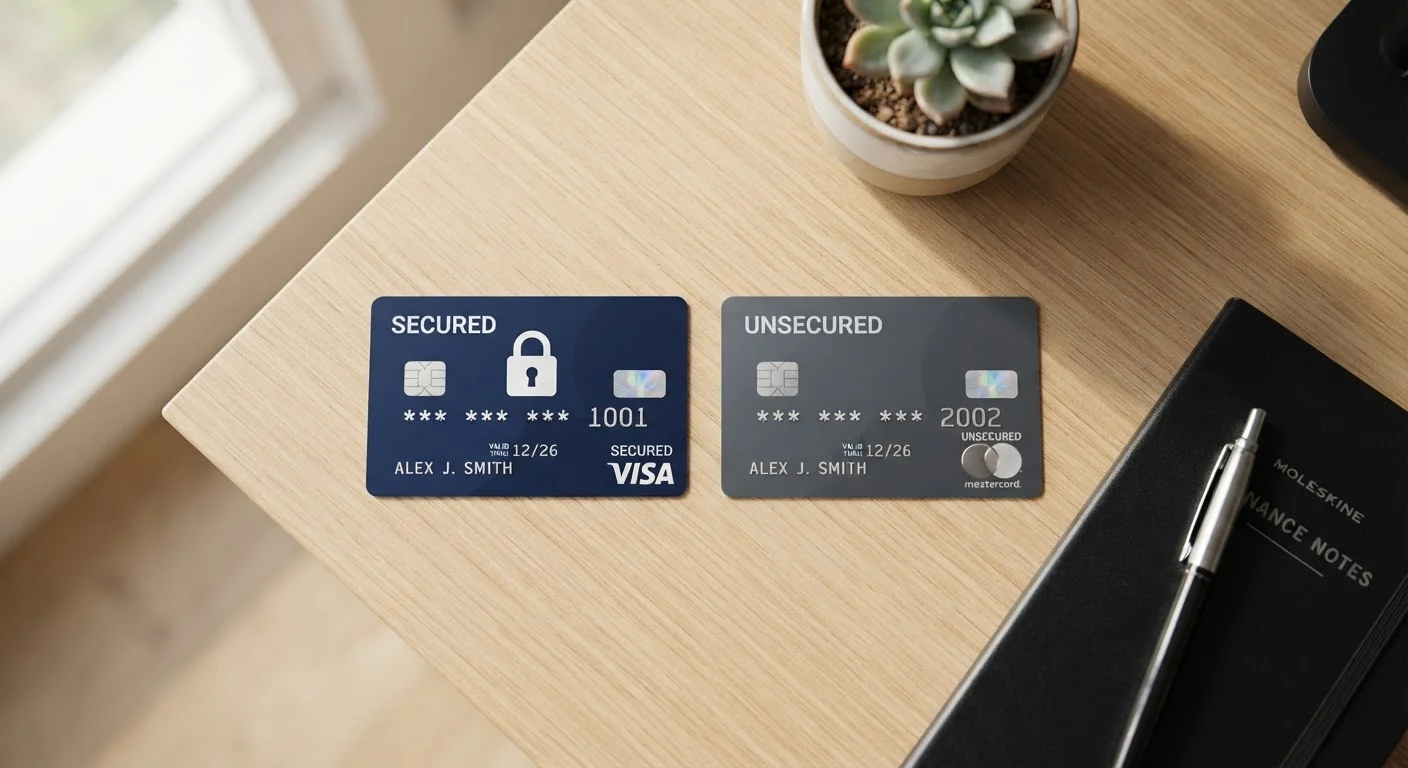
Our Verdict
Secured cards are generally the more accessible starting point for people with no credit history or damaged credit, since approval depends on a deposit rather than a strong credit profile. Unsecured credit-builder cards can work well for those who cannot tie up cash in a deposit, but they often come with higher fees that erode value. Either route, used responsibly, can produce meaningful credit score improvement within 12 months.
| Best for | Recommended |
|---|---|
| Those with no credit history or past credit damage | Secured card |
| Readers who cannot afford to lock up a cash deposit | Unsecured credit-builder card |
| Those who want a clear path to upgrading without a new application | Secured card with upgrade program |
How Each Card Type Actually Works
A secured credit card requires you to place a refundable cash deposit with the issuer - commonly between $200 and $500 - before the account opens. That deposit typically sets your credit limit dollar-for-dollar. Because the issuer holds collateral, they face far less risk, which is why secured cards are available to applicants with thin or damaged credit files.
An unsecured credit card requires no deposit. For people with established credit, that's standard. But lenders also market unsecured cards specifically to credit-builders - applicants with limited or poor histories. These cards are approved based on income, identity verification, and other factors rather than a deposit. The trade-off is that issuers compensate for higher risk through elevated annual fees or lower starting limits.
To understand why this distinction matters beyond your wallet, see our explainer on secured versus unsecured debt more broadly.
| Secured Card | Unsecured Credit-Builder Card | |
|---|---|---|
| Deposit required | Yes - typically $200-$500 | No deposit needed |
| Approval difficulty | Low - deposit reduces lender risk | Moderate - income/identity based |
| Typical annual fees | Low to moderate | Low to high (varies widely) |
| Reports to credit bureaus | Yes, all three major bureaus | Yes, if issuer reports to all three |
| Path to unsecured card | Upgrade program - no new application | Already unsecured; apply for better card later |
| Deposit recovery | Full refund on upgrade or closure | N/A - no deposit held |
| Credit limit flexibility | Tied to deposit amount | Set by issuer; often low initially |
Credit-Building Mechanics: Are They Equal?
From a credit-scoring standpoint, both card types are functionally identical. Major issuers for both categories report your account activity - payment history, credit limit, balance, and account age - to the three major credit bureaus (Equifax, Experian, and TransUnion). The bureaus do not distinguish between secured and unsecured when calculating your score.
What actually moves your score is behavior, not card type. The two highest-impact factors under the FICO model are payment history (roughly 35% of your score) and credit utilization - your balance as a percentage of your limit (roughly 30%). Keeping utilization below 30% of your limit and paying the full statement balance on time each month are the core actions that build credit, regardless of which card sits in your wallet.
Keep Utilization Low on a Small Limit
Credit-builder cards often come with limits of $200-$500, which makes utilization management critical. A $150 balance on a $300 limit is 50% utilization - well above the generally recommended 30% threshold. Consider making a mid-cycle payment to bring the reported balance down before your statement closes each month.
If you're new to managing card statements and interest, our guide to getting your first credit card without falling into debt covers the mechanics in detail.
Costs, Fees, and the Deposit Question
Cost structure is where the two card types diverge most sharply. Secured cards generally charge modest annual fees, and the deposit is not a fee - it remains your money and is returned when you close or graduate the account in good standing. That graduation path is a genuine advantage: many issuers will convert a secured account to an unsecured one after 12 to 18 months of responsible use, often refunding your deposit automatically.
Unsecured credit-builder cards can carry annual fees that range from low to surprisingly high, and sometimes include monthly maintenance charges. Because there is no deposit to recover, the total cost of carrying such a card for a year can exceed what a secured card would cost when you account for these fees. Always calculate the annualized cost before choosing.
Interest rates (APR) on both card types tend to be higher than mainstream credit cards, so carrying a balance is expensive. Paying your statement balance in full each month eliminates interest charges entirely and is the financially sound approach for credit-builders. Many common misconceptions about balances and credit scores are addressed in our article on credit myths that keep people from improving their scores.
Choosing the Right Card and Planning Your Next Step
If you can set aside the deposit, a secured card from a reputable issuer - especially one with a clear upgrade program - is often the more cost-efficient path. You preserve the option to recover your deposit, and you avoid the higher recurring fees that sometimes accompany unsecured credit-builder products.
If the deposit genuinely isn't feasible, an unsecured credit-builder card can still accomplish the goal. Compare total annual costs carefully, and check whether the issuer reports to all three bureaus - some smaller issuers do not, which limits the scoring benefit.
Either way, before you focus on which card to carry, it helps to audit your existing credit profile. Check these things before you try to raise your credit score - errors on your report, for instance, can suppress your score independent of any card strategy.
Once your score improves, you may face a different kind of decision: managing existing debt alongside new credit. Our comparison of personal loans versus balance transfers can help when that stage arrives.
This article is for general informational and educational purposes only and does not constitute personalized financial or credit advice. Consult a qualified financial professional regarding decisions specific to your situation.
The content on this site is provided for informational purposes only and should not be considered a substitute for professional advice. While we strive to provide accurate and up-to-date information, we make no guarantees regarding its completeness or accuracy. Always consult a qualified professional for advice specific to your circumstances before making any decisions.