

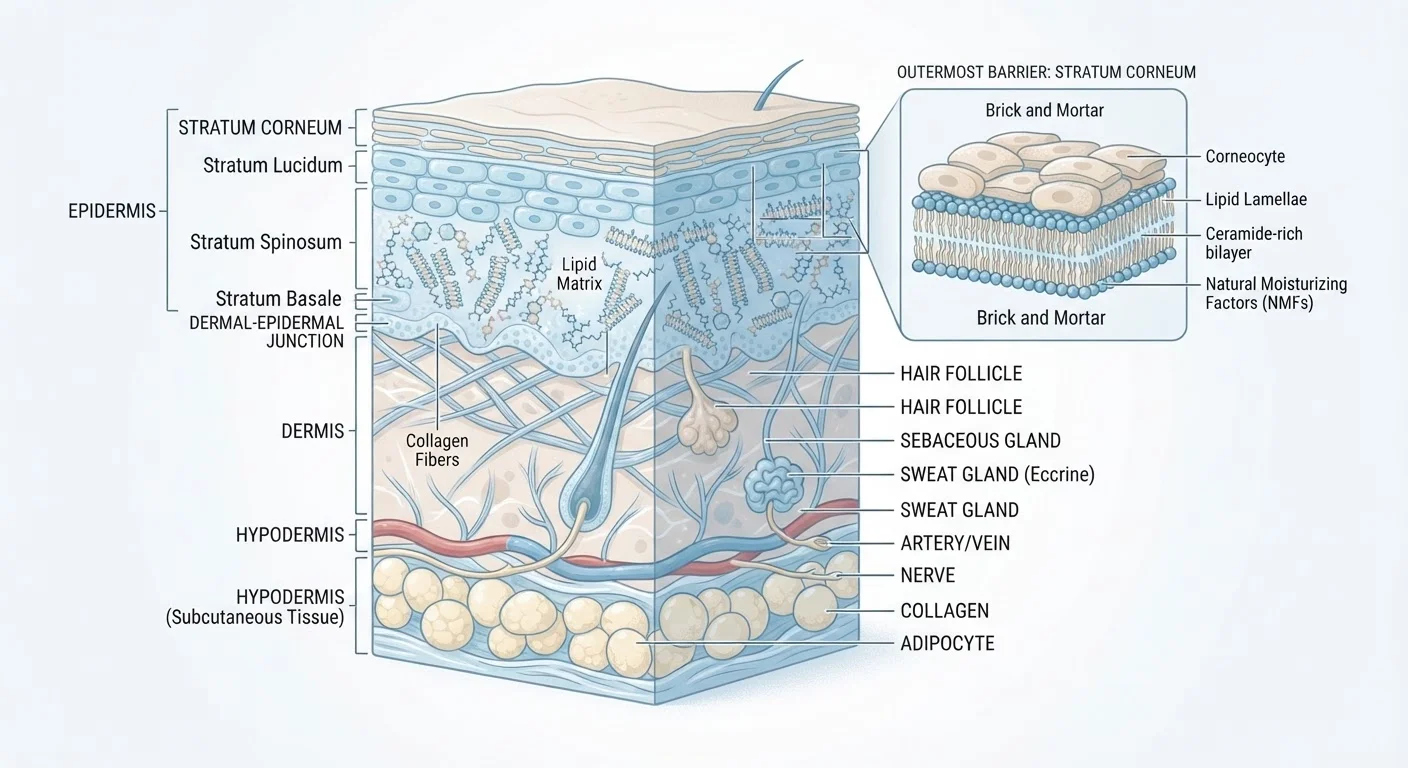
The Brick-and-Mortar Structure of Your Skin
Your skin has several layers, but the one doing the heavy lifting in daily protection is the outermost: the stratum corneum. Dermatologists often describe it using a brick-and-mortar analogy. Flattened, dead skin cells called corneocytes are the bricks, stacked in overlapping rows. Between them sits a matrix of lipids - primarily ceramides, cholesterol, and free fatty acids - that functions as the mortar, sealing the structure together.
This arrangement isn't random. The tight packing of cells and lipids creates a semi-permeable membrane: it lets very little water escape and blocks most external aggressors from getting in. Without this architecture functioning correctly, skin struggles to hold moisture and becomes far more reactive to everyday exposures.
~15-20 layers
Thickness of the stratum corneum in cells
Despite being only about 10-20 micrometers thick, the stratum corneum is the primary line of defense against environmental stressors, according to dermatological anatomy research.
3 lipids
Core lipids that form the skin barrier matrix
Ceramides, cholesterol, and free fatty acids are present in roughly equal proportions in a healthy skin barrier, a ratio that shifts when the barrier is damaged.
~28 days
Average skin cell turnover cycle in adults
The skin naturally renews itself approximately every four weeks, though this process slows with age, affecting how quickly barrier damage can be repaired.
What Disrupts the Skin Barrier - and How to Recognize It
Barrier disruption is remarkably common, and the triggers are often things considered normal parts of a skincare routine. Over-cleansing with harsh or foaming cleansers strips away the lipid layer. Using multiple potent actives - retinoids, vitamin C, AHAs, and BHAs simultaneously - can overwhelm the skin's ability to repair itself. Environmental factors like very cold air, low humidity, and UV exposure also degrade barrier integrity over time.
The signs of a compromised barrier include tightness, stinging or burning when applying previously tolerated products, visible flaking, persistent redness, and a sudden increase in breakouts or sensitivity. If your skin feels reactive to almost everything, that's a meaningful signal worth taking seriously. For a closer look at which ingredients in common products work with or against the barrier, dermatology clears up a lot of the confusion.
Less Is Often More for a Stressed Barrier
If your skin is feeling reactive or sensitive, consider pausing retinoids, exfoliants, and vitamin C serums temporarily. A stripped-back routine of a gentle cleanser, barrier-supportive moisturizer, and SPF gives your skin the breathing room it needs to recover. Reintroduce actives one at a time and gradually.
How to Support Your Skin Barrier With Your Routine
Supporting the skin barrier doesn't require an elaborate regimen - in fact, simplicity often wins. The core principles are: cleanse gently, moisturize consistently, and protect from UV damage. A mild, low-pH cleanser preserves more of the lipid layer than a stripping foam. A moisturizer that contains ceramides, cholesterol, and fatty acids helps replenish exactly what the barrier is made of, rather than just sitting on top of it. Understanding how humectants, emollients, and occlusives work together makes it much easier to choose products that actually help.
Each step in a basic routine has a specific role in maintaining barrier health. A plain-language breakdown of what each core skincare step does can help you understand why skipping moisturizer or SPF creates a gap in the system. Broad-spectrum sunscreen, applied daily, reduces the UV-induced lipid degradation that accumulates silently over years.
If your barrier is already feeling compromised, scaling back actives for a period and focusing on a simple moisturize-and-protect approach is a reasonable starting point. A board-certified dermatologist can assess whether an underlying condition like eczema or rosacea is a contributing factor and recommend appropriate treatment.
This article is for general informational and educational purposes only and does not constitute medical advice. Consult a qualified dermatologist or healthcare provider for guidance specific to your skin or any medical condition.
Frequently Asked Questions
Common signs include persistent redness, a tight or stinging sensation after cleansing, flaking, and skin that suddenly reacts to products it previously tolerated. Increased sensitivity to temperature or wind can also be a clue. These symptoms don't confirm a diagnosis - a dermatologist can give you a clearer picture.
Mild barrier disruption can improve within a few days to a couple of weeks with gentle care, though more significant impairment may take longer. There's no universal timeline - factors like skin type, age, and the cause of damage all play a role. Consistency with a simplified routine generally produces the best results.
Ceramides, cholesterol, and fatty acids are the lipids that make up the barrier itself, so look for these in moisturizers. Petrolatum and dimethicone act as occlusives to seal in moisture while healing occurs. Avoid ingredients like high-concentration alcohol (alcohol denat.) or harsh surfactants while the barrier is recovering.
Yes. Exfoliating too frequently - whether with physical scrubs or chemical acids - physically removes the top layers of skin cells and disrupts the lipid matrix. Dermatologists generally recommend limiting exfoliation to a few times per week at most, depending on your skin type and the strength of the product.
The terms are often used interchangeably, and they refer to the same structure. 'Moisture barrier' emphasizes the hydration-retention function, while 'skin barrier' is the broader term covering both moisture retention and protection from external threats.
The content on this site is provided for informational purposes only and should not be considered a substitute for professional advice. While we strive to provide accurate and up-to-date information, we make no guarantees regarding its completeness or accuracy. Always consult a qualified professional for advice specific to your circumstances before making any decisions.