

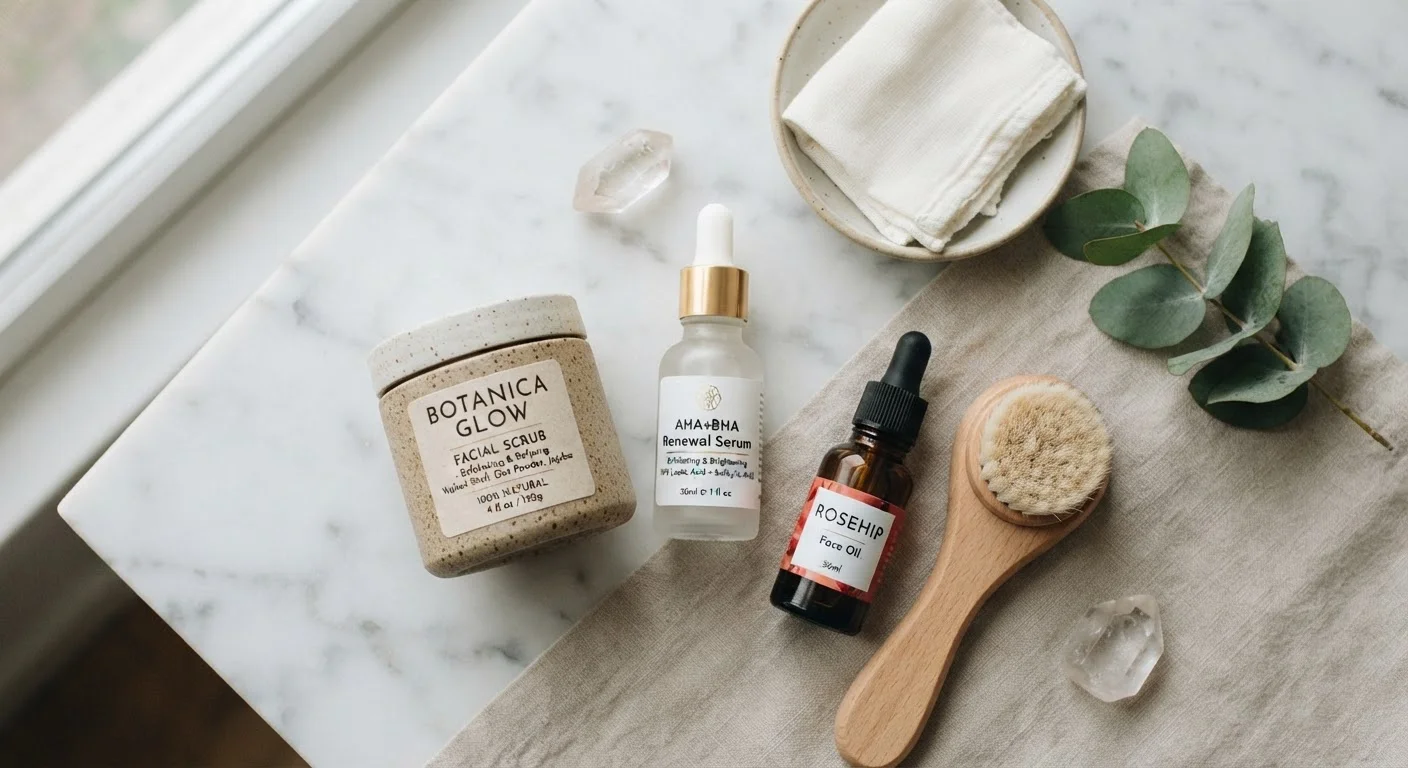
Option A
Chemical Exfoliants (AHAs & BHAs)
The science-backed, skin-type-targeted approach.
Best for: Those dealing with uneven tone, clogged pores, hyperpigmentation, or acne-prone skin who want precise, consistent results.
Option B
Physical Scrubs
The tactile, immediately satisfying classic.
Best for: Those with normal or oily skin seeking a simple, once-or-twice-weekly texture refresh without incorporating liquid acids.
How Each Method Actually Works
Exfoliation - the removal of dead cells from the skin's outermost layer (the stratum corneum) - is one of the most evidence-supported steps in a skincare routine. But not all exfoliation works the same way, and understanding the mechanism helps you choose what's right for your skin.
Chemical exfoliants work by breaking the bonds that hold dead skin cells together. Alpha hydroxy acids (AHAs), such as glycolic and lactic acid, are water-soluble and act on the surface of the skin, making them effective for improving texture, brightness, and mild discoloration. Beta hydroxy acids (BHAs) - most commonly salicylic acid - are oil-soluble, allowing them to move through sebum and exfoliate inside the pore lining, which is why they're widely used for oily and acne-prone skin.
Physical scrubs work through mechanical abrasion: particles in the formula physically dislodge dead cells when rubbed against the skin. Common abrasive ingredients include sugar, salt, rice bran, and finely milled walnut or bamboo. The effectiveness depends heavily on particle size and how much pressure is applied.
For a broader look at where exfoliation fits in your overall routine, see our guide to what each skincare step does.
| Criterion | Chemical Exfoliants | Physical Scrubs |
|---|---|---|
| Mechanism | Dissolves dead cell bonds with acids | Mechanically abrades dead cells |
| Main types | AHAs, BHAs, PHAs | Sugar, salt, rice bran, bamboo |
| Penetration depth | Surface to within pores (BHAs) | Surface only |
| Best for pores | Yes - especially BHAs | Limited pore-clearing ability |
| Sensitivity risk | Irritation if overused or too strong | Microtears if particles too coarse |
| Photosensitivity increase | Yes - especially AHAs | Mild, less documented |
| Learning curve | Moderate - concentration matters | Low - technique is straightforward |
| Suitable for sensitive skin | Yes, with PHAs or low-strength lactic | Generally not recommended |
Risks and Limitations of Each Approach
Neither method is without trade-offs, and dermatological guidance consistently cautions against over-exfoliation with either type.
Physical scrubs carry a well-documented risk of microtearing - microscopic damage to the skin barrier caused by coarse particles or excessive pressure. Scrubs with irregular, jagged particles (such as crushed walnut shells) are more likely to cause this than those with uniform, finely milled abrasives. Over-scrubbing can compromise the skin's moisture barrier, leading to increased sensitivity, redness, and even more breakouts.
Chemical exfoliants, if used too frequently or at too high a concentration, can cause irritation, peeling, and barrier disruption. AHAs in particular increase photosensitivity, making daily SPF use non-negotiable. Starting at a lower concentration and gradually building tolerance is the approach generally recommended by dermatologists.
A Note on Exfoliation and SPF
Both AHAs and physical exfoliation remove the outermost layer of dead skin, leaving fresh, more UV-vulnerable skin exposed. Dermatologists consistently emphasize that daily broad-spectrum SPF 30 or higher is essential whenever you're exfoliating regularly - not just on days you exfoliate. This is one of the most commonly skipped steps, and skipping it can undermine other skincare goals like fading discoloration.
Regardless of which method you choose, exfoliating more than two to three times per week is rarely beneficial for most skin types and can work against your skin's natural repair processes. If you're new to skincare, our beginner's skincare routine guide covers how to layer new steps safely.
Matching the Method to Your Skin
Skin type and specific concerns should drive the choice between chemical and physical exfoliation - and the two aren't mutually exclusive, though layering them requires care.
- Dry or dull skin: Lactic acid (an AHA) is often a good starting point. It exfoliates while also having mild humectant properties, meaning it helps draw moisture into the skin.
- Oily or acne-prone skin: BHAs are generally the more effective option, addressing congestion at the pore level rather than just on the surface.
- Sensitive skin: Polyhydroxy acids (PHAs) are larger-molecule acids that penetrate more slowly and are considered gentler than traditional AHAs - they may be worth exploring if glycolic acid feels too strong.
- Normal or combination skin: Either method can work if used with appropriate frequency and particle size or acid concentration.
Be cautious about combining chemical and physical exfoliation on the same day - this can tip easily into over-exfoliation. Also worth reading: why certain skincare ingredient combinations can backfire, including acids paired with other actives. For body-specific exfoliation guidance, our article on getting body scrub frequency right covers the key considerations.
~28 days
Natural skin cell turnover cycle
Dermatologists generally note that the skin sheds and renews its outer layer approximately every four weeks, a cycle that slows with age.
2-3×/week
Maximum recommended exfoliation frequency
Most dermatological guidance suggests limiting exfoliation to two or three sessions per week to avoid barrier disruption, regardless of the method used.
This article is for general informational purposes only and is not a substitute for professional dermatological advice. If you have a skin condition or persistent concerns, consult a qualified dermatologist.
The content on this site is provided for informational purposes only and should not be considered a substitute for professional advice. While we strive to provide accurate and up-to-date information, we make no guarantees regarding its completeness or accuracy. Always consult a qualified professional for advice specific to your circumstances before making any decisions.