

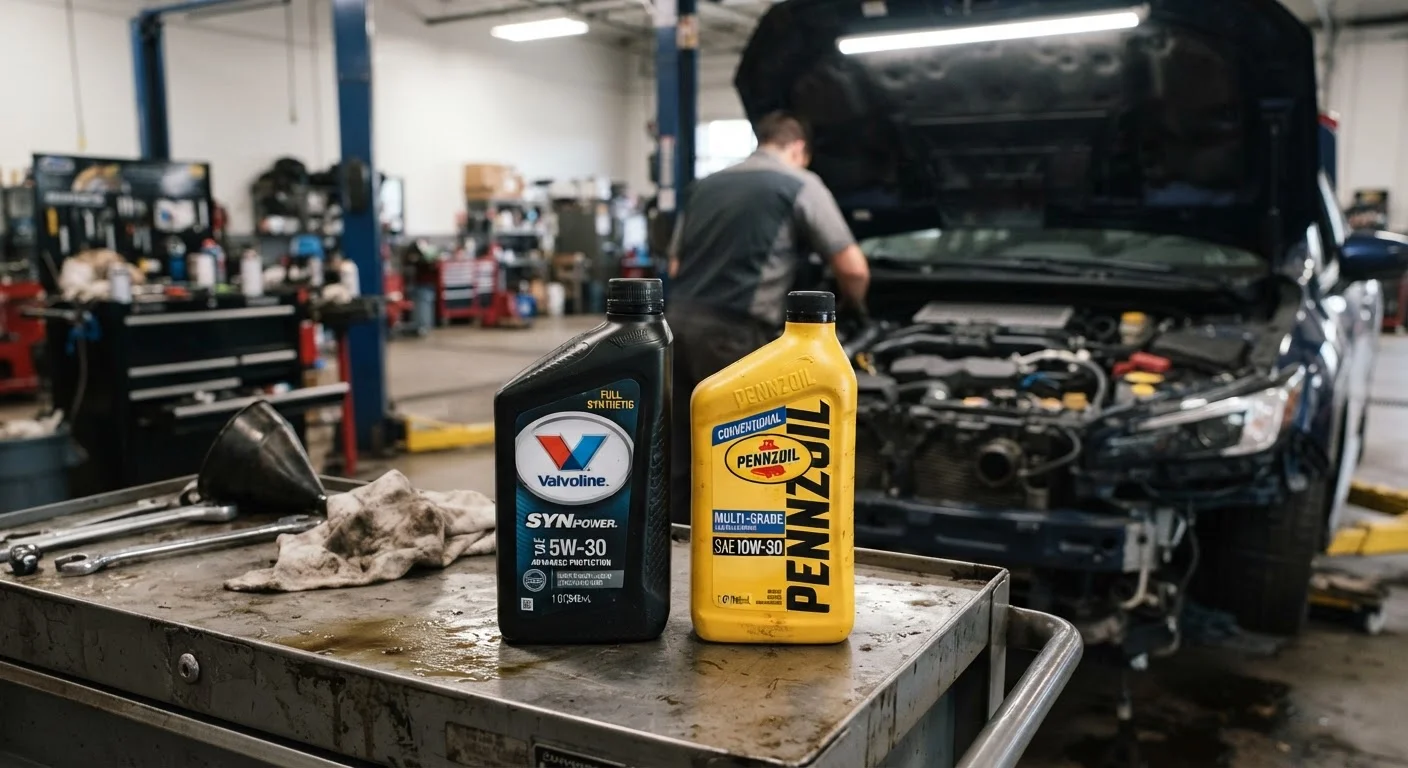
Option A
Synthetic Motor Oil
The engineered, high-performance formulation.
Best for: Drivers who want maximum engine protection, operate in temperature extremes, or have extended oil change intervals specified by their manufacturer.
Option B
Conventional Motor Oil
The time-tested, petroleum-based standard.
Best for: Owners of older or high-mileage vehicles with straightforward driving patterns who follow standard maintenance schedules.
What Makes These Two Oils Fundamentally Different
At the most basic level, both synthetic and conventional motor oil do the same job: lubricate moving engine parts, reduce friction, carry away heat, and suspend contaminants until they reach the oil filter. The difference is in how each oil is made - and how that affects performance under real-world conditions.
Conventional motor oil starts as crude petroleum that is extracted, refined, and blended with additives to meet viscosity and performance standards. The refining process removes many impurities, but the result is still a mixture of hydrocarbon molecules that vary in size and shape. That molecular irregularity has practical consequences: conventional oil breaks down faster under heat and can thicken in cold temperatures more readily than synthetic alternatives.
Synthetic motor oil is chemically engineered - either built from scratch using chemical compounds (fully synthetic) or derived from a base of conventional oil that is then heavily processed (synthetic blend). The molecules in a full synthetic are uniform in size and structure, which translates into more predictable behavior across a wide temperature range and greater resistance to oxidation and thermal breakdown.
| Criterion | Synthetic Motor Oil | Conventional Motor Oil |
|---|---|---|
| Base source | Chemically engineered compounds | Refined crude petroleum |
| Molecule consistency | Uniform, precisely structured | Variable size and shape |
| Cold-weather flow | Flows more freely at low temps | Can thicken in cold conditions |
| Heat resistance | Higher resistance to breakdown | Breaks down faster under heat |
| Typical change interval | 7,500-10,000+ miles (varies) | 3,000-5,000 miles (varies) |
| Cost per quart | Higher upfront cost | Lower upfront cost |
| Turbo engine suitability | Generally required or preferred | Often insufficient for turbo heat |
| Older engine compatibility | Compatible; verify seals first | Standard choice for older engines |
How Each Oil Performs Where It Matters Most
The performance gap between synthetic and conventional oil becomes most apparent at the extremes. During a cold start - especially in winter - oil must flow immediately to protect engine components before they warm up. Synthetic oil flows more freely at low temperatures, reducing the brief but damaging period of metal-on-metal contact that occurs before oil pressure builds. Conventional oil, with its less uniform molecular structure, can be noticeably thicker in cold conditions.
At the other end of the spectrum, high operating temperatures cause oil to thin out and break down chemically. Synthetic formulations resist this degradation longer, which is why many turbocharged engines, which run significantly hotter than naturally aspirated ones, specify full synthetic oil. Pushing a turbo engine on conventional oil can accelerate wear and, in some cases, lead to coking - a process where oil residue bakes onto internal components.
For everyday commuting under moderate conditions, the difference is less dramatic. A well-maintained engine running conventional oil on a normal schedule is not necessarily headed for early failure. The gap widens when driving habits or climate place greater demands on the oil. See our guide on what happens when oil changes are skipped for a closer look at what oil degradation actually does inside an engine over time.
~5 seconds
Cold-start oil starvation window
Engineering studies have noted that most engine wear occurs in the first few seconds after a cold start, before oil pressure fully builds - an interval where oil viscosity matters significantly.
Up to 400°F
Turbocharger bearing temperatures
Turbocharger bearings can reach extremely high temperatures under load, a key reason many manufacturers mandate full synthetic oil in turbocharged engines.
10,000+ miles
Synthetic drain intervals (some specs)
Several major automakers specify full synthetic oil change intervals of 10,000 miles or more, according to published owner's manual recommendations.
Cost, Change Intervals, and the Myth of the 3,000-Mile Rule
Conventional oil typically costs less per quart than synthetic, and a conventional oil change at a shop is usually cheaper than a full-synthetic service. However, the comparison is not straightforward: synthetic oil is generally rated for longer drain intervals, meaning you change it less often. When you factor in the total number of changes per year, the cost difference between the two often narrows - and in some driving scenarios, synthetic can work out to be comparable or even more economical over time.
The 3,000-mile oil change rule, once universal, is now considered outdated for most modern vehicles. Many manufacturers specify intervals of 5,000, 7,500, or even 10,000 miles or more - particularly for vehicles requiring synthetic oil. As our related article on common car maintenance myths explains, following a blanket 3,000-mile rule for a vehicle that doesn't need it wastes money and resources without meaningfully improving engine health.
The definitive answer for your vehicle is always in the owner's manual. It specifies oil type, viscosity grade (such as 5W-30 or 0W-20), and the recommended change interval. If your manufacturer requires synthetic, using conventional oil may void your powertrain warranty and leave your engine under-protected. If conventional is specified, you don't necessarily gain by upgrading - though synthetic will rarely cause harm.
Can You Switch Between Oil Types?
Mixing or switching between synthetic and conventional oil is generally safe for most modern engines - they are compatible at the chemical level. However, switching to synthetic on a very high-mileage engine with worn seals could, in rare cases, cause minor leaks to become more noticeable, since synthetic oil flows more readily. If you are considering a switch on an older vehicle, it is worth consulting a trusted mechanic familiar with your engine's condition. Always default to whatever type your owner's manual specifies.
The content on this site is provided for informational purposes only and should not be considered a substitute for professional advice. While we strive to provide accurate and up-to-date information, we make no guarantees regarding its completeness or accuracy. Always consult a qualified professional for advice specific to your circumstances before making any decisions.