

Our Verdict
Streaming subscription fatigue is a genuine financial and attention drain for many households. There's no single right answer-bundling, rotating, and pausing each have legitimate uses depending on how you actually watch. The key is treating subscriptions as recurring costs that deserve the same scrutiny as any other monthly bill.
Anyone paying for three or more streaming services who hasn't reviewed their actual usage in the past six months.
Why the Bills Crept Up So Fast
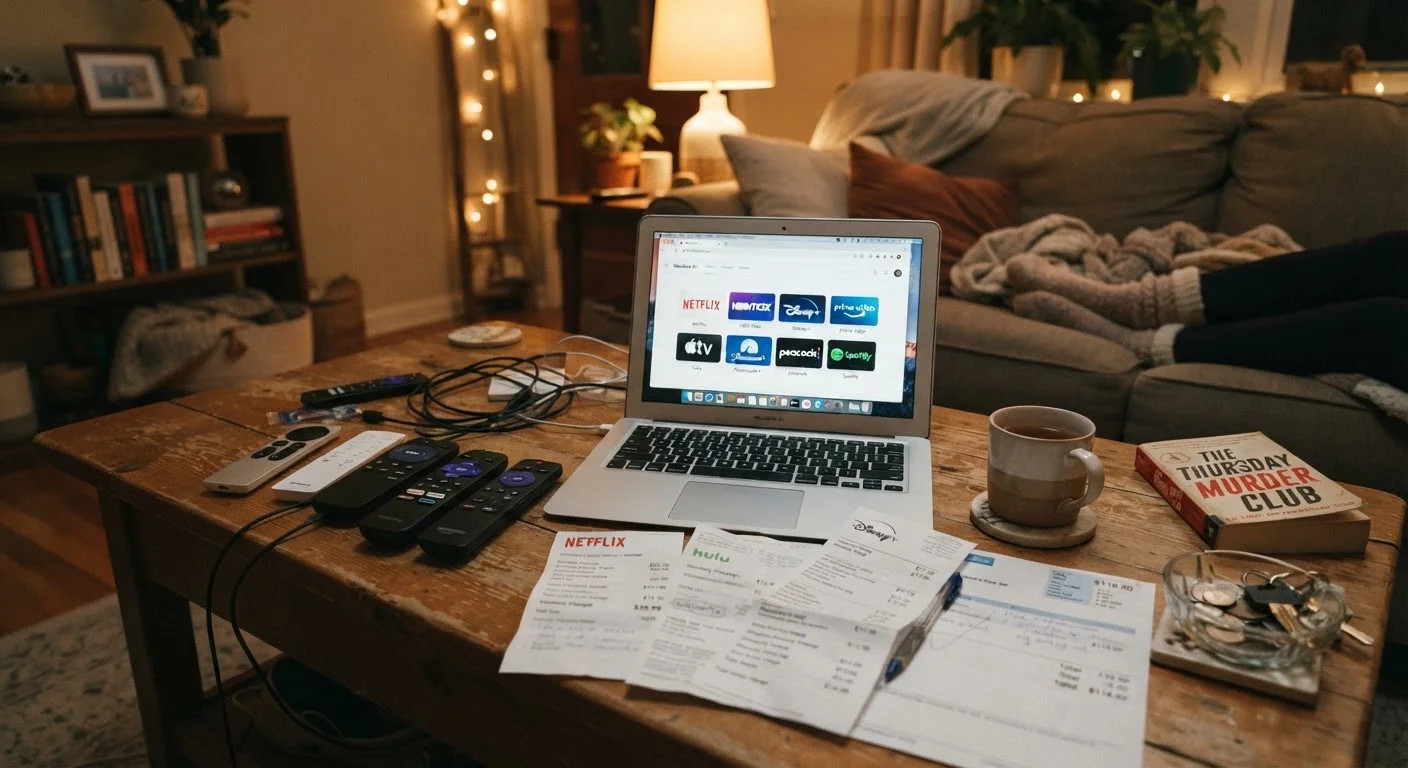
Streaming was supposed to replace the bloated cable bill. For many households, it has quietly become one. Services that launched at $8 or $9 a month have raised prices multiple times, introduced ad-supported tiers to reframe the original price as a "premium" option, and added extra charges for simultaneous streams or higher video quality. Multiply that across four or five services and the monthly total can rival what people once paid for cable.
The psychology works in the services' favor: each individual charge feels small, billing happens quietly in the background, and canceling requires deliberate action. That combination keeps subscribers paying for services they barely use. If you haven't looked at your streaming charges as a line item recently, that audit is a worthwhile starting point-see also our piece on signs your budget may need a structural rethink.
The Case for Staying Subscribed to Multiple Services
Immediate access to broad content libraries
Keeping multiple services active means no waiting, no re-subscribing, and no missing a show mid-season. For households that watch heavily and diversely, the convenience is real.
Bundles can reduce per-service cost
When a provider bundles two or three of its platforms, the combined price is typically lower than subscribing to each separately, and billing is simplified into one charge.
Different services serve different household members
A family with varied tastes-children's animation, sports coverage, prestige drama-may genuinely use three or four services consistently, making the combined cost defensible.
Avoids the hassle of frequent account management
Canceling and rejoining services repeatedly takes time and attention. For busy households, staying subscribed can be worth a modest premium to avoid the friction.
The strongest argument for keeping several active subscriptions is convenience. Searching across platforms to find where a show lives, then subscribing just to watch it, is a friction-heavy experience. For households with multiple viewers who have different tastes-say, one person who watches sports documentaries and another who follows prestige drama-a multi-service setup may genuinely reflect real usage.
Bundled packages, where a parent company combines two or three of its services at a discount, can also make mathematical sense when you'd subscribe to those services individually anyway. The per-service cost drops, and billing consolidates into one charge. The catch is that bundles are designed to include at least one service you use less than you think.
The Case for Cutting Back
Monthly costs stack up faster than expected
Five services at current market prices can easily exceed $70-$80 per month combined. Price increases have outpaced inflation on several major platforms in recent years.
Most households overestimate how much they watch
Studies consistently find a gap between perceived and actual streaming usage. Paying for a service you open twice a month is effectively a donation to the platform.
Choice overload reduces enjoyment
More services means more time browsing and less time actually watching. The decision fatigue that comes from too many options is a documented psychological effect.
Auto-renewal makes inertia expensive
Streaming services are designed to renew quietly. Without an active audit habit, it's common to pay for months of a service after finishing the show that prompted the subscription.
Bundles can trap you in unwanted services
Bundled pricing is attractive, but it typically requires keeping all services in the bundle active. You may end up paying for one platform you never open just to maintain the discount.
The most common finding when households actually track their streaming usage is that one or two services carry the vast majority of watch time. The rest exist out of habit, a specific show that finished months ago, or a free trial that was never canceled. That's money leaving your account every month with little return.
There's also the attention cost. More services means more browsing time deciding what to watch-a phenomenon researchers call "choice overload." Counterintuitively, fewer options often leads to more actual watching and less frustrated scrolling. Redirecting even $15-$20 per month from unused subscriptions toward an automated savings habit can compound meaningfully over time; our guide on automating your savings without disrupting your bills walks through practical ways to do that.
Rotating, Pausing, and Other Middle-Ground Moves
Check Before You Cancel: The Pause Option
Many subscribers don't realize that canceling isn't the only exit. Several major streaming platforms allow account pauses ranging from one to three months. During a pause, your subscription is suspended and you lose access, but your account history, profiles, and watchlist are preserved when you return. Look for a 'Pause Membership' option in your account settings before canceling outright-it's a lower-commitment way to reduce costs during low-usage periods without starting from scratch.
Between "keep everything" and "cancel everything" sits a range of practical strategies. Rotating subscriptions means subscribing to one service, watching what you want over a month or two, canceling, and moving to the next. It requires planning and tracking-writing down what's on your watch list before you cancel helps-but it can cut your annual streaming spend significantly.
Pausing is a less-known option. Several major services allow you to pause your account for one to three months rather than fully canceling. You lose access temporarily but don't have to re-enter payment information or lose your watch history when you return. It's a lower-friction option for seasonal viewers.
Downgrading tiers is another lever. If you're paying for a premium, ad-free plan but watching less than an hour a day, the ad-supported tier at a lower price may represent better value-especially since ad loads on streaming services are generally lighter than traditional broadcast television.
For households troubleshooting whether their internet setup is even delivering the video quality they're paying for, understanding your home network basics is a useful companion read.
How to Actually Audit What You're Using
The most reliable method is simple: for one month, note which service you open and roughly how long you watch. Most smart TVs and streaming devices show recently used apps, which gives a rough signal. Some services also display your viewing history in account settings.
After 30 days, rank your services by actual use. The bottom one or two are your candidates for cancellation or rotation. If you find yourself defaulting to one platform almost every night, that's your anchor subscription-keep it. Everything else should earn its spot based on what you're actively watching, not what you might watch someday.
$61+
Average monthly U.S. household streaming spend
According to JustWatch and industry tracking data, average per-household streaming costs have risen steadily as services have introduced price tiers and raised base rates.
4-5
Average number of streaming services per U.S. household
Deloitte's Digital Media Trends survey has consistently tracked multi-service adoption, finding most American households subscribe to at least four paid streaming platforms.
If you want to understand more about what you're actually getting for your money-what terms like 4K, HDR, or Dolby Atmos mean in practice-our streaming terms glossary breaks down the jargon without the spec-sheet noise.
The content on this site is provided for informational purposes only and should not be considered a substitute for professional advice. While we strive to provide accurate and up-to-date information, we make no guarantees regarding its completeness or accuracy. Always consult a qualified professional for advice specific to your circumstances before making any decisions.