

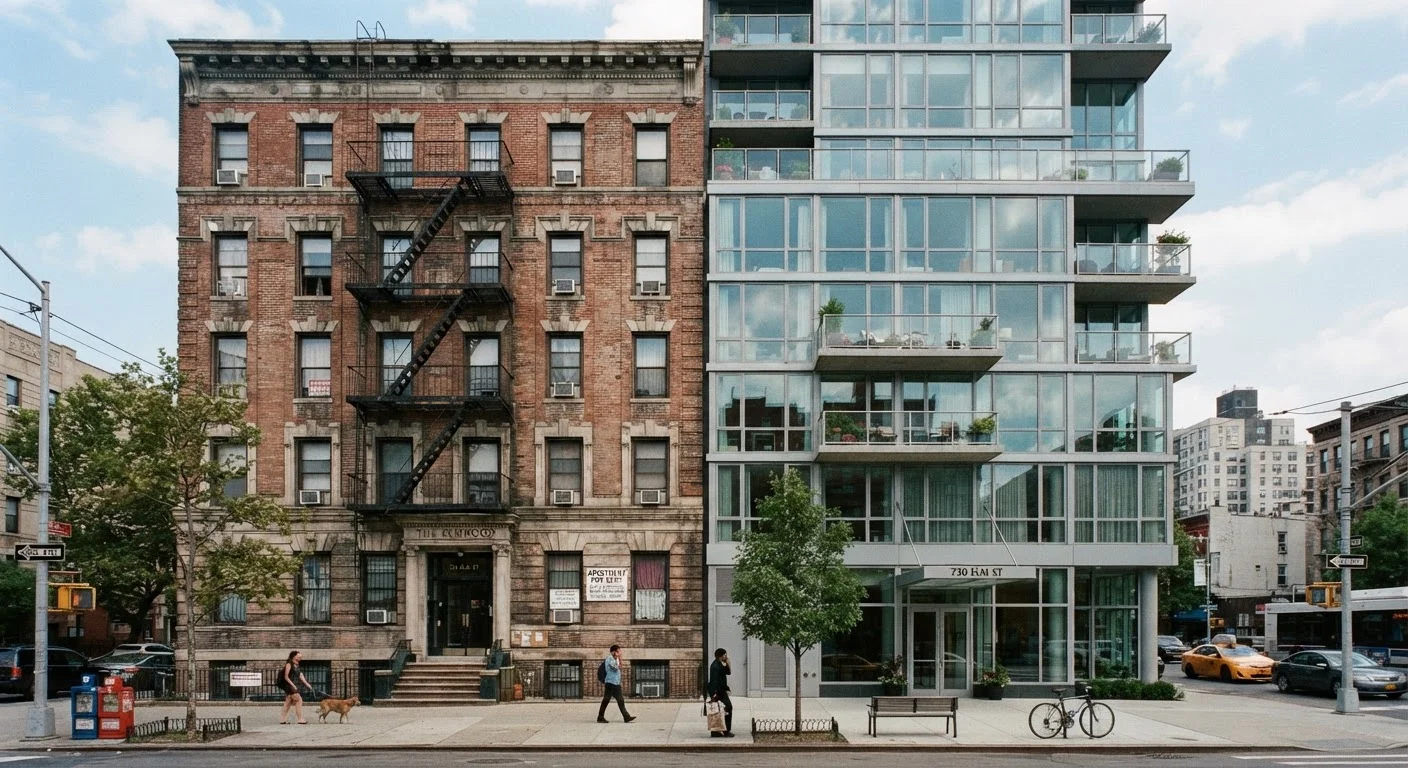
Option A
Rent-Controlled Apartment
The regulated, stability-focused option.
Best for: Long-term renters in designated cities who qualify under local ordinances and want protection from sharp rent increases.
Option B
Market-Rate Apartment
The standard, unregulated rental option.
Best for: Renters with flexibility and financial range who are searching in any city or neighborhood without rent regulation requirements.
How Each System Is Defined and Where It Applies
Rent-controlled and market-rate apartments represent two fundamentally different legal environments for renters. A rent-controlled or rent-stabilized unit is one where local law restricts how much a landlord can raise the rent, typically on an annual basis. A market-rate unit carries no such restriction - the landlord can set rent at whatever price the market will bear when a lease renews or a new tenant moves in.
The geographic reach of rent regulation is narrow. Most US states either lack rent control laws entirely or have passed preemption statutes that block cities from enacting them. For a deeper look at which cities have these rules and how they're structured, see how rent control works and where it applies.
Rent Control vs. Rent Stabilization: A Key Distinction
These terms are often used interchangeably, but they aren't the same. Rent control typically refers to stricter, older ordinances that set hard rent ceilings, while rent stabilization - more common today - allows incremental annual increases tied to a local formula or index. The rules, covered units, and tenant rights differ significantly between the two. Always verify which system, if any, applies to a specific unit before assuming you're protected.
Even within regulated cities, coverage is rarely universal. Ordinances frequently exclude newer construction, single-family homes, owner-occupied buildings with fewer than a set number of units, and federally subsidized housing. Renters should confirm a unit's regulatory status directly with the local housing authority - not rely on a landlord's representation alone.
~4%
Share of US rentals under any rent regulation
Research from the Urban Institute and local housing data suggests a small fraction of the total US rental stock falls under any form of rent control or stabilization.
~180
US jurisdictions with some form of rent regulation
According to the National Multifamily Housing Council, rent control or stabilization laws exist in roughly 180 cities and counties, concentrated in a handful of states.
36
States that preempt local rent control laws
As of recent legislative counts, more than three dozen states prohibit local governments from enacting rent control, effectively limiting regulation to a small geographic footprint.
Key Differences in Tenant Rights and Landlord Obligations
The practical differences between these two housing types go well beyond rent increases. Tenants in regulated units often benefit from stronger just-cause eviction protections, meaning a landlord generally must cite a legally valid reason - such as nonpayment, lease violation, or owner move-in - before beginning eviction proceedings. Market-rate tenants, by contrast, may face non-renewal at the end of a fixed-term lease with only the legally required notice period, which varies by state.
| Criterion | Rent-Controlled Apartment | Market-Rate Apartment |
|---|---|---|
| Annual rent increases | Capped by local ordinance | Set by landlord at renewal |
| Availability | Limited; city- and building-specific | Widely available nationwide |
| Eligibility requirements | Defined by local law | Standard rental application |
| Eviction protections | Often stronger under local law | Governed by state landlord-tenant law |
| Unit age (typical) | Usually pre-1980 construction | Any age of construction |
| Landlord flexibility | Restricted on increases and removal | Broad discretion at lease end |
| Vacancy decontrol risk | Protections may end on vacancy | Not applicable |
One frequently misunderstood feature of rent regulation is vacancy decontrol. Under this policy, used in some jurisdictions, a unit's rent resets to market rate when a tenant voluntarily vacates. This means the protections are tied to the occupancy, not the unit itself. If you're considering subletting a regulated rental, understand that improper subletting can trigger loss of those protections or grounds for eviction.
Lease type also intersects with these rules. A month-to-month agreement in a regulated unit may carry different protections than a fixed-term lease. Our guide to month-to-month vs. fixed-term leases explains how the structure of your lease can affect your rights regardless of regulation status.
Who Qualifies and How to Find Out
There is no income test or application process to qualify for a rent-regulated unit in the traditional sense - eligibility is generally determined by whether the unit itself is covered under local law. That said, a landlord may still screen applicants using standard criteria: credit history, income verification, rental references, and background checks. The unit's regulatory status is a property characteristic, not a tenant entitlement.
To determine whether a specific apartment is regulated, tenants can consult their city or county's housing department, request the unit's rent registration history, or review the lease for rent stabilization riders - required in some jurisdictions. In New York City, for example, tenants can search a public database of rent-stabilized buildings maintained by local authorities.
If you're weighing options across a broader rental market and want to understand whether conditions currently favor renters or landlords, the indicators covered in reading a rental market can help you calibrate your expectations before applying.
Renters who cannot find regulated housing and face affordability constraints may have access to other forms of support. Federal, state, and local programs serve different income bands and household types - the rental assistance programs overview outlines the major categories and how to locate local resources.
This article is for general informational purposes only and does not constitute legal or financial advice. Rent regulation laws vary significantly by jurisdiction. Consult a local tenant rights organization or licensed attorney for guidance specific to your situation.
The content on this site is provided for informational purposes only and should not be considered a substitute for professional advice. While we strive to provide accurate and up-to-date information, we make no guarantees regarding its completeness or accuracy. Always consult a qualified professional for advice specific to your circumstances before making any decisions.