

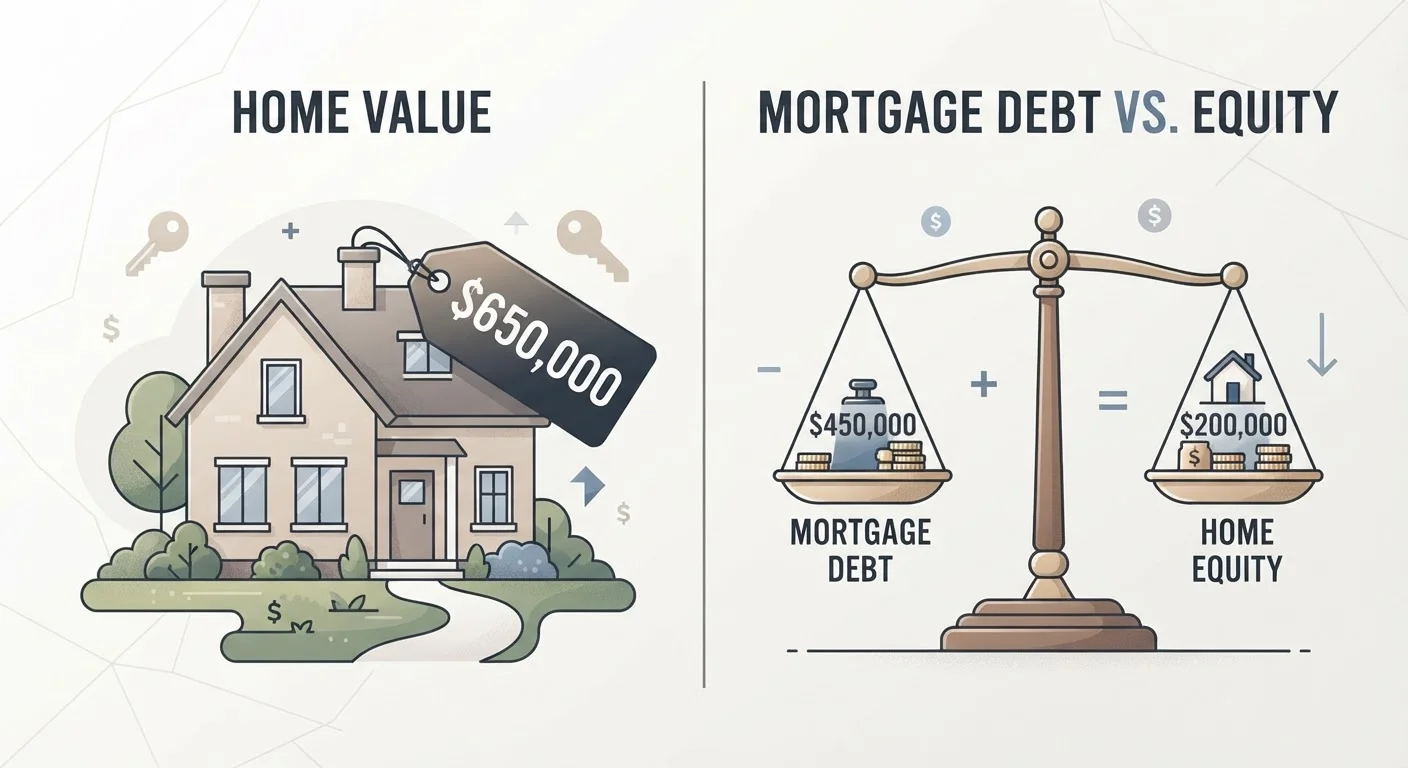
Option A
Home Value
What your property is worth on the open market.
Best for: Sellers, buyers, and lenders who need to know what a property would fetch if sold today.
Option B
Home Equity
The portion of your home's value that you actually own.
Best for: Homeowners evaluating their net worth, borrowing options, or long-term wealth-building progress.
Defining Each Term
Home value - sometimes called market value or appraised value - is the estimated price your property would sell for under normal market conditions on a given date. It is shaped by factors outside your direct control: comparable sales nearby, local demand, interest rate environments, neighborhood trends, and the physical condition of the home itself. Because markets move, home value is not a fixed number - it is a snapshot.
Home equity is a derived figure. It is calculated by subtracting the total outstanding mortgage debt secured against the property from the home's current market value. If your home is valued at $400,000 and you owe $260,000 on your mortgage, your equity stands at $140,000. For a deeper look at how equity accumulates over a loan's life, see how home equity builds over time.
The key distinction: value tells you what the whole asset is worth; equity tells you what you own of it.
How Each One Changes Over Time
Home value fluctuates with the market. A neighborhood revitalization, new infrastructure, or a surge in buyer demand can push values upward - sometimes significantly. The reverse is equally possible: an economic downturn or oversupply of local inventory can suppress values for years.
Equity, by contrast, grows through two distinct mechanisms. The first is appreciation: when market value rises and your debt stays the same, equity expands. The second is amortization: each mortgage payment includes a portion that reduces your principal balance, incrementally increasing your ownership stake - even if your home's value doesn't change at all.
| Criterion | Home Value | Home Equity |
|---|---|---|
| Definition | Market price of the entire property | Value minus outstanding mortgage debt |
| What drives it | Market conditions, location, property state | Value appreciation plus mortgage paydown |
| Who controls it | Largely the market | Market and borrower repayment behavior |
| Primary use | Pricing, appraisal, LTV calculation | Net worth, borrowing eligibility, sale proceeds |
| Can it be negative? | No - property always has some value | Yes - if debt exceeds market value |
| How it's measured | Appraisal or comparative market analysis | Market value minus loan balance |
It is also worth noting that equity can shrink. If home values fall sharply, your equity cushion erodes. If values drop below your outstanding mortgage balance, you enter a state of negative equity - sometimes called being "underwater" - which limits your ability to sell, refinance, or borrow against the home without incurring a loss.
Why Lenders Care About Both
When you apply for a mortgage, refinance, or home equity loan, lenders look at both figures simultaneously through a metric called the loan-to-value ratio (LTV). LTV is calculated by dividing your outstanding mortgage balance by the home's appraised value and expressing it as a percentage.
80%
Common LTV threshold for avoiding PMI
Most conventional lenders require an LTV at or below 80% - meaning at least 20% equity - to waive private mortgage insurance requirements.
~30%
Average homeowner equity share at purchase
With a standard 20% down payment on a conventional loan, buyers begin with roughly 20-30% equity depending on closing costs and loan structure.
A lower LTV signals less risk to the lender - because more of the home's value is owned outright. Borrowers with lower LTV ratios typically qualify for better interest rates and have more refinancing options available to them. High LTV ratios, particularly above 80%, often trigger requirements for private mortgage insurance (PMI) on conventional loans.
Understanding how the two figures interact helps explain why a rising market doesn't automatically translate into easier borrowing. If your home's value increases but you've barely paid down your principal, your LTV improvement may be modest - and may still fall short of a lender's threshold.
For a broader view of what homeownership actually costs month to month, see the financial realities beyond the mortgage payment.
Practical Implications for Homeowners
Understanding the difference between value and equity shapes several real financial decisions. When considering whether to tap home equity through a loan or line of credit, equity - not raw market value - determines how much you can access. When evaluating whether now is a good time to sell, market value is the primary driver of your gross proceeds; equity determines your net proceeds after paying off the mortgage.
First-time buyers weighing the long-term wealth implications of ownership can benefit from tracking both figures together. The rent vs. buy trade-offs discussion often centers on equity accumulation - but equity is only as meaningful as the market value underpinning it.
Finally, keeping these concepts separate also matters for insurance purposes. Your home insurance coverage is typically based on replacement cost - what it would cost to rebuild the structure - which is a different figure from both market value and equity. Conflating them can leave gaps in your financial planning.
This article is for general informational and educational purposes only and does not constitute financial, legal, or investment advice. Readers should consult a qualified financial professional before making decisions about their home, mortgage, or borrowing options.
The content on this site is provided for informational purposes only and should not be considered a substitute for professional advice. While we strive to provide accurate and up-to-date information, we make no guarantees regarding its completeness or accuracy. Always consult a qualified professional for advice specific to your circumstances before making any decisions.