

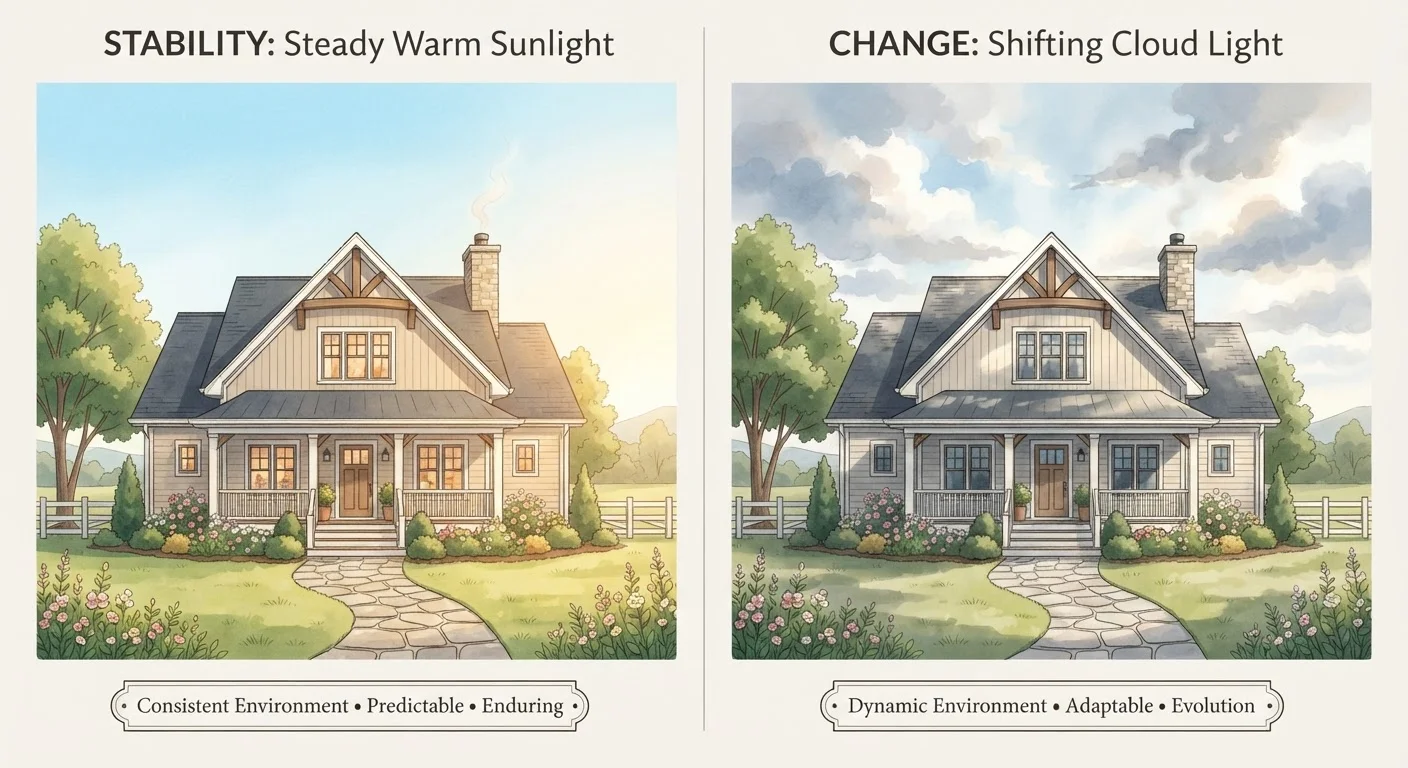
Option A
Fixed-Rate Mortgage
The predictable, long-term stability option.
Best for: Buyers planning to stay in their home long-term who want consistent monthly payments regardless of market conditions.
Option B
Adjustable-Rate Mortgage (ARM)
The flexible, lower-entry-cost alternative.
Best for: Buyers who expect to sell or refinance within a defined period and can tolerate some payment variability over time.
How Each Structure Works
A fixed-rate mortgage carries the same interest rate for the entire loan term - typically 15 or 30 years. Your principal-and-interest payment never changes, which makes long-range budgeting straightforward. Note, however, that your total monthly payment can still shift if property taxes or homeowners insurance premiums change through your escrow account. For a closer look at that dynamic, see how escrow adjustments work.
An adjustable-rate mortgage (ARM) begins with a fixed introductory period - commonly expressed as 5/1, 7/1, or 10/1 - during which the rate stays constant. After that period, the rate adjusts at regular intervals (usually annually) based on a published benchmark index, such as the Secured Overnight Financing Rate (SOFR), plus a lender-set margin. The result is a payment that can rise or fall with market conditions. For a detailed walkthrough of mechanics, see how each mortgage type functions over time.
| Criterion | Fixed-Rate Mortgage | Adjustable-Rate Mortgage (ARM) |
|---|---|---|
| Interest Rate | Stays the same for the full term | Fixed initially, then adjusts periodically |
| Initial Monthly Payment | Typically higher | Typically lower during intro period |
| Payment Predictability | High - principal & interest never change | Lower - varies after adjustment period |
| Rate Caps | Not applicable | Yes - per-adjustment and lifetime limits |
| Best Horizon | Long-term ownership (10+ years) | Shorter-term ownership or refinance plan |
| Risk Profile | Low - lender absorbs rate risk | Moderate - borrower absorbs rate risk |
| Complexity | Straightforward | More complex; benchmark index tracking needed |
Weighing the Trade-offs
The central trade-off is certainty versus cost. Fixed-rate mortgages are generally priced higher at origination because lenders absorb the risk of future rate changes. ARMs shift that risk to the borrower in exchange for a lower initial rate - which can meaningfully reduce early payments or help buyers qualify for a larger loan amount.
ARM borrowers are protected, to a degree, by rate caps: limits on how much the interest rate can move per adjustment period and over the life of the loan. A common cap structure is 2/2/5, meaning the rate cannot rise more than 2 percentage points at the first adjustment, 2 points at subsequent adjustments, and 5 points total from the starting rate. Even so, worst-case scenarios should be stress-tested before committing.
30 years
Most common fixed-rate mortgage term in the US
The 30-year fixed-rate mortgage has been the dominant loan structure for American homebuyers for decades, according to Federal Housing Finance Agency data.
2/2/5
Typical ARM rate cap structure
A 2/2/5 cap means the rate can rise at most 2% at the first adjustment, 2% at each subsequent adjustment, and no more than 5% over the loan's life.
~10%
Share of mortgage applications that are ARMs (varies by rate environment)
Mortgage Bankers Association data has shown ARM applications can shift significantly - rising when fixed rates are elevated and falling in low-rate environments.
The decision also interacts with broader budget planning. Understanding how your mortgage payment fits into fixed versus variable monthly obligations can sharpen your analysis - exploring fixed vs. variable expenses offers a useful framework for that exercise.
Making the Right Call for Your Situation
No mortgage structure is universally superior. Buyers who intend to stay in a property through full loan maturity, or who have little flexibility to absorb payment increases, generally benefit from the certainty of a fixed rate. Those with a defined shorter horizon - a planned relocation, a growing family expecting to upsize - may find the ARM's initial savings compelling, provided they understand what happens if plans change.
Interest rate environment matters too. When rates are low relative to historical norms, locking in a fixed rate can be advantageous. When rates are elevated, an ARM's initial discount may be more attractive, and there's a reasonable expectation - though not a guarantee - that rates could fall before the adjustment period begins.
Consider also your risk temperament. Stability-oriented borrowers often report less financial stress with fixed payments, even when the ARM might produce lower total interest in a favorable rate scenario. Finally, consult with a licensed mortgage professional or HUD-approved housing counselor to model both options against your specific financial picture before deciding.
This article is for general informational purposes only and does not constitute personalized financial or mortgage advice. Consult a qualified mortgage professional for guidance specific to your situation.
The content on this site is provided for informational purposes only and should not be considered a substitute for professional advice. While we strive to provide accurate and up-to-date information, we make no guarantees regarding its completeness or accuracy. Always consult a qualified professional for advice specific to your circumstances before making any decisions.