

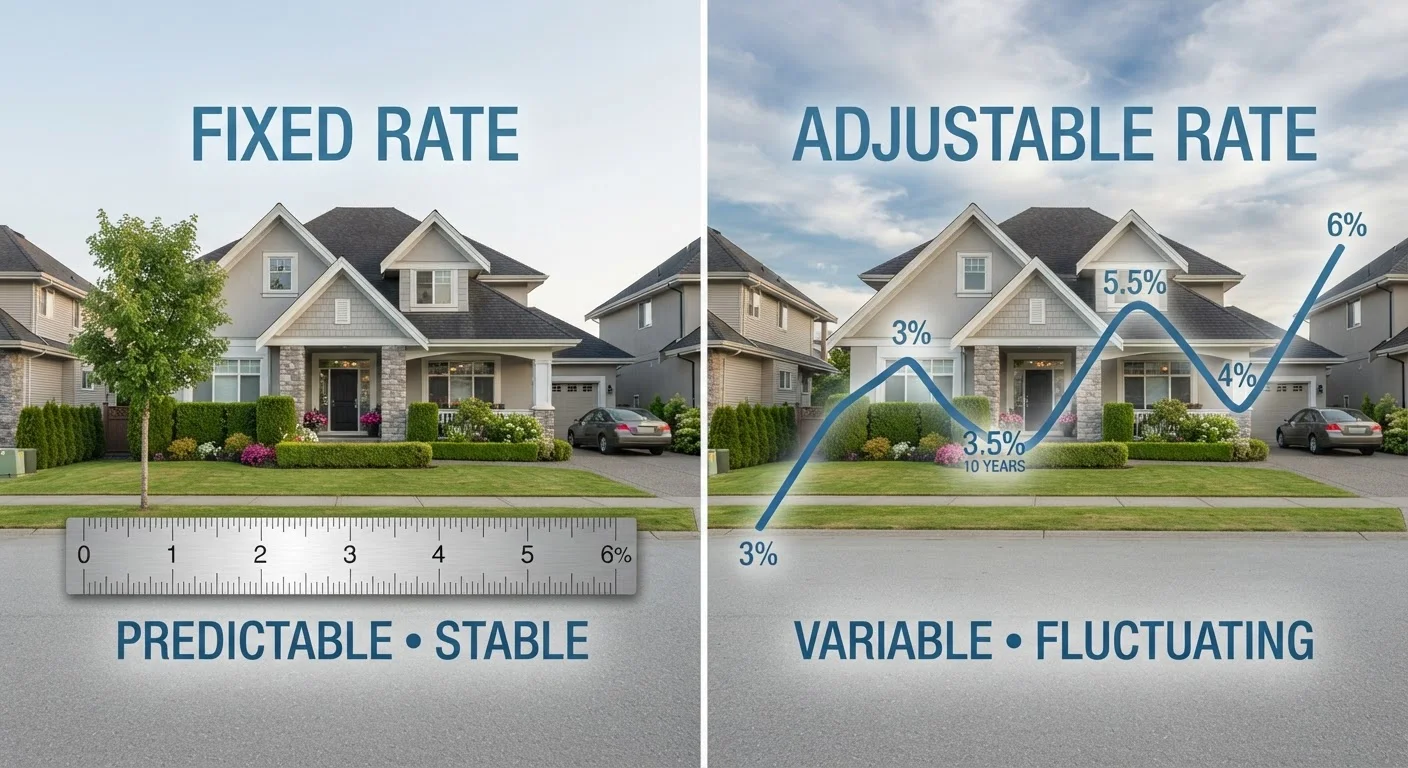
Option A
Fixed-Rate Mortgage
The predictable, set-it-and-forget-it loan structure.
Best for: Buyers who want consistent monthly payments and plan to stay in their home long term.
Option B
Adjustable-Rate Mortgage (ARM)
The flexible loan that trades stability for a lower initial rate.
Best for: Buyers who expect to sell or refinance before the initial fixed period ends.
How a Fixed-Rate Mortgage Works
A fixed-rate mortgage locks your interest rate in place for the entire loan term - most commonly 15 or 30 years. The portion of your monthly payment covering principal and interest never changes, regardless of what happens to prevailing interest rates in the broader market.
This predictability is the structure's defining advantage. When you close on the loan, you know exactly what your principal-and-interest payment will be in year one and in year twenty-nine. Lenders price that certainty into the initial rate, which typically starts higher than the introductory rate on a comparable adjustable-rate loan.
One nuance worth understanding: your total monthly payment can still shift year to year if your loan is set up with an escrow account for property taxes and homeowner's insurance. Because those costs are reassessed annually, your lender recalculates the escrow portion each year. See our explanation of escrow accounts for a detailed breakdown of why this happens even on a fixed-rate loan.
Fixed-rate loans are generally the more straightforward choice for buyers who intend to hold the property long term and want to treat their housing cost as a fixed expense in their budget.
How an Adjustable-Rate Mortgage Works
An adjustable-rate mortgage (ARM) begins with a fixed introductory rate that is typically lower than the rate on a comparable fixed-rate loan. After an initial period - commonly 5, 7, or 10 years - the rate resets periodically, usually once per year, based on a benchmark market index plus a fixed margin set by the lender.
ARMs are described using shorthand such as 5/1 or 7/6. The first number indicates the length of the initial fixed period in years; the second indicates how often the rate can adjust after that. A 5/1 ARM, for example, holds a fixed rate for five years and then adjusts annually.
| Criterion | Fixed-Rate Mortgage | Adjustable-Rate Mortgage (ARM) |
|---|---|---|
| Initial interest rate | Higher (market rate at closing) | Lower introductory rate |
| Rate stability | Locked for full loan term | Fixed intro period, then periodic resets |
| Payment predictability | Principal & interest never change | Payment can rise or fall after intro period |
| Rate caps | Not applicable | Initial, periodic, and lifetime caps apply |
| Common loan terms | 15 or 30 years | 30 years (with 5, 7, or 10-year intro) |
| Best horizon | Long-term ownership (7+ years) | Shorter planned ownership (under 7 years) |
| Market rate risk borne by | Lender | Borrower (after intro period) |
Critically, ARMs include rate caps - contractual limits on how much the interest rate can move. These typically come in three layers: an initial adjustment cap (limiting the first reset), a periodic cap (limiting each subsequent reset), and a lifetime cap (the maximum increase over the life of the loan). Common cap structures are expressed as figures like 2/2/5, meaning the rate can rise no more than 2 percentage points at the first adjustment, 2 points at each subsequent adjustment, and 5 points total over the loan's life.
Understanding the index your ARM is tied to - such as the Secured Overnight Financing Rate (SOFR), which replaced LIBOR as the dominant U.S. benchmark - helps you gauge how your rate might behave when it begins to adjust.
Key Trade-offs and When Each Structure Makes Sense
30 years
Most common fixed-rate mortgage term in the U.S.
The 30-year fixed-rate mortgage has historically been the dominant loan product among American homebuyers according to federal mortgage market data.
5/2/5
Typical ARM cap structure
A common cap arrangement limits the first rate adjustment to 5 points, each subsequent adjustment to 2 points, and the lifetime change to 5 points above the initial rate.
~1-1.5%
Typical initial rate discount of ARM vs. fixed
ARM introductory rates have historically been roughly 1 to 1.5 percentage points lower than 30-year fixed rates, though the spread varies with market conditions.
The fixed-rate mortgage suits buyers who prioritize payment stability over a long ownership horizon. If you are stretching to qualify at today's rates, locking in removes the risk of payment shock - an abrupt increase in your monthly obligation if market rates rise sharply during an ARM's adjustment period.
The ARM can make financial sense in specific scenarios. Buyers who have a clear, credible plan to sell or refinance before the introductory period expires may pay less in cumulative interest than they would on a fixed-rate loan. Similarly, in an environment where rates are broadly elevated and expected to ease, an ARM positions the borrower to benefit from declining rates without bearing the closing costs of a separate refinance.
The decision also involves your financial resilience. An ARM's initial lower rate creates more room in monthly cash flow, but that benefit disappears - and can reverse - when rates reset upward. Buyers should model what their payment would look like at the lifetime cap before committing to an ARM.
This trade-off between certainty and flexibility parallels decisions in other financial contexts. The choice between a month-to-month and a fixed-term lease involves a similar tension - stability versus optionality - and rewards the same kind of deliberate horizon planning.
This article is for general informational and educational purposes only and does not constitute personalized financial or mortgage advice. Consult a licensed mortgage professional or financial adviser before making borrowing decisions.
The content on this site is provided for informational purposes only and should not be considered a substitute for professional advice. While we strive to provide accurate and up-to-date information, we make no guarantees regarding its completeness or accuracy. Always consult a qualified professional for advice specific to your circumstances before making any decisions.