

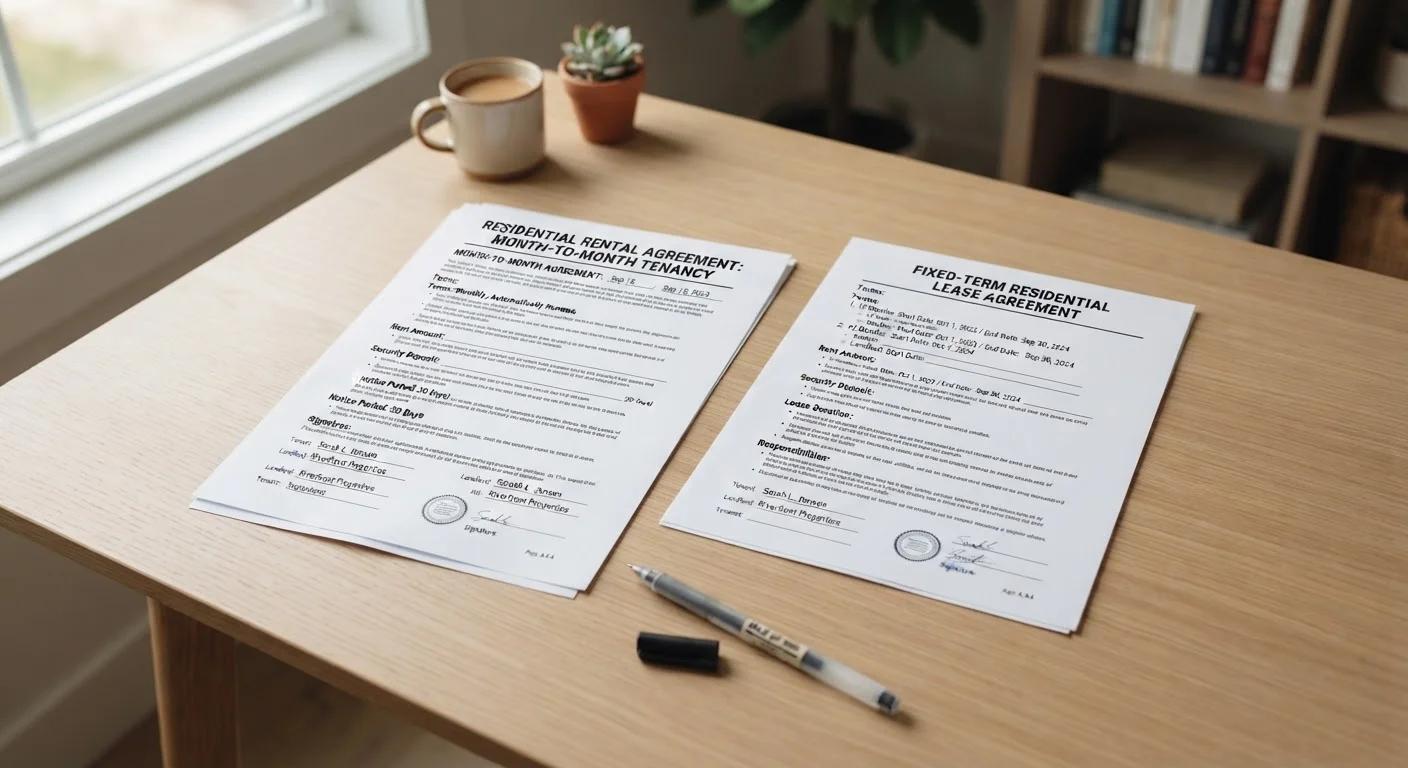
Option A
Month-to-Month Lease
The flexible, no long-term-commitment option.
Best for: Renters who need geographic mobility, are between life transitions, or want the option to leave with relatively short notice.
Option B
Fixed-Term Lease
The stable, predictable long-term agreement.
Best for: Renters who have settled plans, want locked-in rent, and value housing security over the freedom to relocate quickly.
How Each Lease Structure Actually Works
A fixed-term lease is a rental agreement with a defined start and end date - most commonly 12 months, though six-month and 24-month terms exist. During that period, the rent amount, lease conditions, and occupancy rules are contractually fixed. Neither party can unilaterally change the core terms. At the end of the term, the lease either renews (auto-renewal clauses vary by state), converts to a month-to-month arrangement, or is renegotiated.
A month-to-month lease (sometimes called a periodic tenancy) renews automatically each month and can be terminated by either the landlord or tenant with advance written notice - commonly 30 days, though some states require more. There is no fixed endpoint. The trade-off: because the landlord assumes more uncertainty, month-to-month agreements typically carry higher rent than a comparable fixed-term unit in the same building.
For a deeper look at how these structures differ beyond just duration - including rent control implications and notice requirements - see what changes beyond the length.
| Criterion | Month-to-Month Lease | Fixed-Term Lease |
|---|---|---|
| Commitment length | Renews monthly; no fixed end date | Set end date (typically 12 months) |
| Rent stability | Can increase with notice | Locked in for lease term |
| Tenant exit flexibility | Exit with ~30 days' notice | Early exit may trigger penalty fees |
| Typical rent level | Often 10-25% higher | Lower; reflects longer commitment |
| Landlord termination rights | Can terminate with notice (varies by state) | Generally cannot terminate without cause |
| Best market conditions | Softening or uncertain rental market | Rising rent environment |
| Negotiability | Limited; terms reset each month | More clauses negotiable upfront |
The Real Costs of Flexibility and Stability
Flexibility is rarely free. Month-to-month tenants in many urban markets pay a premium of 10-25% above the equivalent fixed-term rent, according to general market patterns reported by rental industry analysts. That gap compounds over time: a renter paying $200 extra per month accumulates $2,400 in additional costs annually, without building any equity or additional rights.
Fixed-term leases carry their own financial risks. Early termination clauses - the fees charged when a tenant exits before the lease ends - can range from one to three months' rent depending on the lease and state law. Some states require landlords to mitigate damages by re-renting the unit quickly, which can reduce what a departing tenant ultimately owes; others do not.
10-25%
Typical month-to-month rent premium
Rental market analysts generally observe that month-to-month tenants pay materially more per month than equivalent fixed-term renters in the same building.
1-3 months
Common early termination fee range
Early termination fees on fixed-term leases commonly equal one to three months' rent, though the amount varies widely by lease and state law.
30-60 days
Typical notice period for termination
Most US states require landlords and tenants to provide 30 to 60 days' written notice to end a month-to-month tenancy, though exact requirements vary by jurisdiction.
Neither structure eliminates financial risk. The question is which risk profile fits your current situation. Renters who are confident they'll stay for the full term gain genuine value from a fixed-term lease. Those with real uncertainty may find the premium of a month-to-month arrangement worth paying - at least temporarily.
Landlord Rights and Leverage Under Each Structure
The lease structure you sign significantly shapes the balance of power between tenant and landlord. Under a fixed-term lease, a landlord generally cannot raise the rent or change lease conditions until the term ends (except where local law explicitly permits mid-term increases). They also typically cannot terminate the tenancy without cause before the end date. This is a meaningful form of housing security, particularly in high-demand rental markets.
Under a month-to-month arrangement, landlords generally have more operational flexibility. In most US states, they can raise the rent or terminate the tenancy with the required notice period - usually 30 to 60 days. In jurisdictions without strong rent control or just-cause eviction laws, this can expose tenants to sudden cost increases or displacement. Renters should research their state and local tenant protection laws before signing either type of lease.
If you're considering negotiating specific clauses - such as notice periods, renewal terms, or early-termination conditions - our guide on negotiating lease terms where landlords often have room to move outlines where landlords commonly have flexibility.
Choosing the Right Structure for Your Situation
The right lease structure depends on factors that are personal, financial, and market-specific. Before signing, consider the following:
- Your timeline certainty: Do you have a job, school enrollment, or family commitment anchoring you to this location for at least 12 months? If yes, a fixed-term lease typically serves you better. If not, month-to-month preserves your options.
- Local market conditions: In a fast-rising rent market, locking in a fixed-term rate can produce meaningful savings. In a softening market, month-to-month gives you the freedom to move when better deals emerge.
- Landlord policy: Some landlords simply do not offer month-to-month at the outset - it may only be available after an initial fixed term. Know what's actually on the table before framing your decision.
- State tenant protections: Laws governing notice requirements, rent increases, and cause for eviction vary significantly by state and municipality. Understanding your local framework matters regardless of which structure you choose.
For renters thinking about renting as a longer-term strategy rather than a temporary bridge, long-term renting as a housing strategy offers a fuller picture of that path's trade-offs.
This article provides general educational information about lease structures and is not legal or financial advice. Consult a qualified attorney or housing counselor if you have questions about your specific lease or tenant rights in your jurisdiction.
The content on this site is provided for informational purposes only and should not be considered a substitute for professional advice. While we strive to provide accurate and up-to-date information, we make no guarantees regarding its completeness or accuracy. Always consult a qualified professional for advice specific to your circumstances before making any decisions.