

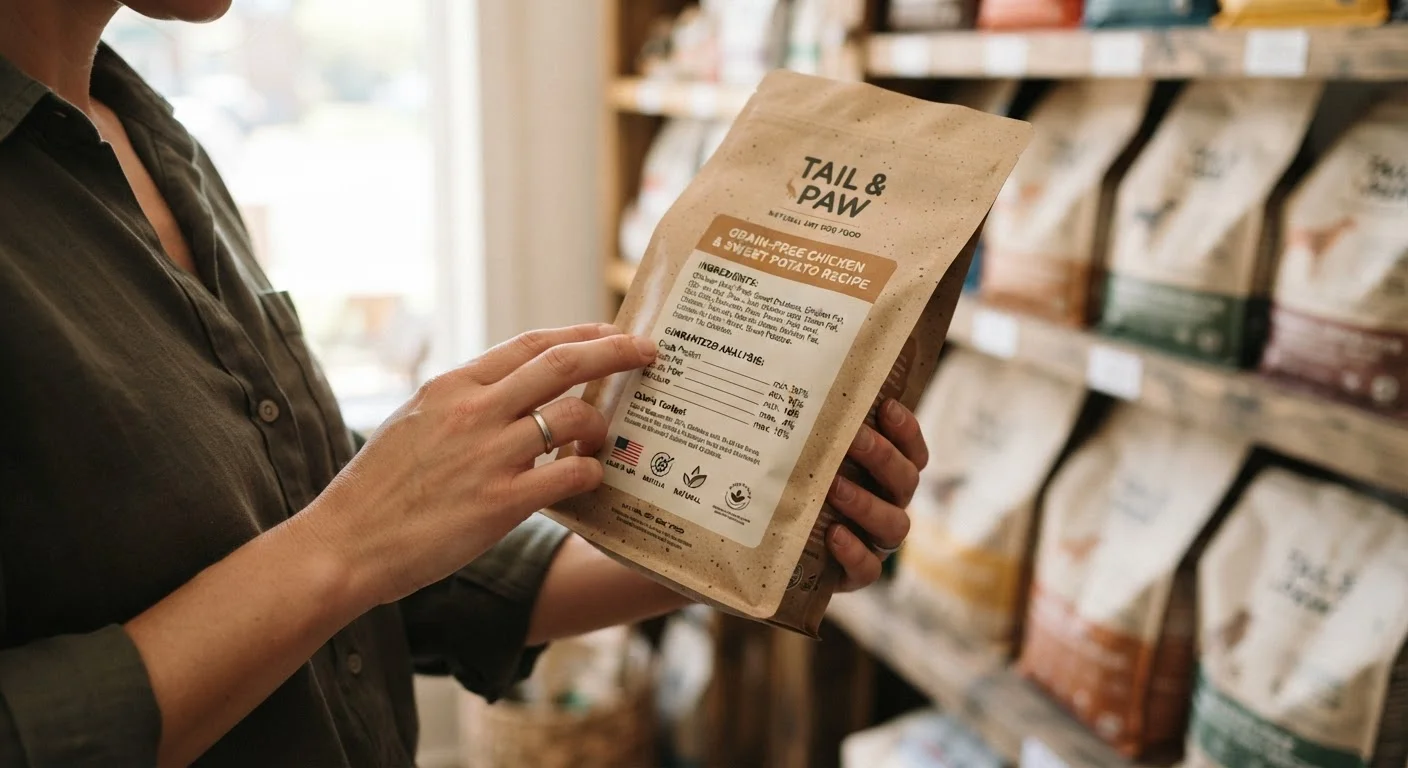
The Five Required Elements Every Label Must Have
Commercial pet food sold in the U.S. must display five core pieces of information: the product name, the net quantity of contents, the manufacturer's name and address, the ingredient list, and the guaranteed analysis. Most labels also include a nutritional adequacy statement, feeding directions, and a calorie statement - all of which carry practical meaning for pet owners.
Understanding how these elements work together - and their limitations - puts you in a much stronger position when comparing products at the store or evaluating a new food for a pet with specific health needs. For a side-by-side look at how pet food labels compare to human food nutrition panels, see how human nutrition labels work.
50+
States following AAFCO model pet food regulations
AAFCO reports that the majority of U.S. states have adopted its model regulations for pet food labeling and ingredient definitions.
4
Nutrients required in every guaranteed analysis panel
Federal and AAFCO guidelines require crude protein, crude fat, crude fiber, and moisture to be listed on all commercial pet food labels.
~70%
Water content in fresh chicken before processing
This high moisture content explains why fresh meat can rank first on the ingredient list yet represent a smaller portion of the finished product by dry weight.
How the Ingredient List Works
Ingredients are listed in descending order by weight before cooking or processing. This is a critical detail. Fresh chicken, for example, is roughly 70-75% water. After processing, the moisture evaporates and the chicken's contribution to the final product is far smaller by weight. This doesn't mean meat first is meaningless - it still signals the formulation intent - but it does mean you shouldn't treat ingredient order as a straightforward ranking of what dominates the finished food.
Watch for "ingredient splitting," where a single ingredient appears in multiple forms (e.g., ground corn, corn gluten meal, corn bran) across the list. Split this way, each sub-form ranks lower individually - even if corn is collectively one of the largest ingredients. For more context on how processing affects ingredient quality, the article on whole foods vs. processed foods offers useful background.
Decoding the Guaranteed Analysis Panel
The guaranteed analysis lists four required nutrients: crude protein (minimum), crude fat (minimum), crude fiber (maximum), and moisture (maximum). Some manufacturers voluntarily add others, such as omega fatty acids or specific minerals.
These are guarantees - legal floors or ceilings - not exact measurements. A food guaranteeing a minimum of 25% crude protein may contain more. The panel also doesn't tell you anything about ingredient quality or digestibility. Two foods with identical guaranteed analysis numbers can differ significantly in how well a pet actually absorbs and uses those nutrients.
Ask Your Vet Before Switching Foods
If you're considering a new food based on label research, it's worth a quick conversation with your veterinarian first - especially for pets with allergies, digestive sensitivities, kidney concerns, or other health conditions. Labels provide useful data, but a vet can help interpret that data in the context of your specific animal's needs.
Comparing wet and dry foods on this panel requires an extra step: converting both to a "dry matter basis" by removing moisture mathematically. A wet food showing 8% protein on label may actually be similar to a dry food at 28%, once water is removed from both. Veterinary nutrition resources can walk you through the conversion formula.
What the AAFCO Statement Actually Tells You
The nutritional adequacy statement - sometimes called the AAFCO statement - is one of the most informative lines on a pet food label. It tells you two things: whether the food has been formulated to meet AAFCO nutrient profiles or tested through actual animal feeding trials, and which life stage it's intended for.
Life stages recognized by AAFCO include growth (puppies or kittens), adult maintenance, reproduction, and "all life stages" - which must meet the most demanding nutrient profiles. A food labeled for "adult maintenance" is not necessarily appropriate for a growing puppy or a pregnant animal. If you're navigating nutrition decisions for a pet with health conditions or at a specific life stage, the Pet Health & Wellness hub provides broader guidance on keeping pets healthy year-round.
If a product carries no AAFCO statement at all, it is typically marketed as a "treat" or "supplement" - and should not be used as a primary diet. This distinction matters more than most pet owners realize.
Frequently Asked Questions
"Complete and balanced" is a regulated phrase meaning the food meets the minimum nutrient requirements established by AAFCO for a specific life stage (such as adult maintenance or growth). A manufacturer must either formulate the food to meet an AAFCO nutrient profile or conduct feeding trials to use this claim. It is not simply a marketing phrase.
Ingredients are listed by weight before processing. Fresh chicken contains a lot of water, so it weighs more raw but shrinks significantly during cooking. After moisture is removed, grains or other ingredients may actually make up a greater portion of the final product by dry weight.
The AAFCO nutritional adequacy statement is usually found near the bottom of a pet food label, often in small print. It tells you whether the food was formulated to meet AAFCO nutrient profiles or tested through feeding trials, and for which life stage - such as puppies, adult dogs, or all life stages.
Not necessarily. A longer list simply reflects more ingredients, which could mean greater variety or additional additives. What matters more is the quality and source of key ingredients and whether the product carries a valid AAFCO nutritional adequacy statement.
Feeding guidelines are broad estimates based on average animals of a given weight. Your pet's actual needs depend on age, activity level, metabolism, health status, and whether they're spayed or neutered. A veterinarian can help you calibrate portions for your specific pet.
By-products are secondary parts of an animal after the primary cuts are removed - such as organs, bone, or blood. They are not inherently harmful or nutritionally inferior; many organs are nutrient-dense. The term simply distinguishes these parts from muscle meat.
The content on this site is provided for informational purposes only and should not be considered a substitute for professional advice. While we strive to provide accurate and up-to-date information, we make no guarantees regarding its completeness or accuracy. Always consult a qualified professional for advice specific to your circumstances before making any decisions.