

Why the Nutrition Facts Panel Exists
The Nutrition Facts panel is a federally mandated disclosure required on most packaged foods sold in the United States, regulated by the FDA. Its purpose is straightforward: give consumers standardized, comparable information so they can make informed choices. The current label format was substantially updated by the FDA, with mandatory compliance completed for most manufacturers, incorporating decades of nutrition science since the label's original design in 1994.
Reading a label well doesn't require a nutrition degree. It requires knowing what each section means and in what order to read it. The steps below walk through the panel from top to bottom - the same order it's printed - so you can apply this knowledge to any packaged food you pick up.
What you will need
How to Read the Label: Step by Step
Follow these steps with any packaged food in hand. The more often you practice, the faster the process becomes - most people can scan a label meaningfully in under 30 seconds once the structure is familiar.
Start with Servings Per Container and Serving Size
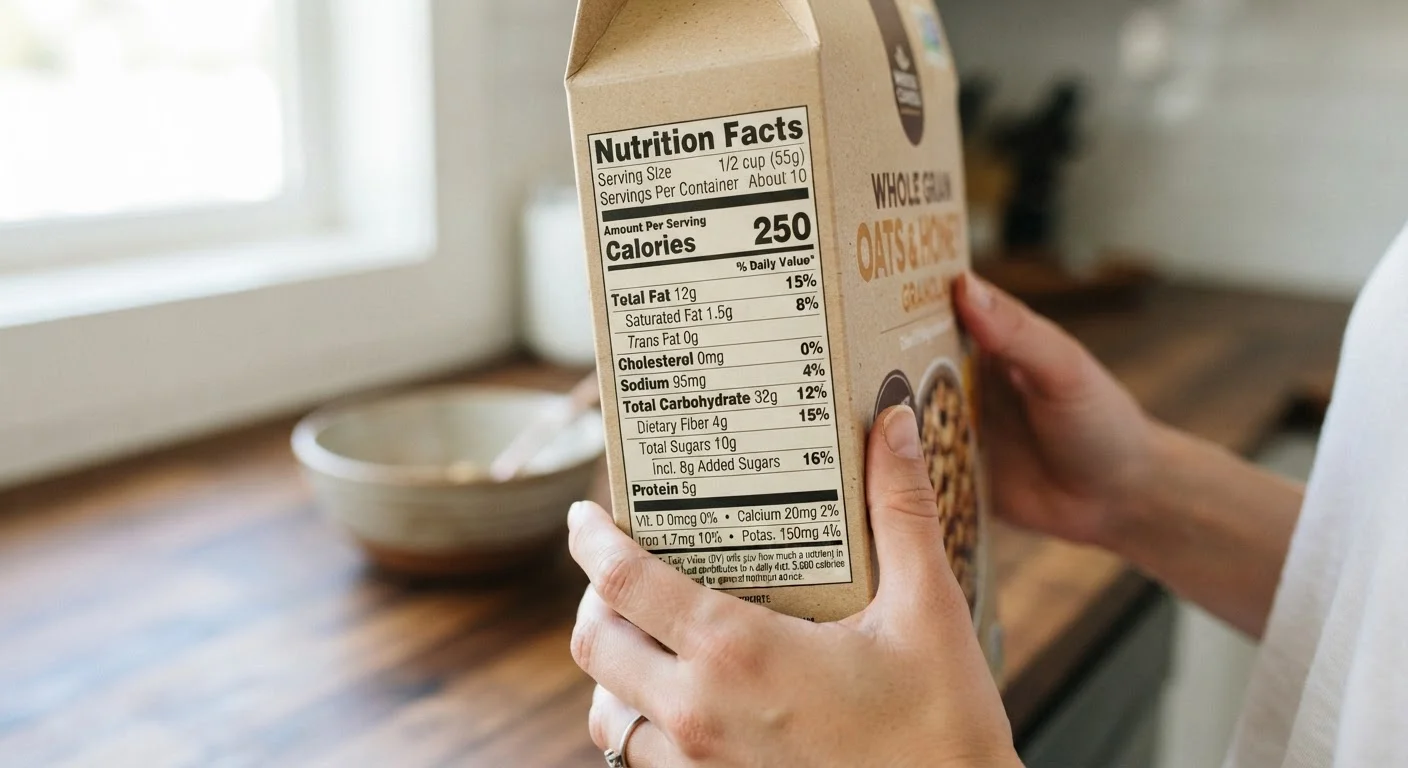
Before you read a single calorie or gram, look at the top of the Nutrition Facts panel. You'll see two lines: servings per container and serving size. Every number that follows is calculated for one serving - not the whole package.
Serving sizes are standardized by the FDA based on what people typically eat (called RACCs), so they reflect realistic portions rather than ideal ones. A bag of chips listed at 15 chips per serving isn't telling you how many to eat - it's the reference unit for all the nutrition data below.
Read the Calorie Count in Context
Calories appear prominently in large type, directly below the serving information. This number tells you how much energy one serving provides from all sources - fat, carbohydrates, and protein combined.
Calories alone don't tell you whether a food is nutritious or not. A handful of almonds and a handful of potato chips might have similar calorie counts, but their nutrient profiles differ significantly. Use calories as one data point, not the whole story. For a deeper look at what those macronutrients actually do, see our guide to macronutrients in plain English.
Scan the Nutrients to Limit
The middle section of the label lists specific nutrients. Dietary guidelines generally recommend most Americans limit:
- Saturated fat - linked in research to elevated LDL cholesterol levels
- Sodium - excess intake is associated with higher blood pressure in many people
- Added sugars - distinct from naturally occurring sugars in fruit or dairy, added sugars contribute calories with minimal nutritional benefit
Added sugars now appear as a separate sub-line under total sugars, a change introduced by the FDA's updated label requirements. This distinction matters: 12g of total sugar in plain yogurt (mostly lactose) is nutritionally different from 12g of added sugar in a flavored snack.
Look for Nutrients to Get Enough Of
Below the nutrients to limit, labels list nutrients many Americans don't get enough of: dietary fiber, vitamin D, calcium, iron, and potassium. A higher %DV here generally signals a more nutrient-dense choice.
Dietary fiber deserves particular attention. Most adults in the U.S. fall short of recommended fiber intake. Fiber supports digestive health, helps with satiety, and is associated with lower risks of certain chronic conditions according to established nutrition research.
Understand Percent Daily Value (%DV)
Percent Daily Value (%DV) is printed to the right of most nutrients. It shows how much of the daily recommended amount one serving provides, based on a 2,000-calorie reference diet established by the FDA.
Your actual needs may differ - calorie requirements vary by age, sex, activity level, and health status - but %DV gives you a consistent, label-to-label comparison tool. Think of it as a universal ruler rather than a personal prescription.
Check the Ingredients List
The ingredients list appears below the Nutrition Facts panel. Ingredients are listed in descending order by weight - whatever appears first makes up the largest proportion of the product. If refined flour or sugar is the first ingredient in a product marketed as "whole grain," the label is telling you something important.
Look for recognizable, whole-food ingredients toward the top. A long list of unfamiliar chemical-sounding names isn't automatically harmful - many are approved preservatives or emulsifiers - but a short, legible list typically indicates less processing. To understand how this connects to broader dietary patterns, see our article on whole foods versus processed foods.
Allergens such as milk, eggs, wheat, soy, peanuts, tree nuts, fish, and shellfish must be declared - either within the ingredient list or in a separate "Contains" statement below it.
Watch Out for Multiple Servings Per Package
Many single-serve-looking packages contain two or more servings. If you eat the whole container, multiply every number on the label - calories, sodium, sugar - by the number of servings per container. This is one of the most common ways people underestimate their intake without realizing it.
Putting It All Together
Nutrition labels are most useful when you treat them as a comparison tool rather than a pass/fail test for individual foods. No single food makes or breaks a healthy diet; patterns across many meals and days matter far more.
Use %DV as a Quick Scoring System
The FDA's general guidance is that 5% DV or less is considered low for a nutrient, while 20% DV or more is considered high. Use this shorthand when comparing similar products side by side - it works faster than trying to interpret raw gram amounts for every nutrient.
A few practical habits help: check the serving size before anything else, use %DV to compare products side by side, and scan the ingredients list when you want to understand what's actually in a product. If you find ingredient lists on consumer products interesting more broadly, a similar skill applies to other packaged goods - our article on reading a skincare label covers how cosmetic ingredient lists follow their own ordering rules.
Labels Are Information, Not Medical Advice
This article provides general nutrition education to help you read food packaging more confidently. It is not personalized dietary guidance or medical advice. If you have a specific health condition, food allergy, or dietary requirement, consult a registered dietitian or your healthcare provider before making significant changes to your eating habits.
This article is for general informational and educational purposes only and is not a substitute for personalized medical or dietary advice. Consult a qualified healthcare professional or registered dietitian for guidance specific to your health needs.
The content on this site is provided for informational purposes only and should not be considered a substitute for professional advice. While we strive to provide accurate and up-to-date information, we make no guarantees regarding its completeness or accuracy. Always consult a qualified professional for advice specific to your circumstances before making any decisions.