

Why Developmental Stage Matters More Than Age Alone
Parents often ask what age is "right" for a first pet. The more useful question is: what developmental stage is my child in, and what does that mean for how they'll interact with an animal every day?
A 4-year-old who is still building impulse control will reach for a hamster faster than they can modulate their grip. A 9-year-old who has internalized household routines can remember a feeding schedule reliably. A motivated 14-year-old may genuinely embrace the daily demands of a dog. These aren't just personality differences - they reflect predictable developmental patterns that have direct implications for pet safety and welfare.
Understanding this connection helps families avoid two common mistakes: underestimating how much supervision a young child needs around animals, and overestimating how much independent responsibility an older child is ready to take on without structure.
Temperament Matters on Both Sides
A child's developmental stage is only half the compatibility equation. An animal's individual temperament - its tolerance for noise, unpredictable movement, and handling - is equally important. Two dogs of the same breed can differ significantly in how they respond to children. Always meet and assess the specific animal, not just the species or breed.
For a broader look at how lifestyle and living situation factor into pet selection, see what your living situation says about the right pet.
Infants and Toddlers (Ages 0-3): Safety First, Always
Children in this stage have virtually no ability to self-regulate when it comes to animals. They grab, poke, and move unpredictably - behaviors that stress most animals and can trigger defensive reactions. At this age, the family's existing pets must be assessed for temperament rather than a new pet introduced primarily for the infant's benefit.
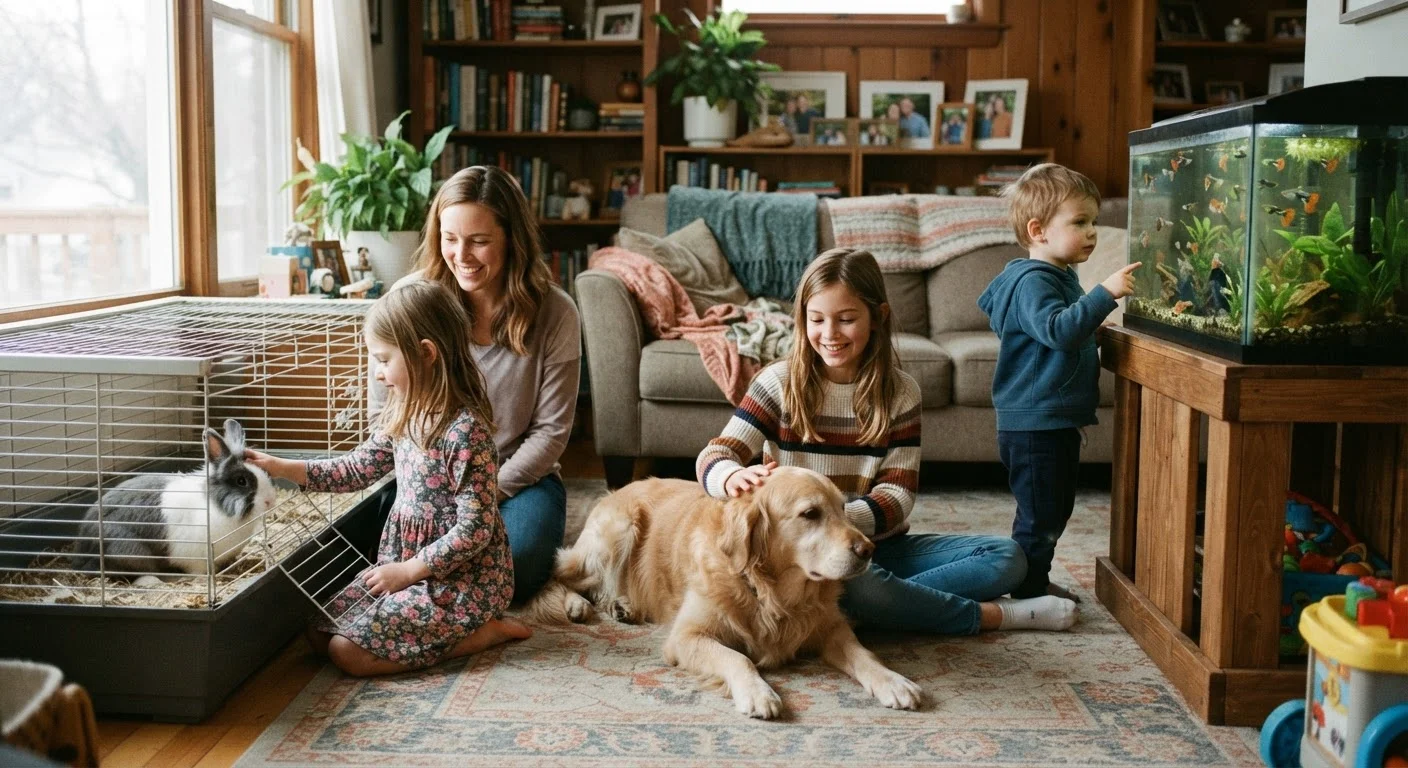
If pets are already in the home, calm, well-socialized dogs and cats with documented gentle temperaments are manageable with strict adult supervision. Fully enclosed habitats - aquariums, for example - allow toddlers to observe animals without physical contact risk.
Experts in pediatric safety consistently emphasize that no interaction between a toddler and any animal should be unsupervised, regardless of the animal's track record. See setting up a safe household with pets and children for practical supervision guidance.
~62%
U.S. households that own at least one pet
According to the American Pet Products Association's National Pet Owners Survey, a majority of American households include at least one pet, reflecting how common these decisions are for families.
Ages 6-8
Typical window for meaningful pet care participation
Child development frameworks generally place the onset of consistent routine-following and empathy - key prerequisites for responsible pet care - in the early middle childhood years.
~50%
Dog bites involving children as victims
The American Veterinary Medical Association notes that children are disproportionately represented in dog bite statistics, underscoring why developmental readiness and adult supervision matter when pairing kids with animals.
Early Childhood (Ages 4-7): Building Empathy, Still Developing Control
Children in this window are beginning to understand that animals have feelings and needs, but their impulse control remains inconsistent. They may genuinely want to be gentle and still squeeze too hard when excited. This stage suits pets that are tolerant of imperfect handling and housed in ways that give them an escape from unwanted attention.
Guinea pigs, with their generally calmer disposition compared to smaller rodents, are frequently cited by veterinarians as more appropriate for this age range than hamsters or gerbils. Dogs that are calm, medium-to-large in size, and well-trained around children can work well - but introductions should be slow and supervised. Small, fragile animals are higher-risk at this stage, not lower.
Assigning simple, concrete care tasks - refilling a water bowl, dropping pellets into a cage - can begin meaningful responsibility-building without placing the animal's welfare solely in the child's hands.
Middle Childhood (Ages 8-12): The Window of Genuine Readiness
This is the developmental sweet spot most often associated with successful first pet ownership. Children in this stage typically have the cognitive maturity to follow routines, the empathy to recognize when an animal is distressed, and the physical coordination to handle pets safely.
Dogs, cats, rabbits, and more interactive small mammals are reasonable considerations at this stage, with adult backup always in place. The factors families should weigh before bringing an animal home - including temperament, supervision needs, and space - apply here as much as at any other stage.
Parents should still hold ultimate accountability for the animal's welfare. A child's stated enthusiasm for a pet does not guarantee sustained follow-through, particularly once the novelty fades.
A family with a 2-year-old asks about getting a hamster as their child's "first pet."
A 9-year-old has been asking for a dog consistently for two years and helps walk the neighbor's dog regularly.
A 15-year-old wants a bearded dragon after watching reptile care videos online.
Parents of a 5-year-old want to use a new pet to teach responsibility.
Adolescence (Ages 13+): Self-Motivation Is the Key Variable
Teenagers can, in principle, handle the demands of almost any common household pet. The real question is motivation. A teen who is genuinely invested in animal care - not just responding to family pressure or a momentary interest - can take on meaningful responsibility for a dog, cat, reptile, or even more specialized animals.
Higher-maintenance pets such as reptiles, parrots, or certain exotic species require consistent, knowledgeable care that teens can learn, but adults should assess whether the interest is durable before committing. The demands of puppies versus adult animals are worth understanding before a teen takes on a young, high-energy pet.
One realistic check: if a teen's interest in a potential pet evaporates when daily chores or school demands pick up, that signals the family - not the teen alone - will be carrying the animal's care long-term. That's a legitimate family decision, but it should be made with clear eyes.
For more on matching pet type to your household's practical realities, comparing small pets to dogs and cats by lifestyle offers a useful framework.
Frequently Asked Questions
Fish and other animals housed entirely in enclosures present the lowest risk for toddlers, who cannot yet reliably control their grip strength or movements. If a dog or cat is already in the home, calm, well-socialized animals with a tolerant temperament and strict adult supervision are essential. No pet interaction with toddlers should be unsupervised.
Most child development professionals suggest that around ages 6-8, children begin developing the consistency and empathy needed to participate meaningfully in pet care. However, adult oversight and backup responsibility remain necessary until early adolescence, and even then, parents carry ultimate accountability for the animal's welfare.
Small animals such as hamsters, gerbils, and guinea pigs are often marketed as "starter pets" for young children, but many are fragile, quick-moving, and prone to stress from rough handling. Guinea pigs tend to be more tolerant than hamsters or gerbils, but all small mammals require gentle, calm interaction - a skill most children under age 7 are still developing.
Research and child development guidance broadly support the idea that age-appropriate pet care tasks - feeding, brushing, or refreshing water - can reinforce responsibility and empathy. The key word is age-appropriate: assigning care tasks beyond a child's developmental readiness can lead to neglect of the animal and frustration for the child.
Puppies require intensive training, socialization, and supervision - demands that stack on top of those already created by young children. Many animal behaviorists suggest that families with children under 5 consider adopting an adult dog with a known, gentle temperament rather than a puppy, reducing unpredictability on both sides.
Signs of readiness include the ability to follow household rules consistently, demonstrated gentleness with animals they've encountered, and genuine (not just expressed) interest sustained over several months. A trial period - such as pet-sitting for a neighbor - can reveal how a child actually engages with animal care before a permanent commitment is made.
The content on this site is provided for informational purposes only and should not be considered a substitute for professional advice. While we strive to provide accurate and up-to-date information, we make no guarantees regarding its completeness or accuracy. Always consult a qualified professional for advice specific to your circumstances before making any decisions.