

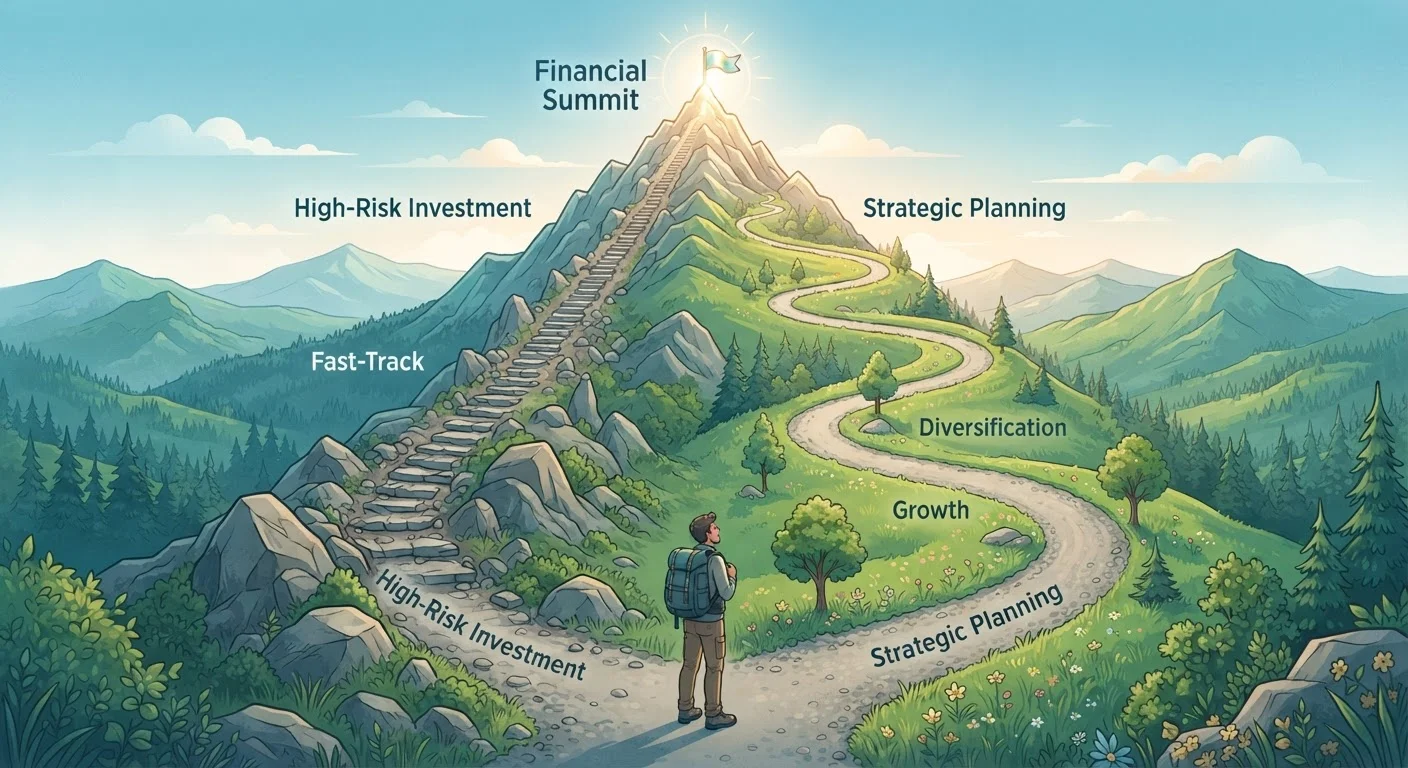
Option A
Debt Avalanche
The mathematically optimal, interest-minimizing approach.
Best for: Best for disciplined savers who want to minimize total interest paid over the life of their debt.
Option B
Debt Snowball
The motivation-first, momentum-building strategy.
Best for: Best for people who need early wins to stay engaged and committed to their payoff journey.
How Each Method Actually Works
Both the debt avalanche and debt snowball share the same foundational structure: pay the minimum required on every account each month, then direct any additional money toward one designated target debt. The difference is entirely in how you choose that target.
With the debt avalanche, you rank your debts by interest rate - highest to lowest - and focus extra payments on the account charging the most interest. Once that balance reaches zero, you redirect its payment to the next-highest-rate debt, creating a cascading effect. Because high-interest debt compounds faster, eliminating it first reduces the overall amount you'll pay before becoming debt-free.
With the debt snowball, you rank debts by balance - smallest to largest - and attack the smallest balance first, regardless of its interest rate. When that account is paid off, you roll that payment amount into the next-smallest balance, building a larger and larger payment over time. The strategy trades some mathematical efficiency for psychological momentum.
Neither method requires a windfall or drastic lifestyle change. Both work within whatever extra payment capacity you already have. For a structured starting point, see Building a Realistic Debt Payoff Plan From Scratch to map out your accounts before choosing a method.
| Criterion | Debt Avalanche | Debt Snowball |
|---|---|---|
| Payoff order | Highest interest rate first | Smallest balance first |
| Total interest paid | Lower (mathematically optimal) | Potentially higher |
| Time to first payoff | Longer if high-rate debt is large | Faster - smallest balance gone first |
| Motivational design | Relies on long-term discipline | Built-in early wins reinforce habits |
| Best when rates differ widely | Strong advantage | Less relevant |
| Best when many small balances exist | Less ideal | Highly effective |
| Complexity | Low - sort by APR | Low - sort by balance |
The Real Cost Difference - and What Research Says
In purely mathematical terms, the avalanche will almost always result in less total interest paid. The gap can be modest or significant depending on how different your interest rates are and how large the balances involved are. If you're carrying one account at 24% APR and another at 6%, the avalanche's advantage is substantial. If all your accounts hover within a few percentage points of each other, the difference narrows considerably.
~$1,000+
Potential interest savings with avalanche over snowball
The actual difference varies widely by balance size and rate spread; higher-rate, larger balances amplify the avalanche's advantage.
15%+
Average credit card APR in recent years
The Federal Reserve has tracked average credit card interest rates, which have remained above 15% for much of the past decade, underscoring the cost of carrying revolving balances.
Higher completion
Snowball adherence vs. interest-minimization focus
Research published in the Journal of Marketing Research found account-elimination strategies correlated with greater likelihood of sustained debt repayment behavior.
What makes the snowball compelling isn't math - it's behavior. A widely cited study published in the Journal of Marketing Research found that consumers who focused on eliminating individual accounts (rather than minimizing total interest) were more likely to pay down debt successfully. The act of closing out an account entirely appears to reinforce commitment and reduce the likelihood of abandoning the plan altogether.
This is why financial educators often say the best strategy is the one you'll actually stick with. A mathematically perfect plan that falls apart in month four costs more than a slightly less efficient plan you follow through to the end.
If you're weighing other tools alongside these strategies - such as consolidating multiple balances - Debt Consolidation Explained covers the mechanics and trade-offs in detail. For a direct comparison of consolidation tools, Personal Loan vs. Balance Transfer breaks down both paths side by side.
Choosing the Right Strategy for Your Situation
Before choosing a method, it helps to audit your debts with two numbers in hand for each account: the current balance and the annual percentage rate (APR). This exercise quickly reveals whether the avalanche or snowball is likely to serve you better.
- Wide rate spread: If your highest-rate debt carries an APR more than 5-8 percentage points above your lowest, the avalanche's savings become harder to ignore.
- Many small balances: If you have five or more accounts, several of which are nearly paid off, the snowball's quick wins can simplify your financial life and free up mental bandwidth.
- History of abandonment: If you've started payoff plans before and lost steam, prioritize the strategy that keeps you engaged - even if it costs slightly more in interest.
It's also worth keeping an emergency fund in mind as you plan. Depleting all available cash toward debt and then encountering an unexpected expense often leads to new debt. Saving While in Debt addresses how to balance these two competing priorities realistically.
Whichever method you choose, the discipline of maintaining it matters most. Both strategies beat the default of making minimum-only payments - which maximizes interest cost and extends your payoff timeline significantly. For a comprehensive walkthrough of building and adjusting a full payoff plan, Building a Realistic Plan to Become Debt-Free offers step-by-step structure.
This article is for general informational and educational purposes only and does not constitute personalized financial advice. Consider consulting a licensed financial professional for guidance tailored to your specific situation.
The content on this site is provided for informational purposes only and should not be considered a substitute for professional advice. While we strive to provide accurate and up-to-date information, we make no guarantees regarding its completeness or accuracy. Always consult a qualified professional for advice specific to your circumstances before making any decisions.