

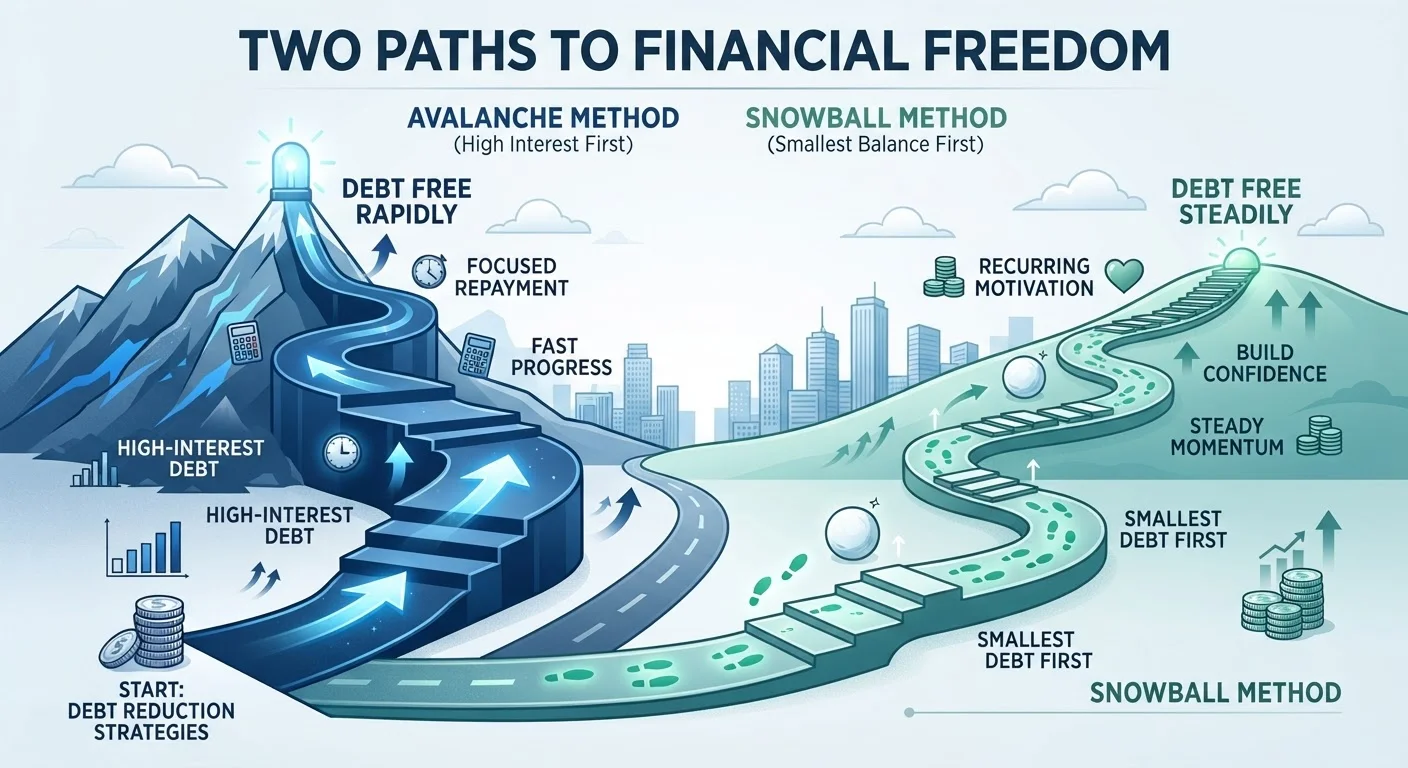
Option A
Debt Avalanche
The mathematically optimal, interest-minimizing approach.
Best for: Readers who are motivated by long-term savings and comfortable staying patient through slower early wins.
Option B
Debt Snowball
The momentum-driven, psychologically rewarding approach.
Best for: Readers who need visible progress and quick wins to stay consistent with their payoff plan.
How Each Strategy Works
Both the debt avalanche and debt snowball share the same foundational mechanic: you pay the minimum required on every debt each month, then direct any additional available funds toward one designated priority account. The two methods differ only in how that priority is determined.
Debt Avalanche: You rank your debts from highest to lowest annual percentage rate (APR). The debt with the steepest interest rate receives all extra payments first, regardless of its balance size. Once that debt is cleared, you roll its payment into the next-highest-rate debt, and so on until all balances reach zero.
Debt Snowball: You rank your debts from smallest to largest outstanding balance. The smallest balance gets extra payments first, regardless of its interest rate. Each time you eliminate a balance, you apply that freed-up payment amount to the next-smallest debt - gradually building a larger and larger "snowball" of funds directed at remaining balances.
For a structured approach to listing and scheduling all your payments, see our guide to building a realistic debt payoff plan.
| Criterion | Debt Avalanche | Debt Snowball |
|---|---|---|
| Payoff order | Highest interest rate first | Smallest balance first |
| Total interest paid | Generally lower | Generally higher |
| Time to first payoff | Potentially longer | Potentially shorter |
| Psychological momentum | Slower to build | Faster early wins |
| Best debt profile | High-rate debts dominate balance | Many accounts, varying sizes |
| Complexity | Requires tracking APRs | Easy to rank by balance |
| Optimal for | Disciplined, math-focused planners | Motivation-driven, behavior-focused planners |
The Real Cost Difference
Over a multi-year payoff timeline, the avalanche method typically produces a lower total interest cost. Because interest compounds continuously on outstanding balances, neutralizing the highest-rate debt first limits how much additional interest accumulates before that balance disappears. The advantage grows wider the larger and longer-lived your high-rate debts are.
The snowball method, by contrast, may leave high-interest balances accruing longer while smaller ones are cleared. This can result in paying meaningfully more in total interest - though the exact difference varies significantly based on each debt's rate, balance, and your monthly surplus.
~$1,000+
Potential interest savings with avalanche vs. snowball
Estimates vary widely by debt mix, but financial modeling consistently shows the avalanche costs less in interest when high-rate balances are large and long-lived.
3-5
Average number of debts carried by indebted U.S. households
Federal Reserve consumer credit data suggests many households juggle multiple debt types simultaneously, making payoff order a meaningful financial decision.
That said, the snowball's cost isn't purely a deficit. Research in consumer behavior suggests that the quick wins from clearing small accounts can improve adherence to a payoff plan. A strategy abandoned halfway through costs far more than a slightly less efficient strategy followed to completion.
If you're also weighing whether to consolidate before choosing a method, our comparison of personal loans vs. balance transfers can help clarify your options first.
Choosing the Right Method for Your Situation
Neither approach is universally superior - the right choice depends on a combination of financial math and personal psychology.
Lean toward the avalanche if:
- You have one or more debts with interest rates significantly above the rest of your portfolio.
- You are motivated by long-term financial efficiency and can tolerate a slower initial pace.
- Your debts have relatively similar balances, so the snowball wouldn't deliver wins much faster anyway.
Lean toward the snowball if:
- You have several small balances that feel overwhelming or cluttering.
- You've abandoned debt payoff attempts before and need early reinforcement to stay on track.
- Your debts have interest rates that are clustered close together, making the avalanche's mathematical edge small.
Minimum Payments Are Non-Negotiable
Both strategies depend on paying the minimum due on every account each month without exception. Skipping minimums on any account triggers late fees, potential penalty APRs, and credit score damage - all of which can undermine either method. Extra funds go to your priority debt only after all minimums are covered.
Some people use a hybrid approach: clearing one or two small nuisance balances for a motivational boost, then switching to an avalanche order. This isn't a formal method, but it reflects the reality that rigid adherence to any single framework matters less than sustained, consistent action.
Once you've selected a method, building it into a broader financial plan is essential. Our article on building a realistic plan to become debt-free walks through the budgeting and adjustment steps that make either strategy executable month to month. And if you're navigating the tension between paying down debt and building savings simultaneously, see our piece on saving while in debt for guidance on balancing those competing priorities.
This article is for general informational and educational purposes only and does not constitute personalized financial or legal advice. Consult a qualified financial professional before making decisions about your specific debt situation.
The content on this site is provided for informational purposes only and should not be considered a substitute for professional advice. While we strive to provide accurate and up-to-date information, we make no guarantees regarding its completeness or accuracy. Always consult a qualified professional for advice specific to your circumstances before making any decisions.