

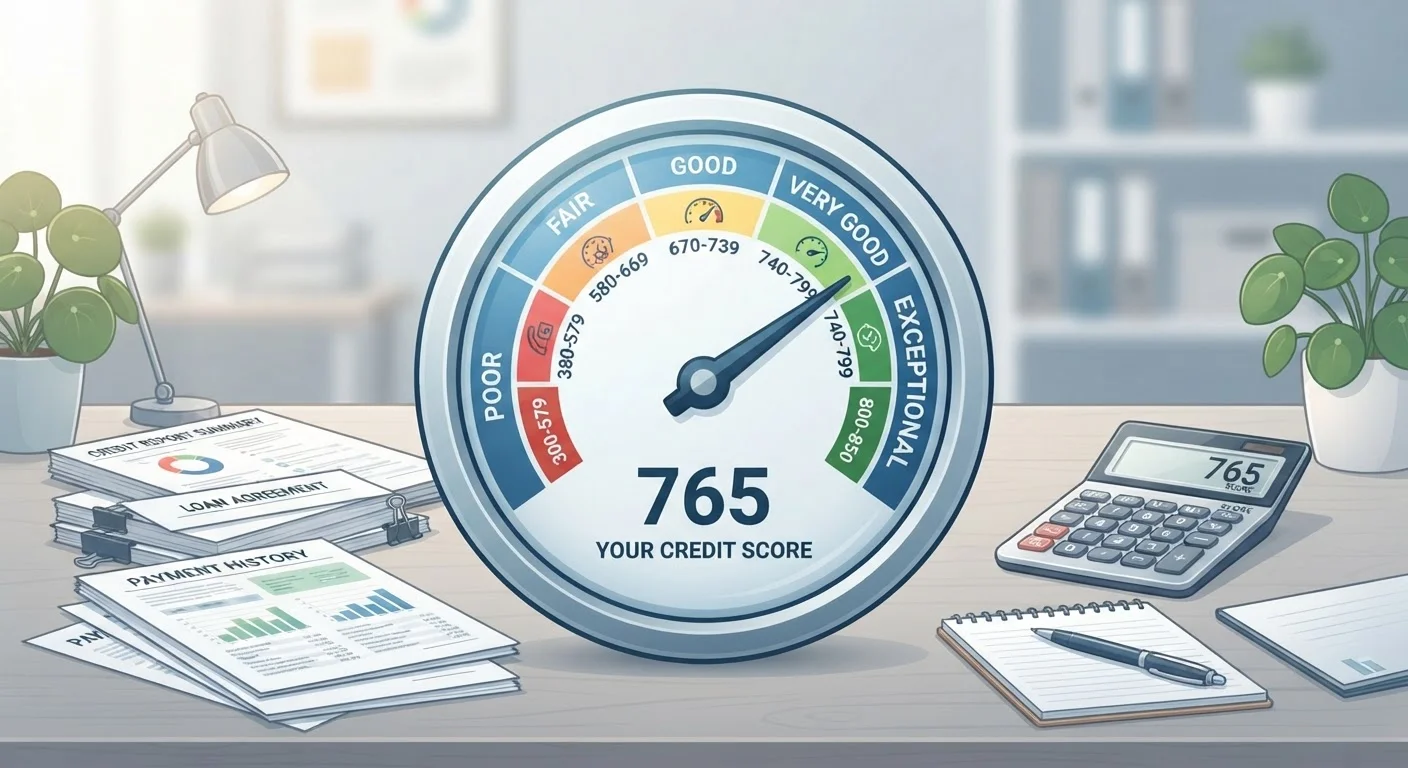
What a Credit Score Actually Represents
A credit score isn't a judgment of your financial worth - it's a statistical prediction. Specifically, it estimates the probability that you'll miss a payment by 90 or more days on any credit obligation within the next 24 months. Lenders use this single number to make fast, standardized decisions about risk.
The data feeding that calculation comes from your credit report - a detailed record maintained by the three major bureaus: Equifax, Experian, and TransUnion. Scoring models read that report and compress the information into a number. Because each bureau's file can differ slightly, and multiple scoring models exist, you can have dozens of technically valid scores at any given time. For a deeper look at how score ranges are defined and why lenders may see a different number than you do, see what credit score ranges actually mean.
300-850
Standard FICO Score range
The FICO Score, the most widely used credit scoring model in U.S. lending decisions, operates on this scale as defined by Fair Isaac Corporation.
35%
Weight of payment history in FICO scoring
Payment history is the single largest component of the base FICO Score model, according to Fair Isaac Corporation's published scoring methodology.
~200 million
Americans with a scoreable credit file
The Consumer Financial Protection Bureau estimates that roughly 200 million Americans have credit files sufficient to generate a credit score.
The Five Factors Behind the Number
FICO's widely used model groups credit behavior into five weighted categories:
- Payment history (≈35%): Whether you've paid on time. A single missed payment - especially a recent one - can have an outsized negative effect.
- Credit utilization (≈30%): The percentage of your available revolving credit currently in use. Keeping balances well below your credit limits generally supports a higher score.
- Length of credit history (≈15%): How long your accounts have been open, including your oldest account, newest account, and the average age of all accounts.
- Credit mix (≈10%): Whether your profile includes different types of credit, such as credit cards, installment loans, and mortgages.
- New credit (≈10%): Recent applications that triggered hard inquiries, plus newly opened accounts.
For a detailed breakdown of how each factor is calculated and what moves the needle most, see the five factors that shape your credit score.
Reducing Utilization Can Act Fast
Because credit utilization is recalculated each billing cycle, paying down revolving balances is one of the faster ways to see a score improvement. Aim to keep individual card utilization and overall utilization well below your credit limits. Even a single billing cycle can reflect the change.
Why Your Score Moves Month to Month
Credit scores aren't static. They recalculate each time a lender requests your score, using whatever data is on your credit report at that moment. Because creditors typically report updated account information once per billing cycle, your score can shift up or down regularly - even if you haven't done anything unusual.
Common causes of score movement include: paying down or charging up a credit card balance (changing your utilization ratio), a new account appearing on your report, an old negative item aging off, or a hard inquiry from a recent application. Before assuming something is wrong, it's worth auditing your credit profile to spot errors or overlooked factors. The checklist at before you try to raise your credit score is a practical starting point.
It's also worth knowing that some widely repeated assumptions about score behavior are simply wrong. Credit myths - like the idea that carrying a small balance helps your score - can lead people to take counterproductive steps.
This article is for general informational and educational purposes only and does not constitute personalized financial or credit advice. Consult a qualified financial professional for guidance specific to your situation.
Frequently Asked Questions
For FICO Scores, 670-739 is generally considered 'good,' 740-799 is 'very good,' and 800 or above is 'exceptional.' Scores below 580 are typically classified as 'poor.' These thresholds can vary slightly by lender and loan type.
Your score updates as lenders report new information - such as your latest balance, payment, or a new account - to the credit bureaus. Changes in your credit utilization ratio are one of the most common reasons for month-to-month fluctuations.
You have many, not just one. Each of the three major credit bureaus - Equifax, Experian, and TransUnion - maintains a separate file, and scores are generated by multiple models (FICO, VantageScore) on top of those files. Lenders may use any of these versions.
No. Checking your own credit score is a 'soft inquiry' and has no impact on your score. Only 'hard inquiries,' triggered when a lender reviews your credit for a lending decision, can have a small, temporary negative effect.
It depends on what's dragging the score down. Paying down high balances can show results within one to two billing cycles. Recovering from a missed payment or collections account generally takes longer - negative items can remain on your report for up to seven years.
Yes. Any credit account reported to the bureaus - such as an installment loan, student loan, or auto loan - can generate a scoreable file. However, having no credit accounts at all means you may be 'credit invisible' with no score.
The content on this site is provided for informational purposes only and should not be considered a substitute for professional advice. While we strive to provide accurate and up-to-date information, we make no guarantees regarding its completeness or accuracy. Always consult a qualified professional for advice specific to your circumstances before making any decisions.