

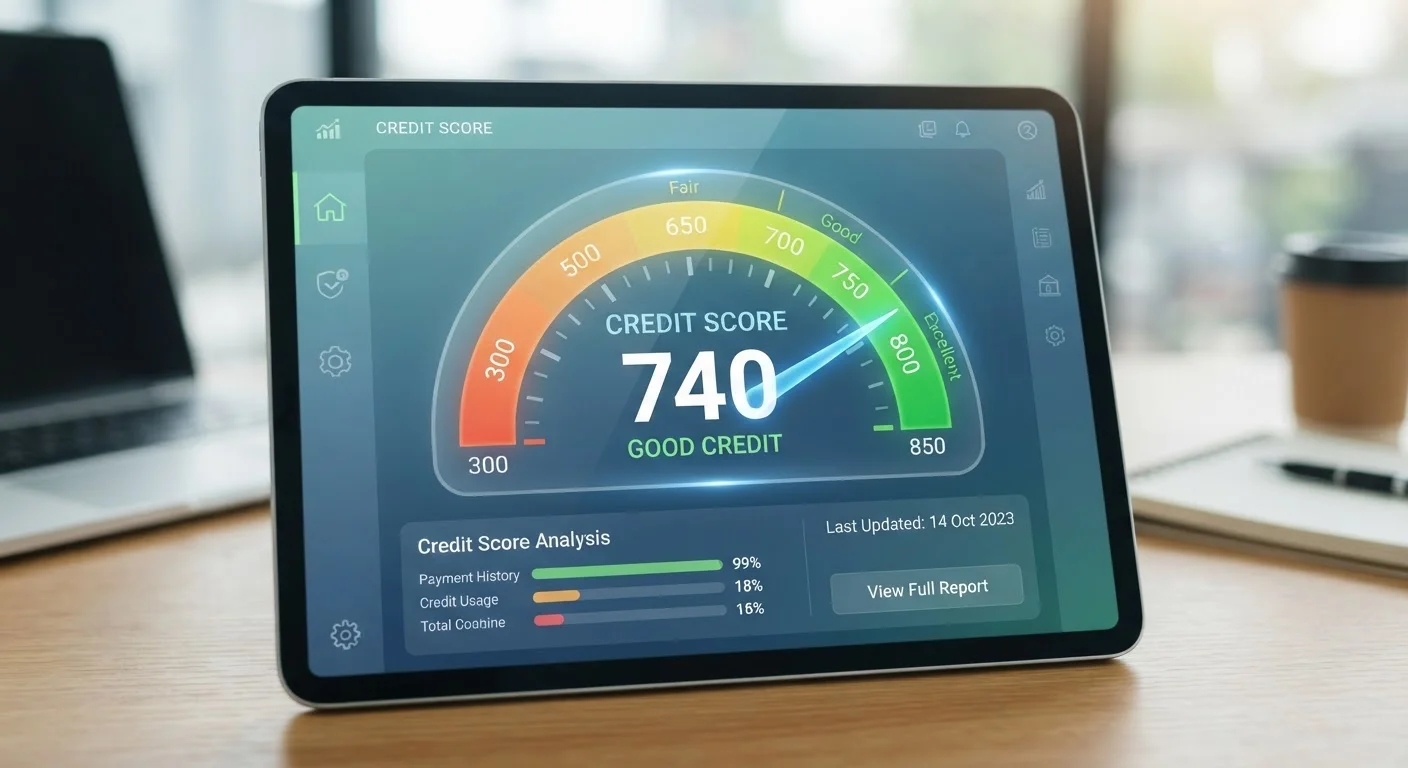
The Scale and What Each Band Signals
The standard credit score scale runs from 300 to 850. That range is not arbitrary - it was designed to give lenders a consistent, comparable measure of credit risk across millions of consumers. In practice, very few people sit at either extreme. Most Americans cluster somewhere in the middle, and the meaning of each band matters more than the precise number.
Using the FICO framework as a reference point:
- 800-850 (Exceptional): Borrowers in this range typically receive the most favorable interest rates and terms. Getting here requires years of disciplined credit behavior.
- 740-799 (Very Good): Lenders consider this tier low-risk. Most prime lending products are accessible here.
- 670-739 (Good): This is roughly the median range for U.S. consumers. Approval odds for mainstream credit products are solid, though not at the lowest available rates.
- 580-669 (Fair): Borrowers may face higher rates, stricter terms, or more limited product choices.
- 300-579 (Poor): Approval for unsecured credit becomes difficult. Secured products or credit-builder tools are often the practical starting point.
VantageScore uses the same 300-850 range but applies different band labels. The underlying logic is similar: higher scores represent lower predicted default risk.
716
Average U.S. FICO Score
According to Experian's State of Credit report, the average FICO Score in the United States has held in the 'good' range in recent years, though individual variation is wide.
~49%
Americans with scores above 750
FICO has reported that roughly half of U.S. consumers score in the very good or exceptional range, meaning meaningful credit-building opportunities remain for the other half.
5 points
Typical hard inquiry impact
A single hard inquiry - such as a lender pulling your credit for a loan application - typically reduces a FICO Score by fewer than 5 points and recovers within months, according to FICO's published guidance.
Why Your Score Isn't One Single Number
One of the most common sources of confusion: you don't have a single credit score. You have many, and they can differ by dozens of points depending on which bureau's data and which scoring model is being used.
The three major credit bureaus - Equifax, Experian, and TransUnion - each independently collect and store credit data. Because not every lender reports to all three bureaus, the underlying data sets can diverge. A delinquency showing on one bureau's file may not appear on another's, which directly shifts the resulting score.
Layered on top of this, both FICO and VantageScore have released multiple versions of their models over the years. Auto lenders often use industry-specific FICO Auto Scores; mortgage lenders typically rely on older FICO versions specified by federal guidelines. The score you see on a free monitoring app may be a different version entirely.
This isn't a flaw - it's a feature of a system designed to let different industries tailor risk assessment to their own lending behavior. What it means practically: the number shown on a free credit monitoring tool is directionally useful, but the score a specific lender pulls may differ. See our field guide to reading a credit report for a closer look at the raw data that feeds these calculations.
Request Your Reports, Not Just Your Score
Your credit score is derived from your credit report, so inaccuracies in the report flow directly into the score. U.S. consumers are entitled to free credit reports from all three major bureaus through AnnualCreditReport.com. Reviewing your reports for errors - incorrect account statuses, accounts you don't recognize - is a concrete first step before focusing on the score itself.
What a Score Does - and Doesn't - Tell a Lender
A credit score is a probability estimate, not a verdict. It predicts the statistical likelihood that a borrower will miss a payment by 90 or more days within the next 24 months. What it does not capture includes your income, assets, employment history, or current savings balance - all of which lenders also evaluate separately.
This is why two applicants with identical credit scores can receive different loan decisions. A lender assessing a mortgage application will look at your debt-to-income ratio alongside the score. An auto lender may weigh the length of your employment or your down payment amount. The score opens or narrows the door; it doesn't make the final call alone.
Understanding this distinction helps reframe the goal. Improving your score matters, but it's one variable in a larger lending equation. For a detailed breakdown of exactly how each scoring factor contributes to the number, see the five factors that shape your credit score. And if you're planning a vehicle purchase, understanding your credit score's role in an auto loan explains how lenders use score ranges to set financing terms.
This article is for general informational and educational purposes only and does not constitute personalized financial or credit advice. Consult a qualified financial professional for guidance specific to your situation.
Frequently Asked Questions
Under the FICO scoring model, a score of 670-739 is generally considered 'good,' while 740-799 is 'very good' and 800 and above is 'exceptional.' Scores below 580 are typically categorized as 'poor.' Different lenders may set their own thresholds depending on the type of credit product.
There are three major credit bureaus - Equifax, Experian, and TransUnion - and each maintains its own version of your credit report. Because lenders don't always report to all three, the data can differ. On top of that, FICO and VantageScore each have multiple versions of their models, so the combination of bureau data and scoring model can produce different numbers.
Your credit score is recalculated each time it is requested, using whatever data is currently in your credit report at that moment. Most lenders report account activity to bureaus monthly, so your score can shift month to month as new information arrives.
No. Checking your own score is classified as a soft inquiry and has no impact on your score. Only hard inquiries - initiated when a lender reviews your credit for a lending decision - can cause a small, temporary dip.
Yes. Landlords, insurers, and even some employers may review credit information as part of their screening processes. In many states, auto and home insurers use credit-based insurance scores (a related but distinct calculation) when setting premiums.
The content on this site is provided for informational purposes only and should not be considered a substitute for professional advice. While we strive to provide accurate and up-to-date information, we make no guarantees regarding its completeness or accuracy. Always consult a qualified professional for advice specific to your circumstances before making any decisions.