

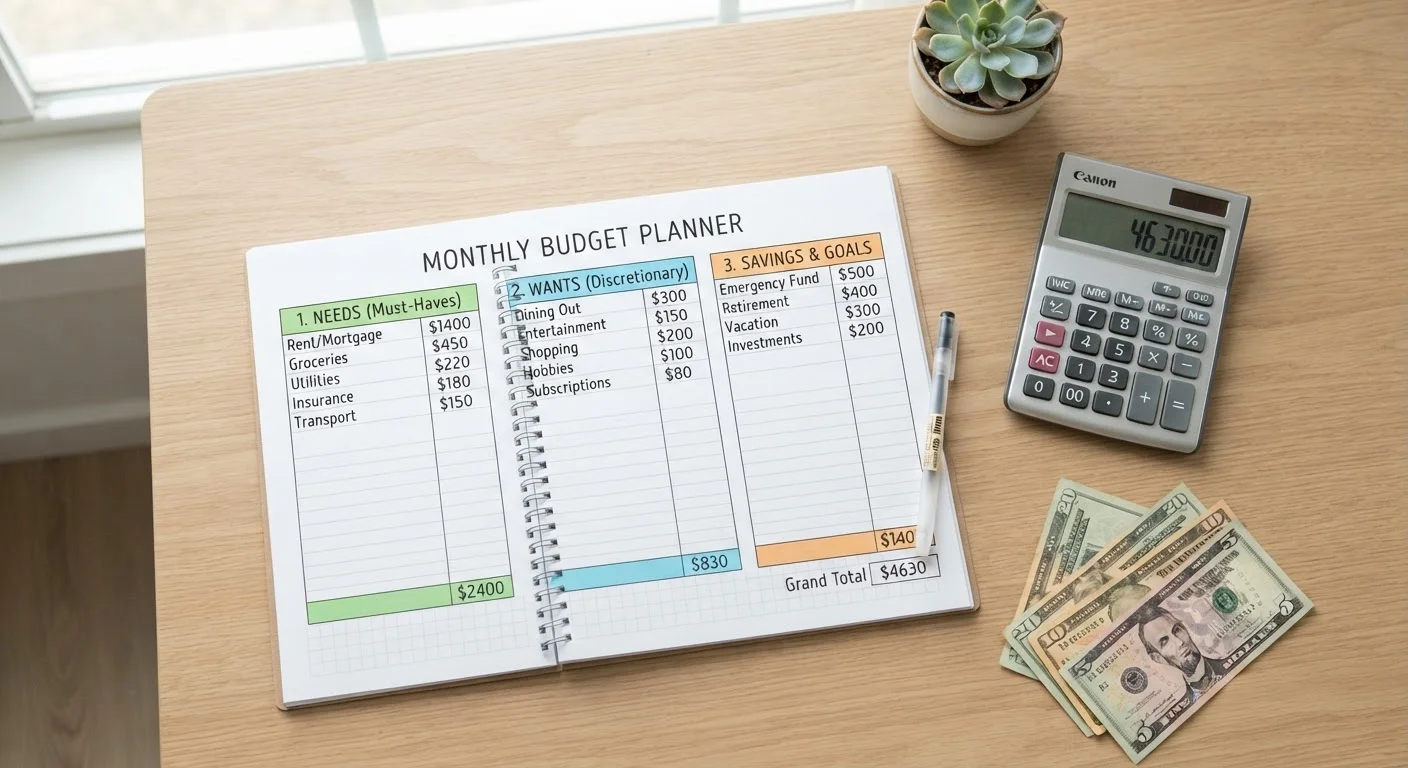
How the Three Categories Work
The 50/30/20 rule divides your monthly take-home pay into three distinct buckets, each with a specific purpose.
50% - Needs
This half of your income covers expenses you cannot reasonably live or work without: rent or mortgage, utilities, groceries, basic transportation, health insurance, and minimum loan payments. The word "needs" is deliberate - a streaming subscription is not a need, even if it feels essential. If your needs consistently exceed 50%, that's a signal to examine fixed costs like housing or loan obligations.
30% - Wants
Wants are discretionary expenses that improve your quality of life but aren't required for basic functioning: dining out, entertainment, gym memberships, travel, and clothing beyond the basics. This category gives you permission to spend on enjoyment without guilt - as long as it stays within the boundary. Keeping wants visible helps prevent lifestyle inflation from quietly crowding out savings.
20% - Savings and Debt Repayment
The final fifth goes toward building financial security and reducing debt above the minimum. This includes emergency fund contributions, retirement account deposits, and any extra payments toward credit card balances or student loans. Automating this transfer as soon as your paycheck arrives removes the temptation to spend it first. For guidance on setting that up, see automating your savings.
~70%
Americans living paycheck to paycheck at some point
Multiple surveys conducted over recent years suggest a majority of U.S. adults report little to no financial cushion, underscoring the need for structured budgeting frameworks.
20%
Recommended personal savings rate under this rule
The 20% savings target aligns broadly with guidance from many financial educators who recommend saving at least 15-20% of income for long-term financial stability.
50%
Share of income allocated to essential needs
Housing alone accounts for a disproportionate share of this bucket for many households - the U.S. Census Bureau consistently reports that a significant share of renters spend over 30% of income on housing costs.
Applying the Rule to Your Real Income
To put the 50/30/20 rule into practice, start with your actual monthly take-home pay. If your income varies - common for freelancers or hourly workers - use a conservative average of your last three to six months.
Multiply that figure by 0.50, 0.30, and 0.20 to get your category ceilings. Then audit your current spending and assign each expense to a bucket. Most people find the exercise itself revealing: what they thought were needs often turn out to be wants, and the savings gap becomes concrete rather than abstract.
If your needs already consume more than 50% of take-home pay - a reality in many major metro areas - adjust the proportions rather than abandoning the framework. A 60/20/20 split still provides structure and keeps savings a non-negotiable. The Saving and Emergency Funds hub offers practical next steps once your savings target is set.
Automate the 20% First
Set up an automatic transfer to savings or retirement accounts on payday - before you have a chance to spend that money elsewhere. Treating savings as a fixed expense rather than what's left over is the most reliable way to make the 20% target stick over time.
Strengths, Limitations, and When to Adjust
The 50/30/20 rule's primary strength is its simplicity. Unlike zero-based budgeting - which requires assigning every dollar to a named category - this framework asks only that you stay within three broad limits. That low friction makes it sustainable for people who find detailed tracking exhausting.
Its main limitation is that percentages are one-size targets applied to vastly different incomes and costs. A household earning $45,000 in a high-rent city may genuinely be unable to keep needs at 50%, while a household earning $150,000 may find 30% for wants is far more than they want to spend. In both cases, the right response is to treat the rule as a starting point and calibrate from there.
People carrying high-interest debt may also choose to redirect part of the wants budget toward accelerated repayment until balances are under control. Understanding how debt load interacts with spending priorities is explored in our piece on credit utilization and the 30% rule. If your budget keeps failing despite your best efforts, signs your budget needs an overhaul can help you diagnose structural problems.
A single professional earns $4,000 per month after taxes. She allocates $2,000 to needs (rent, groceries, utilities, insurance), $1,200 to wants (dining, travel, subscriptions), and $800 to her emergency fund and Roth IRA contributions.
A couple in a high-cost city finds their rent and childcare alone consume 58% of their combined net income, leaving the 50% needs target impossible to hit.
A recent graduate with $28,000 in student loan debt uses the 20% bucket to make extra loan payments beyond the minimum while also building a small emergency fund.
This article is for general informational and educational purposes only and does not constitute personalized financial advice. Consult a qualified financial professional for guidance specific to your situation.
Frequently Asked Questions
The rule applies to your net income - the amount you actually take home after taxes and pre-tax deductions like employer-sponsored retirement contributions. Using gross income would overstate your available budget since those funds never reach your bank account.
Needs are expenses required to maintain basic living and employment: rent or mortgage payments, utilities, groceries, transportation to work, insurance premiums, and minimum debt payments. Upgrades beyond a basic level - like a premium cable package or a luxury car payment - are considered wants.
This is common in high cost-of-living cities. In that case, adjust the split - for example, 60/20/20 - and look for ways to reduce fixed costs over time through refinancing, downsizing, or increasing income. The framework is a guide, not a mandate.
Generally, if your employer match is applied before your paycheck arrives, it may not factor into your net income baseline. However, tracking it toward your overall savings rate is still worthwhile. The key is ensuring your personal contributions meet your long-term goals.
Not necessarily. It works well as an entry-level framework for those new to budgeting, but higher earners, those with significant debt, or people with complex financial goals may benefit from more precise methods. See how it compares to other approaches in our <a href="/finance/budgeting-basics/budgeting-approaches-compared-503020-zero-based-pay-yourself-first-and-more">budgeting methods comparison</a>.
Yes, though it requires agreeing on what counts as a shared need versus individual want. Combining incomes and applying the percentages to total household net pay is one approach. Our article on <a href="/finance/budgeting-basics/budgeting-as-a-couple-what-tends-to-work-and-what-creates-friction">budgeting as a couple</a> covers the trade-offs in detail.
The content on this site is provided for informational purposes only and should not be considered a substitute for professional advice. While we strive to provide accurate and up-to-date information, we make no guarantees regarding its completeness or accuracy. Always consult a qualified professional for advice specific to your circumstances before making any decisions.