

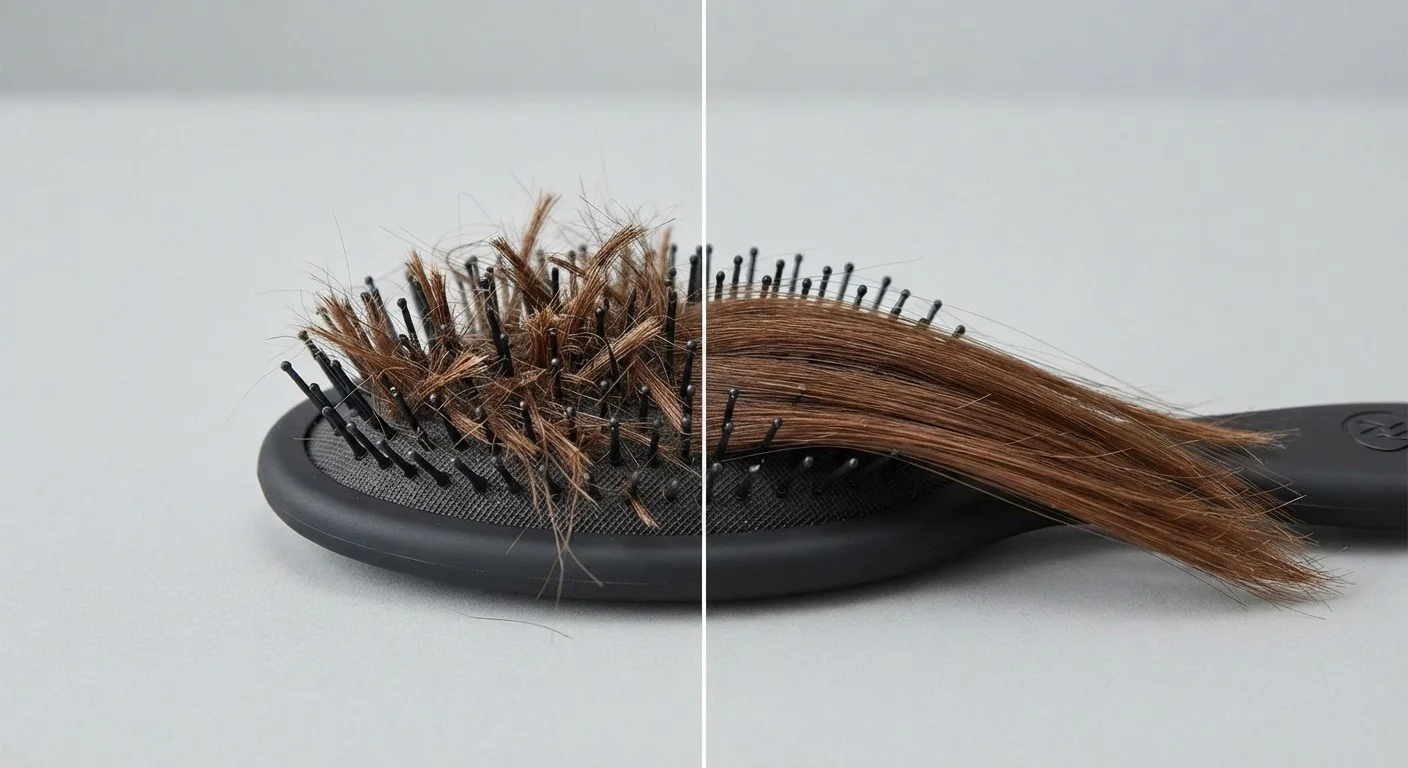
Option A
Hair Breakage
Damage to the strand itself, not the follicle.
Best for: Understanding why strands snap mid-shaft due to mechanical stress, heat, or moisture imbalance.
Option B
Hair Loss (Shedding)
A follicle-level process involving the hair's natural or disrupted growth cycle.
Best for: Recognizing when the root itself releases the strand - and when that signals a systemic concern.
How to Tell the Difference at a Glance
The single most reliable way to distinguish breakage from shedding is to examine the strand itself. A hair that has been shed naturally - released by the follicle at the end of its growth phase - will have a small, often white or translucent bulb at one end. That bulb is the root structure. A broken hair has no bulb. Instead, both ends will look frayed, blunt, or tapered, because the shaft snapped somewhere in the middle.
Length is another useful cue. Shed hairs tend to reflect your actual hair length. Broken strands are usually significantly shorter - sometimes just a few centimeters - because they've fractured partway down the shaft rather than releasing from the root.
| Criterion | Hair Breakage | Hair Loss (Shedding) |
|---|---|---|
| Origin | Mid-shaft fracture | Follicle releases strand at root |
| Root bulb present? | No | Yes - small white or translucent bulb |
| Typical strand length | Shorter than normal hair length | Reflects actual hair length |
| Primary causes | Heat, chemicals, mechanical stress, dryness | Hormonal shifts, genetics, stress, nutrition, medical |
| Scalp density affected? | Not directly | Yes, over time |
| Typical response area | Strand care and styling habits | Systemic health or dermatological evaluation |
If you're finding a mix of both types in your brush or shower drain, that's common. Many people experience some degree of each simultaneously. The key is identifying which pattern is dominant, since the contributing factors - and the appropriate responses - differ considerably.
What Causes Hair Breakage
Hair breakage is fundamentally a structural problem. The hair shaft is made up of keratin proteins arranged in overlapping scales (the cuticle). When that structure is compromised, the strand becomes fragile and prone to snapping under ordinary tension.
Common contributors include:
- Heat styling: Repeated high-heat exposure degrades the protein bonds within the shaft.
- Chemical processing: Bleaching, perming, and relaxing treatments alter the hair's internal structure, often leaving it porous and weak.
- Mechanical stress: Tight hairstyles, aggressive brushing, and rough towel-drying all place physical strain on the strand.
- Moisture imbalance: Both excessive dryness and over-moisturizing (hygral fatigue) can weaken the shaft's integrity over time.
The myths around hair care - like assuming natural ingredients are always gentler - can sometimes lead people to unknowingly continue habits that worsen breakage.
What Causes True Hair Loss
Hair loss, by contrast, begins at the follicle. The hair growth cycle has three main phases: anagen (active growth), catagen (transition), and telogen (rest and shedding). Losing 50-100 hairs per day is considered within the normal range for most adults, as follicles continuously cycle through these phases.
When shedding exceeds what's typical, or when it becomes diffuse or patterned, the cause is usually systemic rather than topical. Recognized contributors include:
- Telogen effluvium: A temporary increase in shedding often triggered by physical or emotional stress, illness, nutritional deficiency, or hormonal shifts (such as postpartum changes).
- Androgenetic alopecia: A hereditary pattern of follicle sensitivity to androgens affecting both men and women.
- Medical conditions and medications: Thyroid disorders, iron deficiency, and certain medications can all influence the growth cycle.
- Alopecia areata: An autoimmune condition that disrupts follicle function.
When to See a Dermatologist
If you're shedding well above what feels normal for you - particularly if it's been consistent for more than a few months, or if you're noticing visible thinning at the scalp - a dermatologist is the right point of contact. Hair loss can be a signal of underlying health conditions that benefit from early identification. Self-diagnosis based on appearance alone is often unreliable.
Understanding what the scalp itself is signaling is often part of the picture. Conditions like scalp inflammation or persistent flaking can sometimes accompany or complicate hair loss - see what your scalp is actually telling you for a closer look at those signs.
Why the Distinction Shapes Your Approach
Treating breakage as though it were hair loss - or vice versa - leads people toward interventions that simply don't address the actual issue. Topical conditioning treatments and adjusted styling habits can meaningfully support strand integrity when breakage is the problem. They will not, however, restart follicle activity in cases of genuine hair loss.
Conversely, someone experiencing telogen effluvium doesn't necessarily need a restructuring hair mask - they may need a blood panel, a conversation about nutritional gaps, or guidance from a dermatologist or physician.
Wash frequency can also intersect with both concerns. Cleansing habits affect scalp health and strand condition in ways that aren't always intuitive - how often you wash can influence oil balance and strand integrity over time.
If shedding has increased noticeably, if density is visibly reducing, or if loss follows a distinct pattern, consulting a board-certified dermatologist is the appropriate next step. This article is for general informational purposes only and is not a substitute for professional medical evaluation.
This article is for informational purposes only and does not constitute medical advice. If you are experiencing significant or persistent hair loss, consult a qualified healthcare professional.
The content on this site is provided for informational purposes only and should not be considered a substitute for professional advice. While we strive to provide accurate and up-to-date information, we make no guarantees regarding its completeness or accuracy. Always consult a qualified professional for advice specific to your circumstances before making any decisions.