

Our Verdict
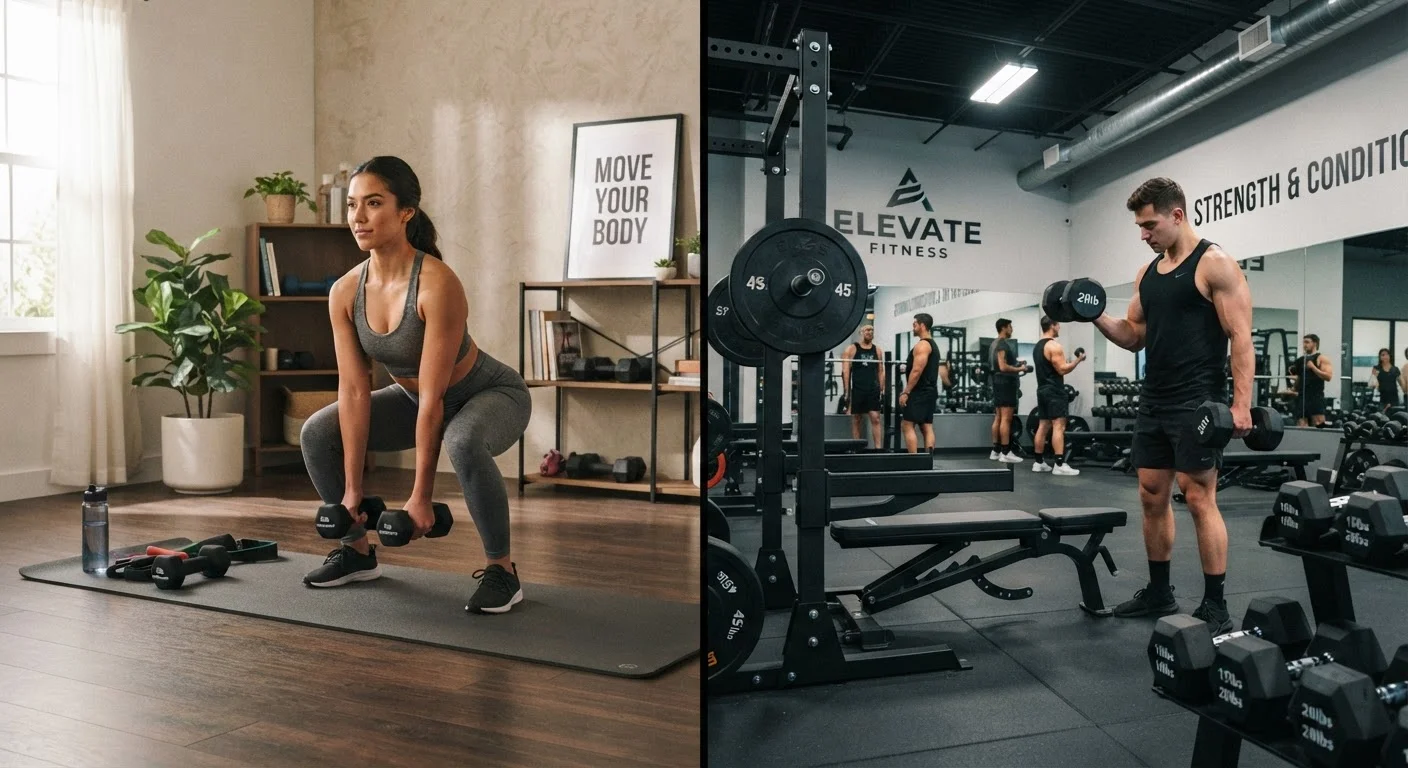
Both home workouts and gym memberships can support a sustainable fitness routine - the difference lies in which environment actually gets you moving consistently. If cost, schedule flexibility, and privacy are priorities, home training deserves serious consideration. If access to heavy equipment, coaching, and a motivating community are what keep you accountable, a gym membership is likely worth the investment.
| Best for | Recommended |
|---|---|
| Those working within strict time or cost constraints | Home Workouts |
| People who thrive on social motivation and structured environments | Gym Membership |
| Experienced lifters focused on progressive strength training | Gym Membership |
| Anyone who wants flexibility without long-term financial commitment | Home Workouts |
The Core Question: What Actually Drives Consistency?
Before comparing price tags or equipment lists, the most useful question is simpler: Which setting makes you more likely to exercise tomorrow? Exercise science consistently identifies adherence - showing up over months and years - as the primary driver of results, regardless of training method.
Convenience is one of the strongest predictors of exercise adherence. A 2017 study published in the International Journal of Environmental Research and Public Health found that proximity to exercise facilities meaningfully influenced physical activity levels. For some people, a ten-minute commute is a dealbreaker. For others, leaving the house is the mental shift that separates leisure from training mode.
Neither home nor gym workouts have an inherent advantage here - they compete on very different terms depending on the individual. Once you recognize consistency as the real metric, the comparison becomes easier to navigate. You can also explore how to structure whatever routine you choose with a realistic weekly exercise schedule built around your actual life.
Cost: More Nuanced Than It Looks
Gym memberships in the U.S. typically range from roughly $10 to $100 or more per month depending on facility type, location, and access tier. Over several years, that adds up - but the comparison isn't simply "free vs. paid."
Home workouts carry upfront costs. Resistance bands, adjustable dumbbells, a pull-up bar, or a quality exercise mat all require investment. A functional home setup can cost anywhere from under $100 to several thousand dollars depending on goals. Unlike a membership, however, equipment is a one-time purchase that depreciates slowly.
| Home Workouts | Gym Membership | |
|---|---|---|
| Upfront Cost | Equipment purchase required | Typically low or none |
| Ongoing Cost | Minimal after setup | $10-$100+ per month |
| Equipment Variety | Limited by budget and space | Extensive, professionally maintained |
| Convenience | No commute, available anytime | Requires travel to facility |
| Social Motivation | Low unless using digital classes | High - classes, trainers, community |
| Privacy | Complete privacy | Shared public environment |
| Space Required | Needs dedicated area at home | No home space needed |
The real cost question is utilization. A $30/month gym membership used twice a week delivers solid value. The same membership used twice a month does not. Similarly, a $400 home dumbbell set provides excellent return if used regularly - and collects dust if it doesn't fit your routine.
Space, Equipment, and Training Variety
Gyms offer access to equipment that is genuinely difficult to replicate at home: cable machines, barbells with significant loading capacity, rowing ergometers, and a range of cardio machines. For those focused on progressive overload in strength training - gradually increasing resistance over time - a gym's equipment depth is a meaningful advantage.
Home training has become dramatically more capable, particularly with adjustable dumbbells and resistance bands. Bodyweight training can drive real fitness improvements across strength, mobility, and endurance - especially for beginners and intermediate exercisers. Its limits become more apparent at advanced strength levels.
Space is a genuine constraint for many Americans. Apartment dwellers, families, or those without a spare room may find dedicated home training difficult. A gym sidesteps this completely.
Start Small to Test Your Habits
If you're unsure which setting suits you, try a short-term gym pass before committing to an annual contract, or invest in a minimal home kit - resistance bands and a mat - before purchasing larger equipment. Your actual behavior over four to six weeks is far more informative than your intentions at the start.
Motivation, Accountability, and Social Environment
Gyms provide a social environment that some exercisers find genuinely energizing - group fitness classes, training partners, and the ambient energy of others working hard. Research on social facilitation suggests that exercising alongside others can boost effort and enjoyment for many people.
Home workouts remove social pressure entirely, which can be a feature or a bug. Privacy is valuable for beginners who feel intimidated in gym settings. The absence of external accountability, however, means internal motivation carries more weight - and motivation is variable and unreliable on its own.
Structured classes, personal trainers, and community-based programming are primarily gym advantages. Digital fitness platforms have partially closed this gap for home exercisers, offering live and on-demand instruction, but the in-person dynamic is distinct.
Pairing either environment with a clear training focus - such as understanding what strength training and cardio each actually do for your body - helps you make better use of whatever setting you choose.
This article is for general informational purposes only and does not constitute medical or personal fitness advice. Consult a qualified health professional before beginning any new exercise program, especially if you have existing health conditions.
The content on this site is provided for informational purposes only and should not be considered a substitute for professional advice. While we strive to provide accurate and up-to-date information, we make no guarantees regarding its completeness or accuracy. Always consult a qualified professional for advice specific to your circumstances before making any decisions.