

Option A
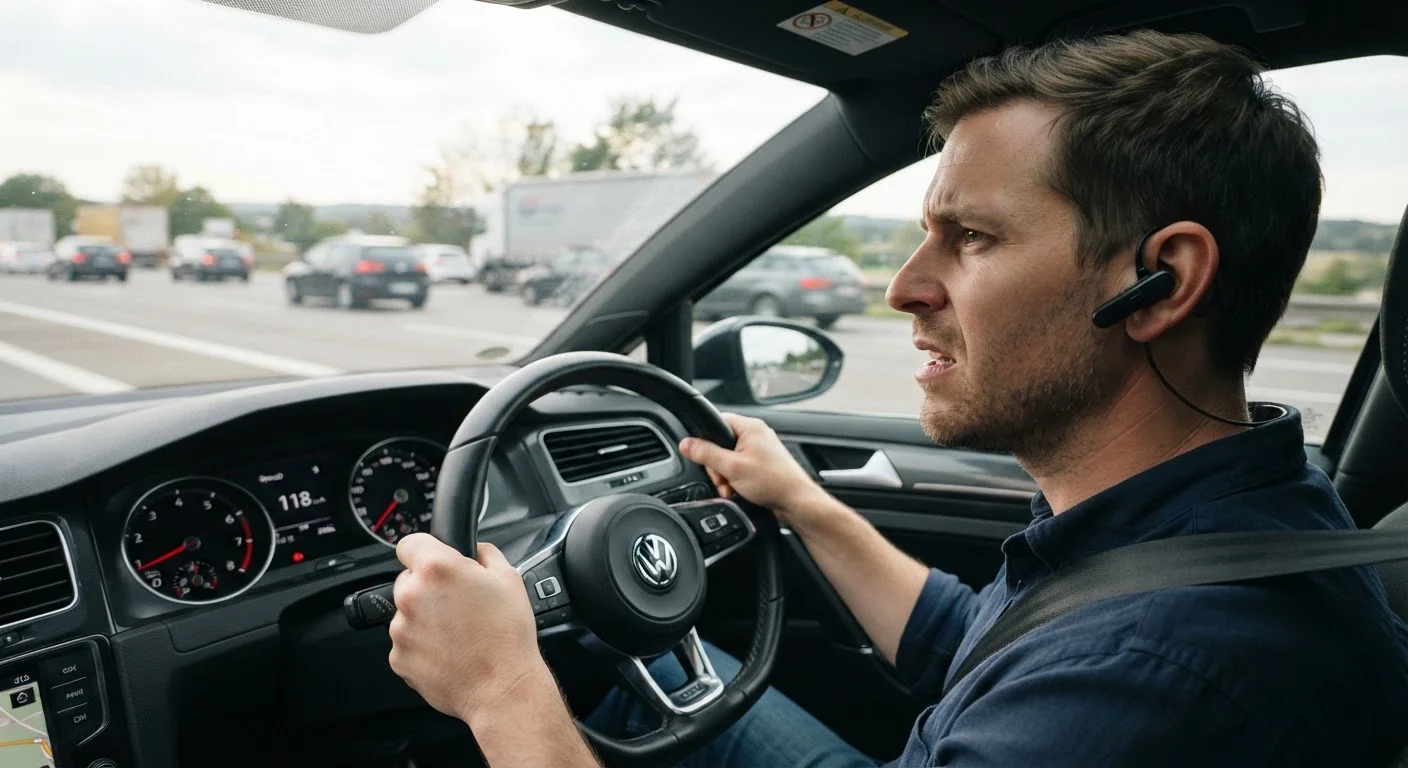
Hands-Free Calling
The legally permitted, tech-enabled option.
Best for: Drivers who need to communicate while behind the wheel and are subject to handheld phone bans.
Option B
Phone-in-Hand Calling
The manually operated, widely restricted method.
Best for: No recommended driving use case - handheld phone use while driving is illegal in most U.S. states.
What the Law Says vs. What Research Shows
In most U.S. states, holding a phone while driving is illegal. As of widely reported legislative trends, more than 20 states have enacted hands-free laws requiring drivers to use Bluetooth, speakerphone mounted on the dash, or earpieces. The legal rationale is straightforward: removing the phone from the hand eliminates a physical handling risk and keeps both hands available for vehicle control.
What the law permits and what safety research recommends, however, are not always the same thing. The National Safety Council (NSC) - a nonprofit accredited safety organization - has long maintained that hands-free devices do not make phone calls safe while driving. Their position, supported by peer-reviewed cognitive science, is that the primary danger isn't holding the phone; it's the conversation itself.
Understanding this gap is essential for any driver who assumes that switching to a Bluetooth headset fully resolves their distraction risk.
| Criterion | Hands-Free Calling | Phone-in-Hand Calling |
|---|---|---|
| Legal status (most U.S. states) | Permitted | Illegal while driving |
| Manual distraction | Minimal | High - one hand occupied |
| Visual distraction | Low | Moderate to high |
| Cognitive distraction | Significant | Significant |
| Reaction time impact | Measurably slower than no call | Measurably slower than no call |
| NSC safety classification | Distracted driving risk | Distracted driving risk |
| Overall crash risk vs. no phone use | Elevated | Significantly elevated |
The Science of Cognitive Distraction
Distracted driving research typically separates three types of distraction: visual (eyes off the road), manual (hands off the wheel), and cognitive (mind off the task of driving). Handheld phone use involves all three simultaneously - a well-documented and serious combination.
Hands-free calling eliminates manual and largely reduces visual distraction. But cognitive distraction remains nearly identical. Studies published in journals including Human Factors have used brain imaging and driving simulation to show that when a driver engages in a phone conversation, activity in the parietal lobe - the brain region involved in spatial processing - decreases by approximately 37%. That reduction in spatial attention occurs whether the phone is in hand or connected via Bluetooth.
Research from the University of Utah found that drivers using hands-free devices had slower reaction times, missed traffic signals at higher rates, and followed vehicles more closely than drivers not using phones at all. Reaction time impairment was measured as comparable to driving with a blood alcohol content at the legal limit in some test conditions - a finding also relevant to how impairment from other sources compares.
37%
Reduction in spatial brain activity during phone calls
Research using brain imaging found parietal lobe activity drops significantly during phone conversations, affecting spatial awareness while driving.
50%
Visual information potentially missed during calls
The National Safety Council cites research suggesting drivers can fail to process up to half of what they see while engaged in phone conversations.
4x
Increased crash risk with any phone use while driving
Research published in epidemiological studies estimates phone use while driving quadruples crash risk compared to driving without a phone.
It's worth noting that talking to a passenger produces less cognitive impairment than a phone call. Researchers attribute this to the fact that a passenger naturally pauses conversation during hazardous moments and shares the driver's visual environment - neither of which is true of a remote caller.
What Drivers Should Actually Know
The practical takeaway isn't that hands-free calling is equivalent to texting or equally dangerous to handheld use in every scenario - the physical risks of holding a device are real and hands-free does reduce those. But the persistent public assumption that hands-free is categorically safe doesn't hold up under scrutiny.
Drivers who want to minimize risk should consider the following evidence-based approaches:
- Pull over or park before making or receiving a call, particularly for longer conversations.
- Use voicemail or call-back features to defer non-urgent calls until the vehicle is stopped.
- Inform callers that you are driving and will return the call - most callers will understand.
- Avoid emotionally complex or demanding conversations while in motion, as emotional engagement amplifies cognitive distraction.
For more context on how driver impairment operates across different conditions, see our coverage of drowsy versus alcohol-impaired driving. Similarly, understanding evidence-based safety fundamentals - like those covered in our article on seat belt myths - helps build a clearer, research-grounded picture of risk behind the wheel.
State Laws Vary - Check Your Local Rules
Distracted driving laws differ significantly by state, and some localities have additional restrictions. What is technically permitted under a hands-free law in one state may be restricted differently elsewhere. Always verify the specific regulations in your state and any state you plan to drive through. Compliance with the law, while important, does not eliminate all safety risk as described in this article.
The content on this site is provided for informational purposes only and should not be considered a substitute for professional advice. While we strive to provide accurate and up-to-date information, we make no guarantees regarding its completeness or accuracy. Always consult a qualified professional for advice specific to your circumstances before making any decisions.