

Option A
Replacement Cost Value (RCV)
The more complete - and more expensive - coverage option.
Best for: Homeowners who want to fully rebuild or replace what they lost without absorbing a depreciation penalty.
Option B
Actual Cash Value (ACV)
The lower-premium option that factors in depreciation.
Best for: Homeowners with older structures or contents who can accept a smaller payout in exchange for lower premiums.
How Each Valuation Method Works
When you file a homeowners insurance claim, the dollar amount your insurer pays depends heavily on which valuation method is written into your policy. The two most common are Replacement Cost Value (RCV) and Actual Cash Value (ACV) - and they can produce dramatically different outcomes for the same loss.
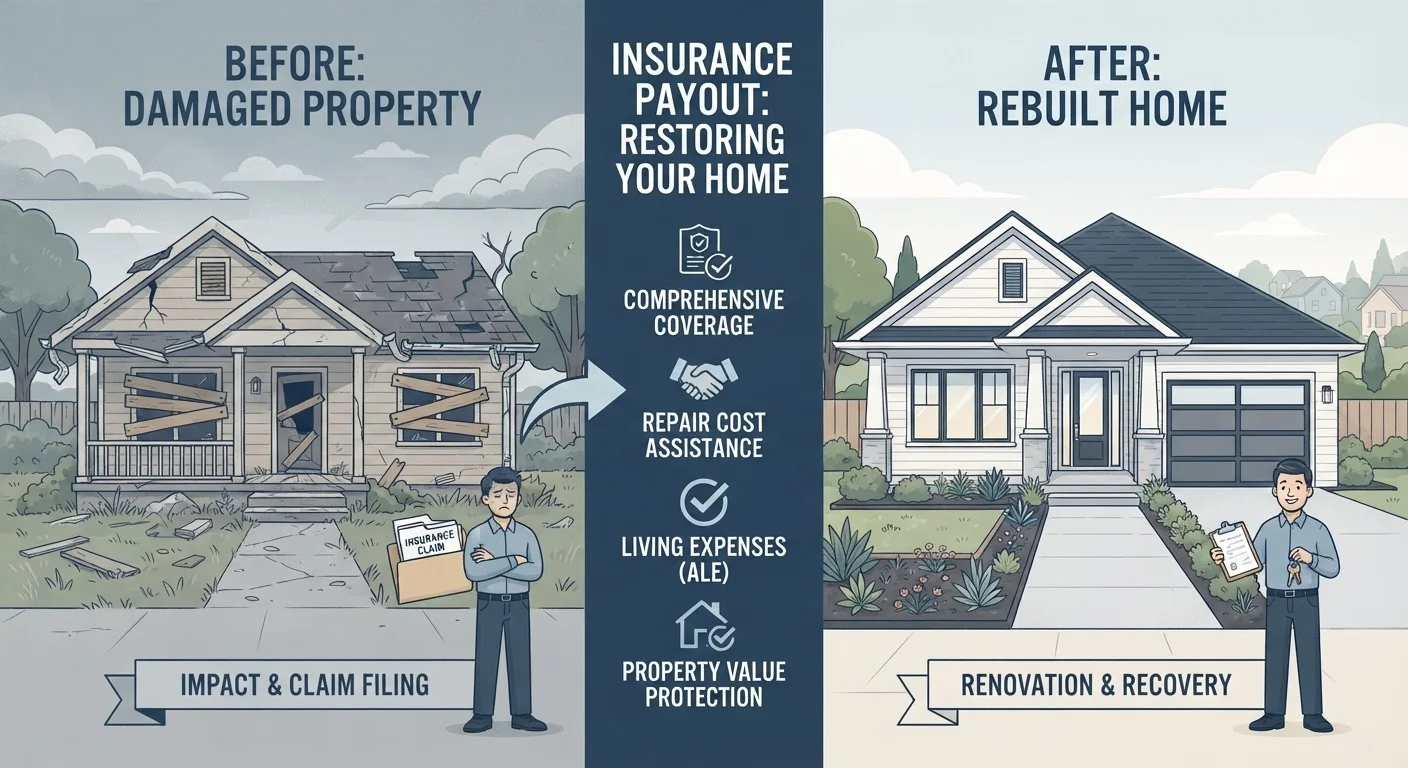
Replacement Cost Value pays the amount needed to repair or rebuild damaged property using materials of similar kind and quality at current market prices, without any reduction for depreciation. If a hailstorm destroys your 10-year-old roof, RCV covers what a comparable new roof costs today.
Actual Cash Value starts from the same replacement cost figure but subtracts depreciation - an adjustment reflecting the age, wear, and remaining useful life of the damaged item. That same 10-year-old roof might have depreciated 40-50%, meaning your payout covers only a fraction of the replacement bill. You absorb the rest.
For a deeper look at how each method affects real-world claim scenarios, see our guide to ACV vs. RCV coverage.
| Criterion | Replacement Cost Value (RCV) | Actual Cash Value (ACV) |
|---|---|---|
| Payout basis | Cost to rebuild/replace at today's prices | Replacement cost minus depreciation |
| Depreciation deducted | No | Yes |
| Premium cost | Higher | Lower |
| Out-of-pocket risk at claim time | Lower | Higher (depreciation gap) |
| Best suited for | Newer homes, risk-averse owners | Older homes, cost-conscious owners |
| Complexity | Straightforward payout | May involve recoverable depreciation clauses |
The Depreciation Gap - and Why It Matters
The practical difference between these two methods often surprises homeowners at claim time. Depreciation is calculated using factors like the item's expected lifespan, its age, and its condition. Insurers use standardized depreciation schedules - so a roof, appliance, or flooring type each has its own depreciation rate.
Consider a straightforward example: a covered kitchen fire damages cabinets and flooring installed 12 years ago. Under RCV, you'd receive the cost to install equivalent new materials today. Under ACV, the insurer would deduct 12 years of depreciation from that figure, potentially leaving you thousands of dollars short of what your contractor charges.
~20%
Typical premium difference between RCV and ACV
Industry estimates generally place RCV premiums 15-25% higher than comparable ACV policies, though actual differences vary by insurer and property characteristics.
40-50%
Depreciation on a 10-year-old roof under ACV
Roofing materials typically have a 20-year lifespan in insurer depreciation schedules, meaning a decade-old roof may lose roughly half its value before your payout is calculated.
It's worth noting that some ACV policies allow you to recover depreciation after repairs are completed - a feature called a recoverable depreciation clause. Not all policies include this, so reviewing your declarations page and policy language carefully is essential. Understanding what your policy covers - and excludes can help you identify these distinctions before a loss occurs.
Premium Differences and Coverage Trade-Offs
RCV policies generally carry higher premiums than ACV policies because the insurer is accepting more financial exposure. The cost difference varies by insurer, property age, location, and coverage limits, but the gap can be meaningful over time.
For homeowners with newer properties and recently updated systems, RCV often represents better value - the items most likely to be damaged have high replacement costs and haven't yet depreciated significantly. For owners of older homes where most systems are well into their lifespan, the calculus is more nuanced.
Keep in mind that RCV vs. ACV choices don't always apply uniformly across an entire policy. Your dwelling structure might carry RCV while personal property is settled at ACV, or vice versa. Detached structures like garages are often a separate line item with their own valuation setting. Always verify each coverage component individually.
Check Each Coverage Component Separately
RCV and ACV designations don't always apply uniformly to an entire homeowners policy. Your dwelling coverage, personal property coverage, and other structures (like a detached garage) may each carry different valuation methods. Review your declarations page line by line, and ask your insurer or agent to clarify any coverage component that isn't explicitly labeled.
The financial realities of homeownership extend well beyond your mortgage payment - insurance structure is one of several decisions that affect your long-term costs. For broader context, see the financial realities beyond the mortgage payment.
Once you've filed a claim, a separate question arises: when filing is actually worth it. Filing for small losses under an ACV policy - where your net payout may be minimal after depreciation - can sometimes do more harm than good if it affects future premiums or renewal status.
This article provides general educational information about homeowners insurance concepts and is not a substitute for personalized advice from a licensed insurance professional. Coverage terms, depreciation methods, and policy conditions vary significantly by insurer and state. Review your specific policy documents and consult a qualified professional before making coverage decisions.
The content on this site is provided for informational purposes only and should not be considered a substitute for professional advice. While we strive to provide accurate and up-to-date information, we make no guarantees regarding its completeness or accuracy. Always consult a qualified professional for advice specific to your circumstances before making any decisions.