

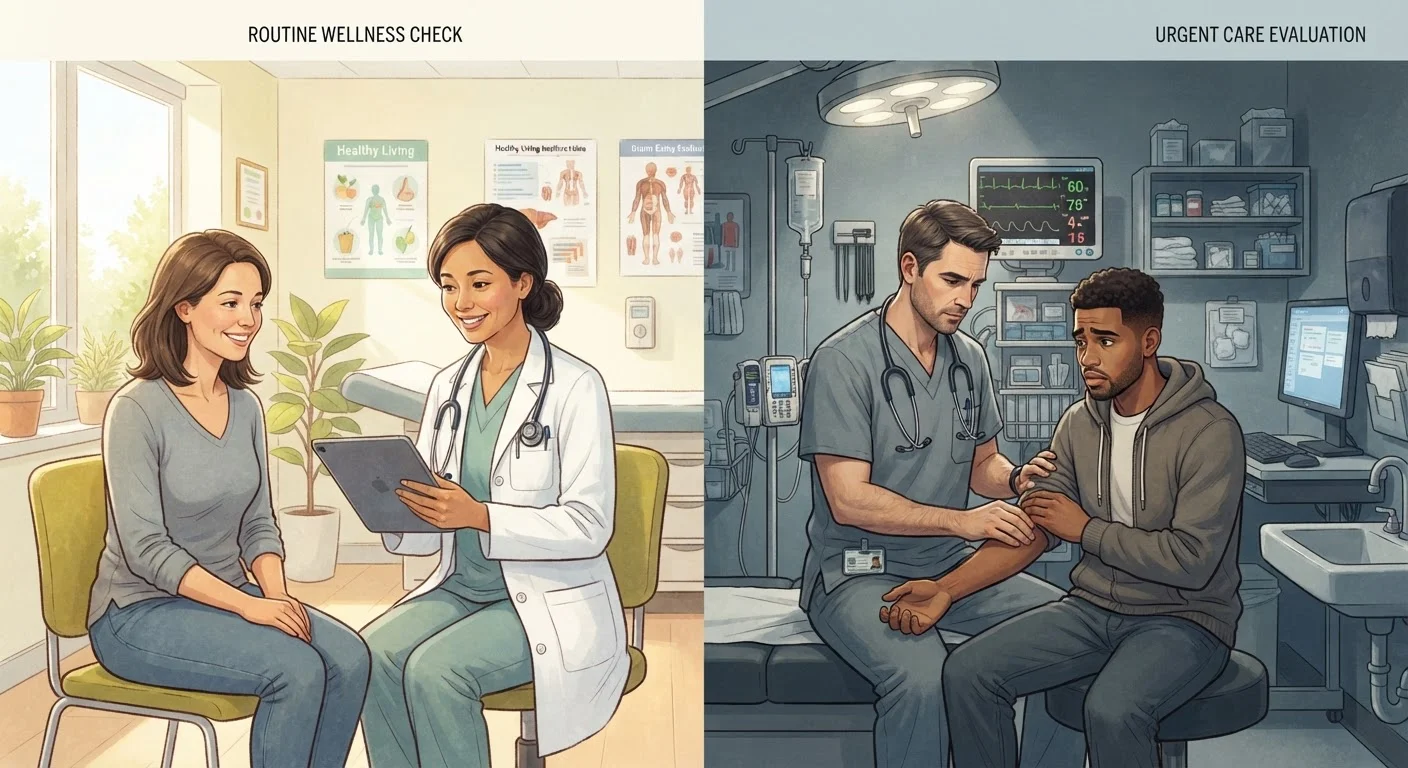
Option A
Preventive Care
The proactive approach to long-term health maintenance.
Best for: People who want to detect health risks early, maintain baseline wellness, and reduce the likelihood of serious illness developing unnoticed.
Option B
Reactive Care
The responsive approach to treating illness or injury after it occurs.
Best for: People experiencing active symptoms, acute conditions, injuries, or medical emergencies that require immediate diagnosis and treatment.
Defining Each Approach
At its core, preventive care is any medical service aimed at stopping a health problem before it starts - or catching it at its earliest, most manageable stage. This includes annual wellness exams, immunizations, blood pressure checks, cholesterol screenings, mammograms, colonoscopies, and counseling for lifestyle risk factors. The emphasis is on surveillance and early action, not the treatment of existing illness.
Reactive care, by contrast, is what happens after a problem has already emerged. An urgent care visit for a respiratory infection, an ER trip following an injury, a course of antibiotics for a bacterial condition - these all fall under reactive care. The trigger is a symptom, diagnosis, or health event that requires a direct clinical response.
Neither category is inherently superior. They serve distinct functions, and a well-rounded approach to health typically involves both. For a broader overview of what preventive services entail, see our guide to what preventive care actually covers.
| Criterion | Preventive Care | Reactive Care |
|---|---|---|
| Primary goal | Prevent or detect disease early | Treat existing illness or injury |
| Trigger | Scheduled or routine | Symptom, injury, or diagnosis |
| Timing | Before symptoms appear | After a health problem develops |
| Examples | Annual physicals, screenings, vaccines | ER visits, antibiotics, surgery |
| Insurance cost-sharing (ACA plans) | Often $0 for covered services | Subject to deductible and copays |
| Long-term cost tendency | Generally lower when effective | Can be higher for advanced conditions |
| Who coordinates it | Primary care provider | PCP, specialist, or ER physician |
Why the Timing Difference Matters
The fundamental distinction between these two approaches is timing. Preventive care intervenes before disease establishes a foothold; reactive care addresses conditions that are already underway. That timing gap has real clinical significance.
Many of the most common chronic conditions in the United States - cardiovascular disease, type 2 diabetes, certain cancers, and hypertension - develop gradually and silently. They often produce no noticeable symptoms until they have already caused measurable damage. By the time reactive care becomes necessary, the window for simpler, less invasive interventions may have narrowed considerably.
This is not to suggest that reactive care is inadequate - modern medicine offers extraordinary tools for treating even advanced disease. However, research from organizations such as the CDC and the U.S. Preventive Services Task Force consistently supports the value of screening and early detection for reducing disease burden at a population level.
75%
Of U.S. healthcare spending tied to chronic disease
According to the CDC, approximately 75% of U.S. healthcare spending is attributable to chronic diseases, many of which are preventable or manageable with early intervention.
1 in 3
Adults with prediabetes who are unaware
The CDC estimates that roughly 96 million American adults have prediabetes, and more than 80% do not know they have it - highlighting the role preventive screening can play.
5-year survival
Colorectal cancer: localized vs. distant stage
The American Cancer Society reports that 5-year survival rates for colorectal cancer are significantly higher when detected at a localized stage, underscoring the value of routine colonoscopies.
It is also worth noting that the line between the two approaches can blur. A blood glucose test ordered during a routine physical is preventive. The same test ordered in response to symptoms of excessive thirst and fatigue is diagnostic - a form of reactive care. The context in which a service is delivered matters both clinically and, often, for insurance billing purposes. Our article on common preventive care coverage misconceptions explains how these distinctions affect what you pay.
Building a Balanced Health Strategy
The most effective approach to personal health is not choosing between preventive and reactive care - it is understanding when each is appropriate and ensuring you have access to both. A few practical principles can help guide that balance.
Stay current with recommended screenings. The U.S. Preventive Services Task Force publishes evidence-based recommendations for screenings and preventive services by age, sex, and risk profile. Your primary care provider can help identify which apply to you.
Do not delay reactive care when it is needed. Preventive care is not a substitute for addressing genuine symptoms. Ignoring warning signs in favor of a "wait for my next annual visit" approach can allow treatable conditions to worsen.
Understand your coverage. Many preventive services are available at no out-of-pocket cost under plans compliant with the Affordable Care Act, but coverage details vary. Confirming what is covered before your visit prevents billing surprises. If you are new to building a preventive routine, our first-timer's overview of preventive care offers a practical starting point.
Coordinate care through a primary care provider. Having a consistent provider who knows your health history allows for smarter decisions about when to screen, when to refer, and when to treat. Our comparison of primary care versus specialist roles in preventive health explores how these relationships work together.
This article is for general informational and educational purposes only and does not constitute medical advice. Always consult a qualified healthcare professional for guidance specific to your health situation, symptoms, or medical history.
The content on this site is provided for informational purposes only and should not be considered a substitute for professional advice. While we strive to provide accurate and up-to-date information, we make no guarantees regarding its completeness or accuracy. Always consult a qualified professional for advice specific to your circumstances before making any decisions.