

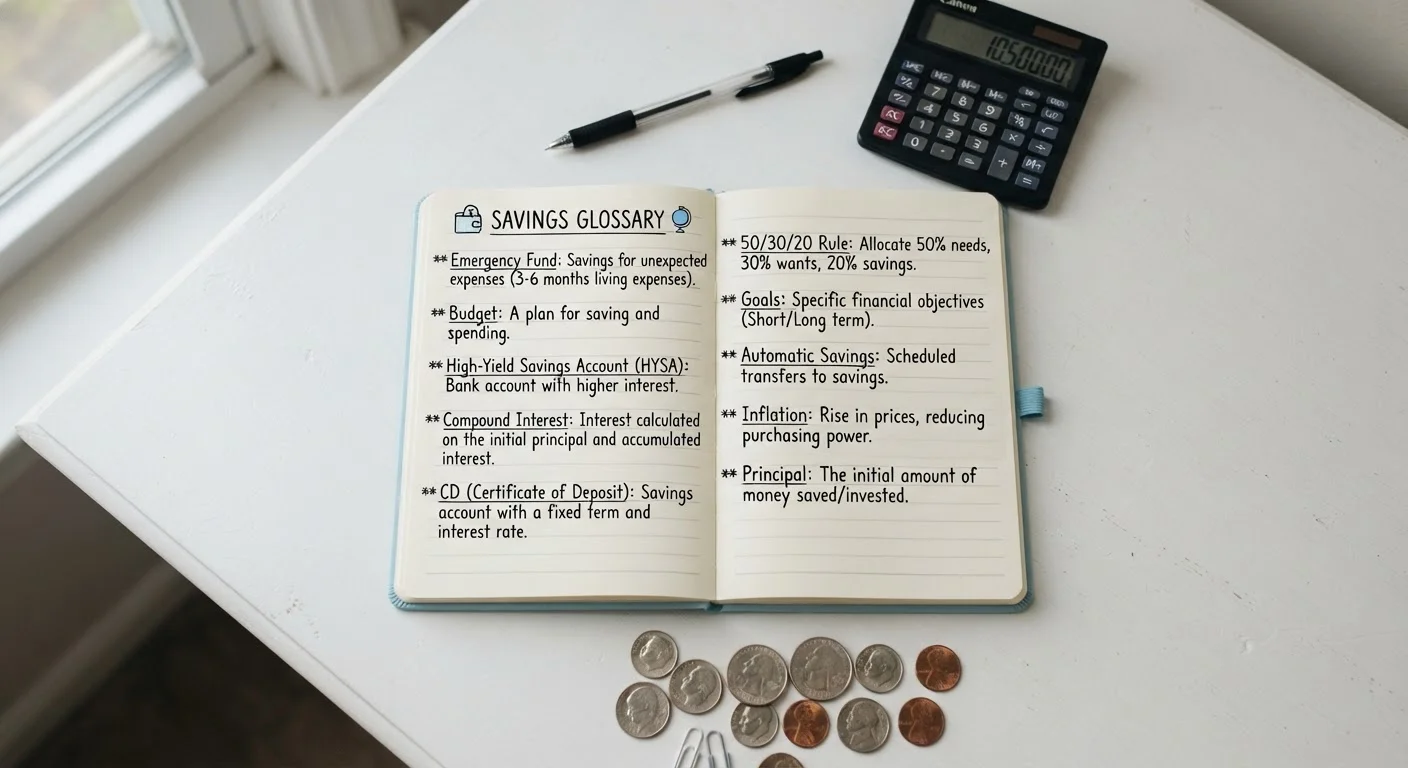
Why Savings Vocabulary Matters
When you open a savings account, compare rates, or decide how much to set aside each month, you're navigating a landscape full of financial terms that aren't always explained well. A misread acronym or fuzzy understanding of "liquidity" can quietly cost you - in missed interest, poorly chosen accounts, or funds you can't access when you need them most.
This reference covers the core terms every saver should be fluent in, whether you're just starting to build a cushion or refining a system that's already in place. For a broader overview of budgeting language, see the Personal Finance Glossary for definitions that pair well with these concepts.
APY (Annual Percentage Yield)
The real rate of return on a savings account over one year, factoring in compound interest. A higher APY means your balance grows faster. APY differs from APR (Annual Percentage Rate), which is typically used for borrowing costs.
Compound Interest
Interest calculated on both your original principal and any interest already earned. Over time, compounding accelerates growth - which is why starting to save early matters even when amounts are small.
Liquidity
How quickly and easily an asset can be converted into cash without losing value. A standard savings account is highly liquid; a home or CD locked in a term is much less so. Emergency funds need high liquidity.
FDIC Insurance
Federal Deposit Insurance Corporation coverage protects deposits at member banks up to $250,000 per depositor, per institution, per ownership category. It activates automatically - no action required from the account holder.
Sinking Fund
A dedicated savings bucket set aside for a specific, planned future expense - such as a car repair, annual insurance premium, or holiday spending. It differs from an emergency fund, which is reserved for unplanned costs.
Emergency Fund
A reserve of liquid savings intended to cover genuine unplanned expenses, such as job loss, medical bills, or urgent repairs. Financial educators commonly suggest building three to six months of essential living expenses, though the right amount varies by individual circumstance.
High-Yield Savings Account (HYSA)
A savings account - typically offered by online banks or credit unions - that pays a notably higher interest rate than a traditional bank savings account. Rates are variable and can change at the institution's discretion.
Certificate of Deposit (CD)
A time-deposit account that holds funds for a fixed term (e.g., six months, one year, five years) in exchange for a stated interest rate. Early withdrawal typically incurs a penalty, making CDs unsuitable for money you might need unexpectedly.
Money Market Account (MMA)
A deposit account that often blends features of savings and checking accounts, sometimes offering debit card access or check-writing. MMAs usually carry higher minimum balance requirements and may pay higher rates than standard savings accounts.
Opportunity Cost
The potential benefit you forgo when you choose one financial option over another. Keeping savings in a low-interest account, for example, carries an opportunity cost relative to a higher-yield alternative.
Account Types and Access
Knowing where to hold your savings is just as important as knowing how much to save. Different account structures carry different rules around access, insurance, and earning potential.
| FDIC Coverage Limit | $250,000 per depositor, per insured bank, per ownership category (FDIC.gov) |
| NCUA Equivalent | Credit union deposits are insured up to the same limit by the NCUA (NCUA.gov) |
| Compounding Frequency | Daily compounding yields more than monthly or annual compounding at the same stated rate (General banking principle) |
| Liquidity Scale | Checking > Savings > Money Market > CD > Real Estate (General financial education framework) |
| CD Early Withdrawal | Penalties commonly range from 90 days to 12 months of interest, depending on the term and institution (General banking practice; terms vary) |
High-yield savings accounts (HYSAs) typically offer rates well above the national average for standard savings accounts, though rates can change at any time. Money market accounts often combine slightly higher yields with check-writing or debit privileges, making them useful for funds you may need occasionally. Certificates of deposit (CDs) lock money away for a fixed term in exchange for a guaranteed rate - breaking the term early usually triggers a penalty, so they work best for savings you won't touch.
Understanding how these accounts differ prevents a common mistake: parking emergency reserves in a CD where they're inaccessible during a real crisis. For a full guide on matching account types to your emergency fund, see Your Financial Safety Net.
Common Pitfalls and What to Watch Next
Knowing the terms doesn't automatically protect your savings. Certain habits - like keeping savings and checking funds in the same account or treating a sinking fund as a general buffer - can erode a safety net over time without obvious warning signs. The patterns that quietly drain savings are worth reviewing once you're comfortable with this vocabulary.
Once you have the language down, the next step is applying it to a long-term strategy. The complete guide to building and protecting savings walks through how each of these concepts fits into a durable financial plan. And if you've encountered advice that sounds authoritative but doesn't feel quite right, separating savings myths from reality is a useful companion read.
This article is for general informational and educational purposes only and does not constitute personalized financial advice. Consult a licensed financial professional for guidance specific to your situation.
The content on this site is provided for informational purposes only and should not be considered a substitute for professional advice. While we strive to provide accurate and up-to-date information, we make no guarantees regarding its completeness or accuracy. Always consult a qualified professional for advice specific to your circumstances before making any decisions.