

Days 1-30: The First Missed Payment
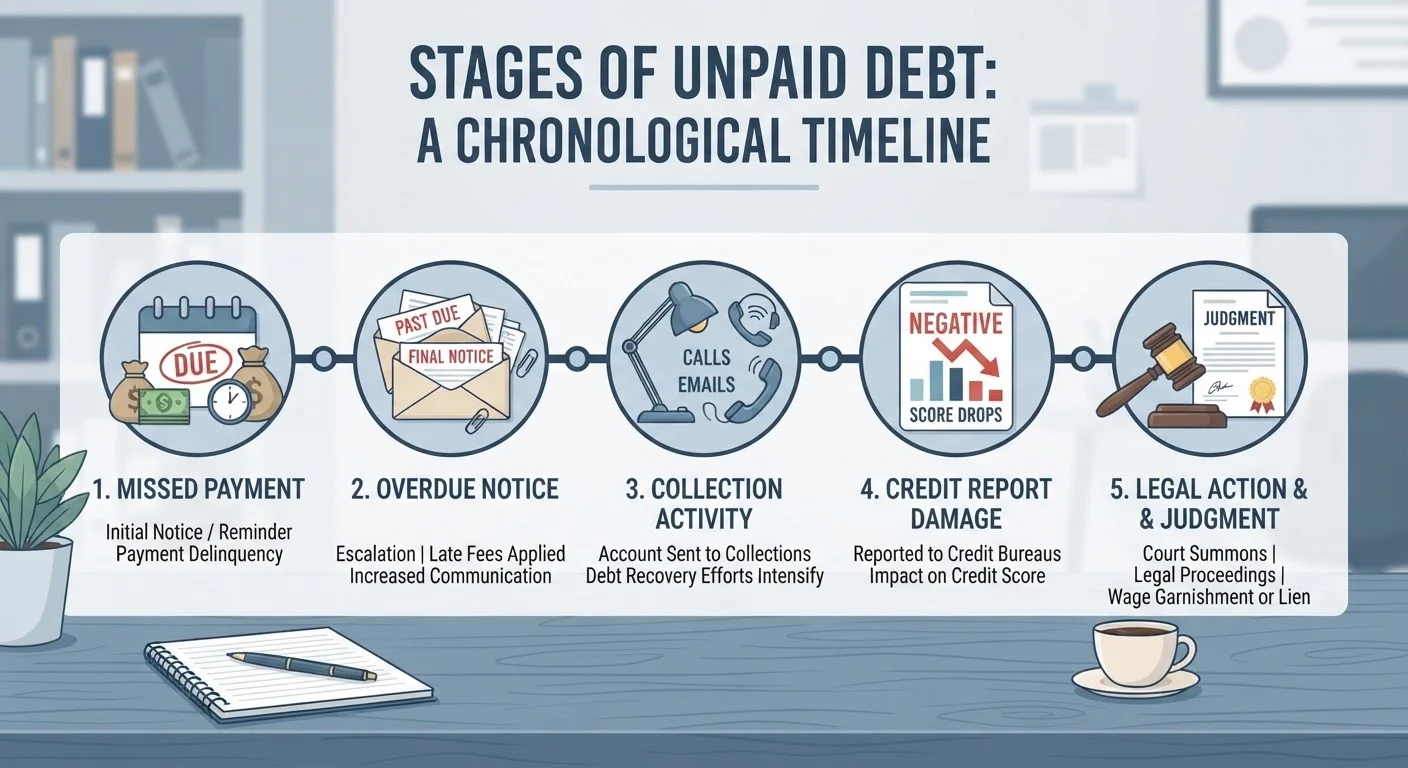
Missing a payment sets the process in motion immediately, even if the consequences aren't visible right away. Your creditor will typically charge a late fee, and interest continues to accrue on your balance. Most lenders do not report a payment as late to the credit bureaus until it is at least 30 days past due - but once that threshold is crossed, your credit score can drop noticeably, sometimes by 50 to 100 points depending on your overall credit profile.
During this window, the creditor's own customer service team will attempt to reach you by phone and mail. If financial hardship is the cause, contacting the creditor directly at this stage often yields the most flexibility - hardship programs, payment deferrals, or waived fees may be available before the account escalates.
Act Early for the Most Options
The window between a first missed payment and the 30-day reporting deadline is your highest-leverage moment. Calling your creditor to explain a temporary hardship - before the late payment hits your credit report - often opens doors to payment plans, fee waivers, or temporary forbearance that disappear once the account becomes seriously delinquent.
Days 30-180: Delinquency and Internal Collections
Between one and six months of non-payment, your account is considered seriously delinquent. Each 30-day milestone (60 days late, 90 days late) triggers additional credit score damage and increasingly urgent creditor contact. By 90 days past due, many lenders have shifted your account to an internal collections department.
Around the 120-180 day mark, most creditors - particularly credit card issuers - will charge off the debt. A charge-off means the original creditor has written the balance off as a loss for accounting purposes. Critically, this does not cancel your legal obligation to repay. The charge-off itself is reported to the credit bureaus as a serious negative event, and the balance still exists.
7 years
How long most negative marks stay on your credit report
Under the Fair Credit Reporting Act, most derogatory information must be removed from consumer credit reports after seven years from the original delinquency date.
3-10 years
Typical statute of limitations range by state
State laws governing how long creditors have to sue for unpaid debts vary widely; consulting your state's specific rules is essential before responding to time-barred debt claims.
120-180 days
When most creditors issue a charge-off
Credit card issuers and many other lenders typically charge off delinquent accounts between four and six months of non-payment, reporting the event to the credit bureaus.
Months 6-12: Sale to Third-Party Debt Collectors
After a charge-off, the original creditor typically sells the debt - often for pennies on the dollar - to a third-party collection agency. At this point, you may begin hearing from a new company you've never done business with, claiming to own your debt. This is legal and common.
Debt collectors are governed by the Fair Debt Collection Practices Act (FDCPA), which restricts when and how they can contact you, prohibits harassment, and gives you the right to request written verification of the debt. If you receive a collection notice, you have 30 days to dispute the debt in writing and request validation.
The collection account will appear on your credit report in addition to the original charge-off, compounding the damage. Some debts are resold multiple times, meaning different collection agencies may contact you about the same balance over the years.
Your Rights With Debt Collectors
The Fair Debt Collection Practices Act (FDCPA) gives consumers meaningful protections. Collectors cannot call before 8 a.m. or after 9 p.m., use abusive language, or misrepresent the amount owed. You can send a written request to cease contact, though this does not eliminate the debt or prevent legal action. The Consumer Financial Protection Bureau (CFPB) provides free resources on filing complaints against collectors who violate these rules.
The Seven-Year Credit Reporting Window
Under the Fair Credit Reporting Act (FCRA), most negative information - including late payments, charge-offs, and collection accounts - must be removed from your credit report seven years after the date of the original delinquency. This clock starts from when you first missed the payment that led to the default, not from when the debt was sold or when a collector last contacted you.
This means a debt sold repeatedly to different collectors does not reset your seven-year window. If you notice a collection account on your report that should have aged off, you can dispute it directly with the credit bureaus. See common debt myths that distort this timeline for misconceptions that lead people to make costly errors around credit reporting.
The Statute of Limitations: The Legal Deadline
Separate from credit reporting rules, every state sets a statute of limitations - a deadline by which creditors must file a lawsuit to collect a debt. Once this window closes, the debt is considered time-barred, and while collectors may still attempt to contact you, they generally cannot win a lawsuit to force repayment.
Statutes of limitations typically range from three to ten years and vary by state and contract type (written contract, oral agreement, credit card agreement, etc.). Some actions - such as making a partial payment or signing a new agreement - can restart this clock in certain states, so understanding your state's specific rules matters before responding to collectors on older debts.
For anyone navigating this stage, building a forward-looking strategy is essential. The structured debt payoff planning process offers a practical framework for moving from assessment to action, whatever your starting point. For a broader view of the entire debt management journey, the complete debt and credit roadmap covers every stage from first credit score to becoming debt-free.
This article is for general informational purposes only and does not constitute legal, financial, or tax advice. Individual circumstances vary significantly. Consult a licensed financial adviser, nonprofit credit counselor, or consumer law attorney for guidance specific to your situation.
Frequently Asked Questions
Unpaid debt doesn't disappear, but two separate clocks do eventually run out. After seven years, most negative marks must be removed from your credit report under the Fair Credit Reporting Act. Separately, the statute of limitations - which limits the window for creditors to sue - expires based on your state and debt type, typically between three and ten years.
If a creditor or collector wins a lawsuit against you, a court may issue a judgment allowing them to garnish wages, levy bank accounts, or place liens on property, depending on your state's laws. Ignoring a lawsuit is rarely a good strategy - consulting a consumer law attorney or nonprofit credit counselor is advisable if you're served with legal papers.
Paying a legitimate old debt generally won't hurt your score and can sometimes help. However, making a payment on a time-barred debt may restart the statute of limitations in some states, exposing you to renewed legal risk. It's wise to understand your state's rules before paying very old debts.
A collection account can remain on your credit report for up to seven years from the date of the original delinquency - regardless of whether the debt is sold to a new collector. The account doesn't reset its reporting clock each time it's transferred.
The statute of limitations is the legal deadline by which a creditor or collector must file a lawsuit to collect a debt. It varies widely - typically between three and ten years - based on your state and the type of debt contract. After this period, a debt is often called 'time-barred,' meaning collectors generally cannot successfully sue to collect it.
The content on this site is provided for informational purposes only and should not be considered a substitute for professional advice. While we strive to provide accurate and up-to-date information, we make no guarantees regarding its completeness or accuracy. Always consult a qualified professional for advice specific to your circumstances before making any decisions.