

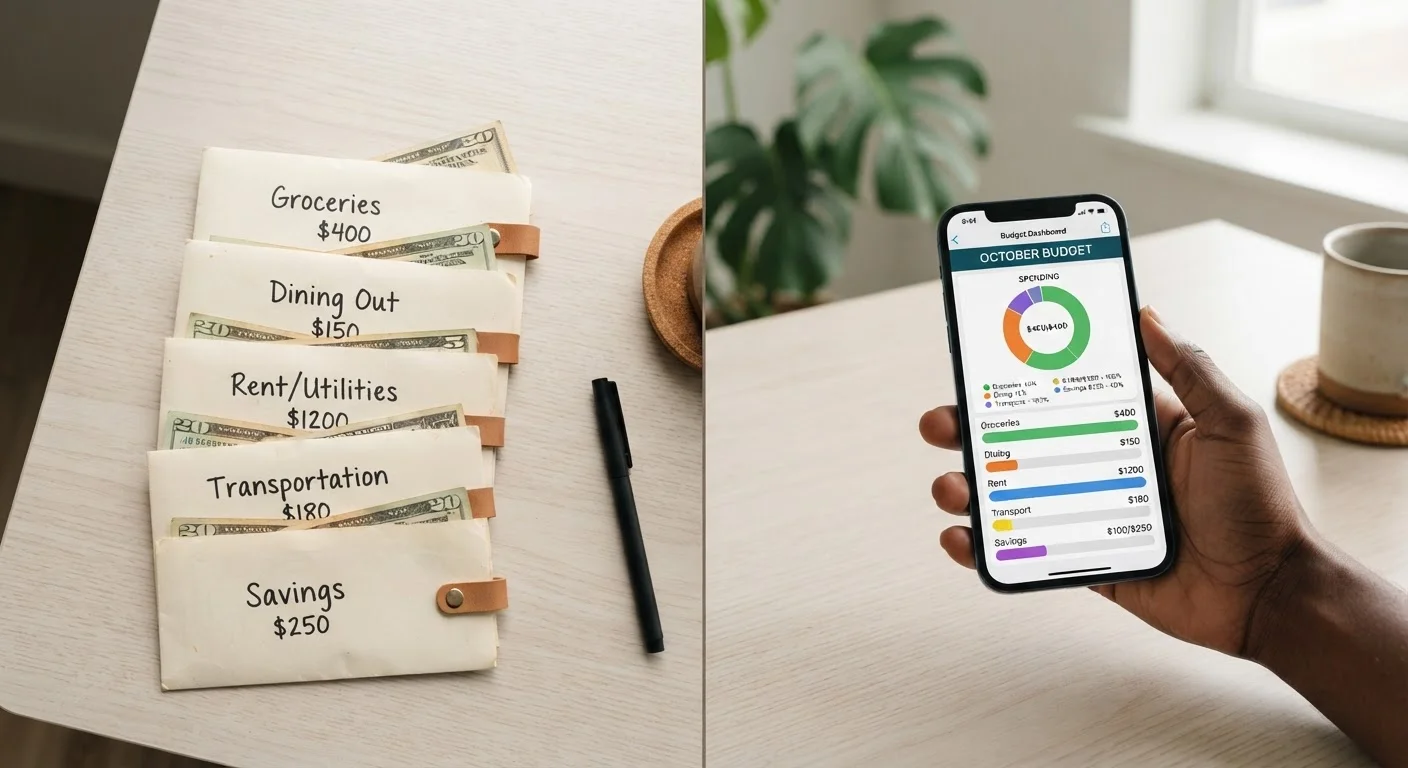
Option A
Envelope Budgeting
The tactile, cash-based system built on physical limits.
Best for: People who overspend on impulse purchases and want an immediate, tangible barrier to stop them.
Option B
Digital Spending Trackers
The data-driven approach that fits modern, card-based spending habits.
Best for: People who rarely use cash and want automatic transaction tracking with visual reporting.
How Each Method Works
Envelope budgeting is one of the oldest structured spending systems in personal finance. At the start of each pay period, you withdraw cash and divide it into labeled envelopes - one for groceries, one for gas, one for dining out, and so on. When an envelope is empty, spending in that category stops until the next period. The system is intentionally rigid. That rigidity is its core feature, not a flaw.
Digital spending trackers take the opposite approach. Instead of controlling spending through physical limits, they record and categorize every transaction - typically by linking directly to your bank accounts and credit cards. The tool logs purchases automatically, groups them by category, and presents the data through dashboards or reports. The goal is awareness and accountability, with the assumption that seeing the numbers clearly will motivate better decisions.
Both methods address the same underlying challenge: spending more than planned. They just apply pressure at different points in the process. Envelopes intervene before you spend; trackers intervene after. If you're unsure which framework fits your broader financial picture, the overview of major budgeting approaches covers how these methods sit alongside zero-based, 50/30/20, and other systems.
| Criterion | Envelope Budgeting | Digital Spending Trackers |
|---|---|---|
| Payment type | Cash only | Cards and bank accounts |
| Spending limit enforcement | Hard limit - envelope runs out | Soft limit - alerts and reports |
| Setup effort | Moderate - cash withdrawal and labeling | Low - account linking and categories |
| Ongoing maintenance | Regular ATM visits; manual tracking | Weekly review; fix miscategorizations |
| Psychological mechanism | Pain of paying with physical cash | Awareness from spending data |
| Works for online purchases | Not directly - requires workarounds | Yes - captured automatically |
| Historical reporting | Limited - manual record required | Strong - months of data stored |
| Privacy and security risk | Physical theft risk from cash | Data-sharing risk with third-party apps |
The Psychology Behind Each Approach
A notable body of behavioral economics research has examined what happens when people pay with cash versus cards. The general finding is that physical cash feels more real - spending it registers as a loss in a way that swiping a card does not. This is sometimes called the pain of paying. Envelope budgeting exploits this effect deliberately. When you can see and feel the bills leaving your hand, the psychological cost of spending is higher, which tends to reduce impulsive purchases.
Digital trackers rely on a different mechanism: feedback loops. The theory is that accurate, timely information about spending behavior will prompt course corrections. In practice, this works well for people who are already motivated to change and who make time each week to review their data. For others, the app becomes a detailed record of overspending rather than a tool that prevents it.
~18%
Reduction in spending when using cash vs. cards
Multiple studies in behavioral economics, including work by Drazen Prelec and Duncan Simester, have found that card payments can increase willingness to spend compared with cash transactions.
~1 in 3
Americans who report having a written budget
Surveys by Gallup and similar polling organizations have consistently found that only about a third of U.S. adults follow a detailed household budget.
60%+
Of budgeters who abandon their system within months
Financial planning research and consumer surveys suggest that consistency - not method choice - is the primary predictor of whether a budget produces lasting change.
Neither mechanism is foolproof. Envelopes can feel cumbersome, and some people simply refill them mid-period or shift funds between categories too freely. Digital tools require you to actually look at and act on the data they collect. Understanding your own behavioral tendencies - are you more likely to be deterred by friction or by information? - is the most reliable guide to which method will hold.
Practical Trade-Offs Worth Knowing
Envelope budgeting has real logistical friction in a world built around card payments. Subscriptions, online purchases, and automatic bill pay don't fit into a physical envelope system without workarounds. Safety is another concern - carrying significant cash is not practical for everyone. The system also requires regular trips to the bank or ATM and careful record-keeping if you want to track what was spent in each category over time.
Digital trackers handle card-based spending seamlessly, but they come with their own limitations. Automatic categorization is imperfect; tools frequently misclassify transactions, and correcting them manually takes time. Security and privacy are legitimate considerations when linking bank accounts to third-party apps - reviewing the data-sharing terms of any tool you use is worthwhile. And crucially, a tracker that is set up but rarely checked provides almost no benefit.
Couples navigating shared finances will find different friction points with each method. The budgeting as a couple guide explores the communication and coordination dynamics that determine whether a shared system succeeds. Many households find a hybrid approach most practical: digital tracking for fixed bills and recurring costs, and cash envelopes for the variable categories - groceries, dining, personal spending - where overspending tends to happen.
If your current approach isn't holding together, it may be a structural issue rather than a willpower problem. Signs your budget needs a complete overhaul can help you diagnose what's going wrong before switching methods entirely.
This article provides general financial education and is not personalized financial advice. Consult a qualified financial professional for guidance specific to your situation.
The content on this site is provided for informational purposes only and should not be considered a substitute for professional advice. While we strive to provide accurate and up-to-date information, we make no guarantees regarding its completeness or accuracy. Always consult a qualified professional for advice specific to your circumstances before making any decisions.