

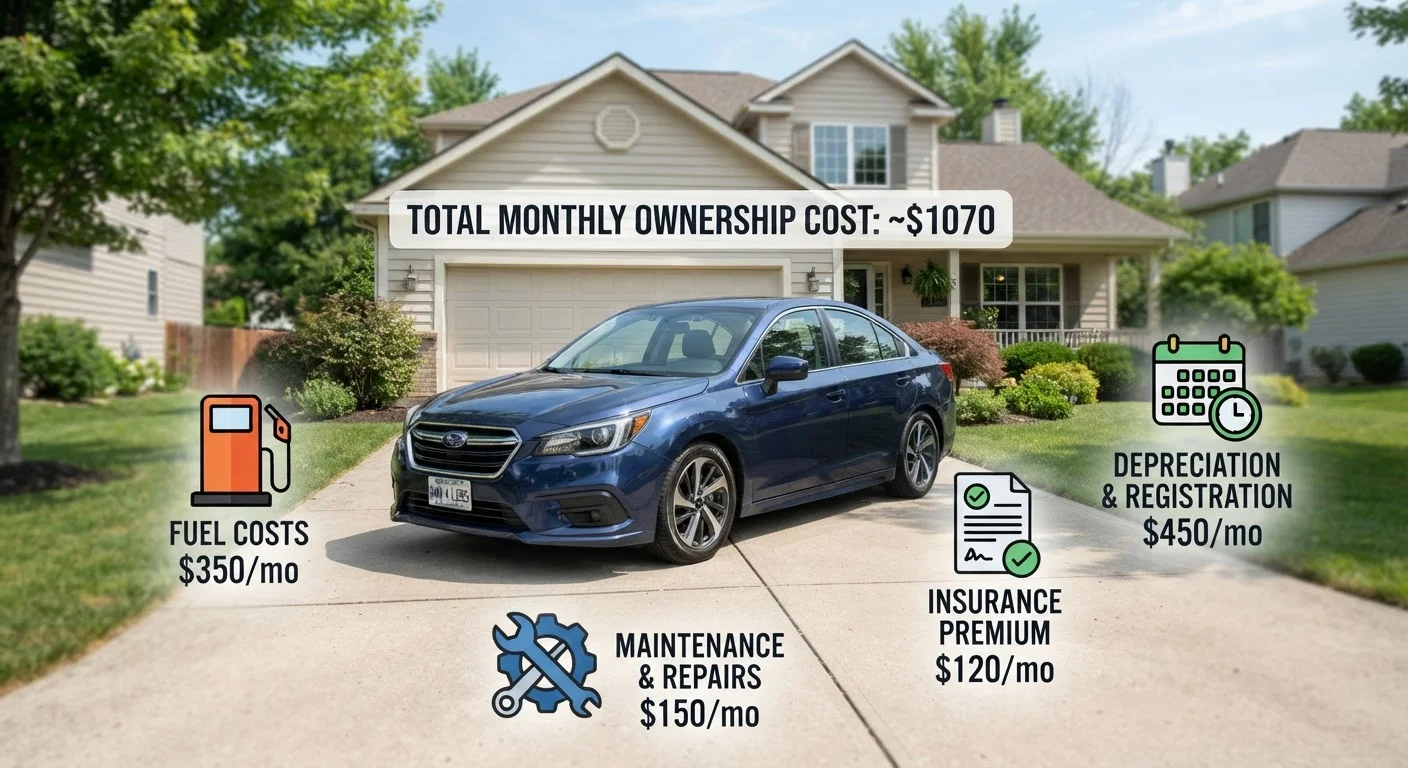
Why the Sticker Price Tells Only Part of the Story
When most people budget for a car, they focus on the monthly payment or the purchase price. Those numbers matter - but they represent only a fraction of what you'll actually spend. A vehicle bought for $28,000 can easily cost $50,000 or more over five years once every category of expense is counted. Understanding these costs upfront is how you avoid financial surprises and choose a vehicle that genuinely fits your life.
This is similar to the dynamic homebuyers face when they look beyond the mortgage. Just as homeownership carries costs well beyond the mortgage payment, car ownership carries ongoing obligations that compound year after year.
$10,000+
Average annual cost to own a new vehicle
AAA's annual 'Your Driving Costs' study has consistently placed the all-in annual cost of new vehicle ownership above $10,000 when depreciation, fuel, insurance, and maintenance are included.
~50%
Value lost to depreciation in first five years
Automotive valuation data consistently shows most new vehicles lose roughly half their original value within five years of purchase, making depreciation the dominant ownership cost.
$5,200+
Interest paid on a typical 60-month auto loan
Based on a $28,000 loan at 7% interest over 60 months - a common financing scenario - total interest paid exceeds $5,200 without covering any vehicle expenses.
Depreciation: The Cost You Never Write a Check For
Depreciation - the reduction in a vehicle's market value over time - is typically the largest single cost of ownership, yet it never appears on a monthly statement. New vehicles can shed 15-20% of their value within the first year and roughly 50% within five years, according to commonly cited automotive valuation data. This loss is realized when you sell or trade in the vehicle.
The practical implication: a $35,000 vehicle might be worth $17,000-$18,000 after five years, representing a $17,000-$18,000 loss from depreciation alone - often more than the cumulative fuel bill over the same period. Choosing a vehicle with a historically strong resale value can reduce this loss, though no outcome can be guaranteed.
Insurance, Fuel, and Maintenance: The Recurring Costs
Insurance is a mandatory recurring expense in every U.S. state, and premiums differ substantially based on the vehicle's make, age, and safety rating, as well as your driving record, credit history, location, and coverage level. Costs can range from a few hundred to several thousand dollars annually.
Fuel costs depend on how much you drive, local gas prices, and the vehicle's fuel economy rating. A driver covering 15,000 miles per year in a vehicle averaging 25 mpg will use roughly 600 gallons annually. At $3.50 per gallon, that's $2,100 per year - a figure that shifts meaningfully with price fluctuations or a switch to a more or less efficient vehicle.
Maintenance falls into two categories: scheduled (oil changes, tire rotations, fluid checks, filter replacements) and unscheduled (unexpected repairs). Scheduled maintenance is relatively predictable and, when followed, helps prevent costly unscheduled repairs. Our car maintenance hub covers essential upkeep across vehicle systems. Skipping routine service to save money in the short term typically increases total costs over time.
Build a Full Ownership Budget Before You Buy
Before committing to any vehicle, estimate all five cost categories: depreciation, insurance, fuel, maintenance, and financing. Many automotive resources and consumer finance tools offer ownership cost calculators that aggregate these estimates by vehicle type. Comparing two vehicles on total five-year cost rather than monthly payment often leads to a meaningfully different - and better-informed - decision.
Registration, Taxes, Financing, and Other Often-Overlooked Costs
Registration and taxes vary by state and are often tied to the vehicle's value. Some states charge annual registration fees based on a percentage of the car's worth, meaning a more expensive vehicle costs more to register each year.
Loan interest is a significant expense for the majority of buyers who finance their purchase. On a $28,000 loan at 7% interest over 60 months, total interest paid exceeds $5,200 - money spent without adding to equity or covering any tangible ownership expense.
Parking, tolls, and incidentals also add up, particularly in urban areas. These vary widely but can meaningfully raise annual costs for city drivers.
Taken together, these categories explain why a vehicle's total cost of ownership so frequently exceeds buyer expectations - and why evaluating a car by monthly payment alone can be misleading. Comparing this type of layered cost analysis to what buyers encounter in closing costs illustrates how major purchases routinely carry more financial complexity than the headline number suggests.
A driver buys a new midsize SUV for $38,000 and focuses only on the $650/month loan payment when budgeting.
A commuter chooses a vehicle with a lower purchase price but poor fuel economy to keep the monthly payment down.
A buyer defers a recommended timing belt replacement to avoid the upfront cost.
Frequently Asked Questions
Industry estimates from AAA have placed the average annual cost of owning a new vehicle at over $10,000 when all expenses are included. This figure varies considerably depending on vehicle type, mileage driven, location, and individual insurance rates. Used vehicles generally carry lower ownership costs but may have higher maintenance needs.
Depreciation is widely considered the largest and most underappreciated ownership cost. A new vehicle can lose 15-20% of its value in the first year alone, meaning the financial loss from depreciation often exceeds what you spend on fuel and insurance combined.
Buying used typically reduces depreciation loss and the upfront purchase price, which can lower overall TCO. However, older vehicles may come with higher maintenance and repair costs, and financing rates for used cars are often higher than for new ones. See our <a href="/autos-vehicles/buying-a-car/new-car-vs-used-car-weighing-the-real-trade-offs">new vs. used car guide</a> for a full comparison.
Leasing generally means lower monthly payments and predictable costs during the lease term, but you build no equity and may face mileage penalties. Buying costs more upfront but can be more economical long-term if you keep the vehicle for many years. Our article on <a href="/autos-vehicles/buying-a-car/leasing-vs-buying-a-car-understanding-the-financial-mechanics">leasing vs. buying</a> breaks down the financial mechanics in detail.
Keeping up with scheduled maintenance, driving conservatively to reduce wear and improve fuel economy, shopping for competitive insurance rates at renewal, and holding a vehicle long enough to spread depreciation across more years are all ways to reduce per-year ownership costs. Selecting a vehicle with strong reliability ratings from the outset also matters.
Yes. Annual registration fees, state and local taxes, and any emissions or inspection fees are legitimate recurring costs that should be included in your ownership budget. These vary widely by state and by the value of the vehicle.
The content on this site is provided for informational purposes only and should not be considered a substitute for professional advice. While we strive to provide accurate and up-to-date information, we make no guarantees regarding its completeness or accuracy. Always consult a qualified professional for advice specific to your circumstances before making any decisions.