

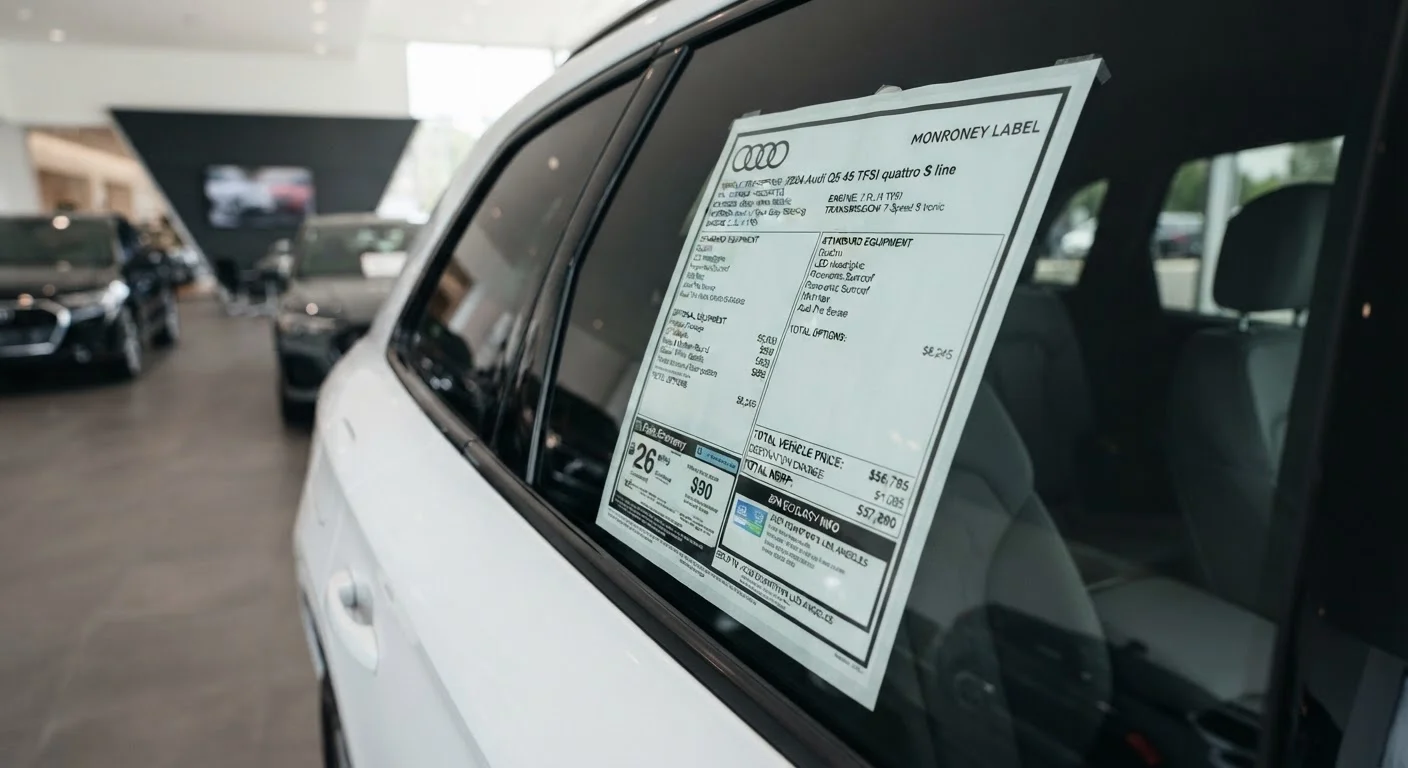
What Is the Monroney Label?
Before you sign anything at a dealership, one document is already working in your favor: the Monroney label, commonly called the window sticker. Named after Senator A.S. Mike Monroney, whose 1958 Automobile Information Disclosure Act created it, this federally mandated label must appear on every new passenger vehicle sold in the United States. Removing it before the sale - by anyone other than the buyer - is a federal violation.
The label is not marketing material. It is a standardized disclosure document designed to give buyers consistent, comparable information across every make and model. Understanding each section helps you evaluate what you're actually getting and provides a factual foundation for any negotiation. Sticker price is only the beginning - the label tells you what that number is built from.
| Legal Name | Monroney Label (Automobile Information Disclosure Act, 1958) |
| Required By | Federal law (U.S.) |
| Who Can Remove It | Only the purchaser (15 U.S.C. § 1232) |
| Fuel Economy Source | U.S. Environmental Protection Agency (EPA) |
| Destination Charge | Non-negotiable; set by manufacturer |
| Safety Ratings Bodies | NHTSA and/or IIHS |
Breaking Down Each Section
Vehicle Identification and Basic Specs
At the top of every Monroney label you'll find the make, model, trim level, and a unique Vehicle Identification Number (VIN) - a 17-character code that identifies the specific vehicle. Below that, you'll typically see the model year, the manufacturing plant, and standard equipment included at that trim level.
Manufacturer's Suggested Retail Price (MSRP)
The MSRP is the base price the manufacturer recommends for the vehicle, before any packages, options, or destination charges. It is not the price you must pay - it's a starting reference. Common car-buying myths often center on misunderstanding what MSRP actually means in practice.
Options and Packages
This section itemizes every factory-installed option or package added beyond the base trim, each with its individual price. This is where you can verify exactly which features are on the vehicle and what the dealer is charging for them.
Destination and Delivery Charge
A federally required line item, the destination charge reflects the cost of shipping the vehicle from the manufacturing plant to the dealership. This charge is non-negotiable and is set by the manufacturer - it is the same for all dealers selling that model within a region.
Fuel Economy Estimates
EPA fuel economy estimates - expressed in miles per gallon (mpg) for city, highway, and combined driving - appear prominently on the label. These are standardized estimates based on controlled testing; your real-world results will vary depending on driving habits, load, and conditions. The label also includes an estimated annual fuel cost based on average mileage and a national average fuel price.
Safety Ratings
Many window stickers include government crash-test ratings from the National Highway Traffic Safety Administration (NHTSA) and/or the Insurance Institute for Highway Safety (IIHS). Not every vehicle carries both, and not every new model has been tested yet, so a blank rating field doesn't necessarily indicate a safety problem.
Monroney Label
The federally mandated window sticker required on all new passenger vehicles sold in the U.S., disclosing price, equipment, fuel economy, and safety information.
MSRP
Manufacturer's Suggested Retail Price - the base price recommended by the automaker before options, packages, or dealer fees are added.
VIN
Vehicle Identification Number - a unique 17-character alphanumeric code that identifies a specific vehicle's make, model, year, plant, and production sequence.
Destination Charge
A fixed, manufacturer-set fee covering the cost of transporting the vehicle from the assembly plant to the dealership; it is not negotiable.
EPA Fuel Economy Estimate
Miles-per-gallon figures produced through standardized U.S. Environmental Protection Agency testing, used to compare fuel efficiency across vehicles.
Dealer Add-On
Accessories or services installed or bundled by the dealership - listed on a supplemental sticker, not the federal Monroney label, and typically negotiable.
Using the Label Strategically
The Monroney label gives you a verifiable, manufacturer-issued baseline. Before visiting any dealership, you can research the base MSRP and option pricing on the manufacturer's website - if those figures don't match the label on the lot, ask why. Discrepancies in option pricing or undisclosed add-ons are worth examining closely.
Pay particular attention to any items listed outside the factory-printed sections. Dealers sometimes affix supplemental stickers listing additional dealer-installed accessories or market adjustments. These are not part of the federal Monroney label and are generally negotiable, unlike the destination charge.
The fuel economy section can also be a useful comparison tool. The EPA's fueleconomy.gov database allows you to compare estimates across models and see how the vehicle performs against class averages - useful context that doesn't require taking a salesperson's word for it.
Reading the Monroney label carefully takes only a few minutes but puts substantive, accurate information in your hands before a single number is discussed at the negotiating table.
This article is for general informational and educational purposes only. Pricing, fees, and regulatory details can vary; consult applicable manufacturer documentation and a qualified automotive professional for guidance specific to your situation.
The content on this site is provided for informational purposes only and should not be considered a substitute for professional advice. While we strive to provide accurate and up-to-date information, we make no guarantees regarding its completeness or accuracy. Always consult a qualified professional for advice specific to your circumstances before making any decisions.